Behind the Camera on THE RED BADGE OF COURAGE
Filming started on August 25, 1950.
Originally, director John Huston had wanted to shoot The Red Badge
of Courage in Virginia. When that proved too expensive, he moved the
location to his farm in Calabasas, Calif.
Originally Huston tried to save time by having his assistant director,
Andrew Marton, line up one shot while he was finishing another. But Huston
had trouble making up his mind about what he really wanted. When he spent
more time rearranging the shots Marton had lined up than he might have
spent doing it all himself, he abandoned the idea.
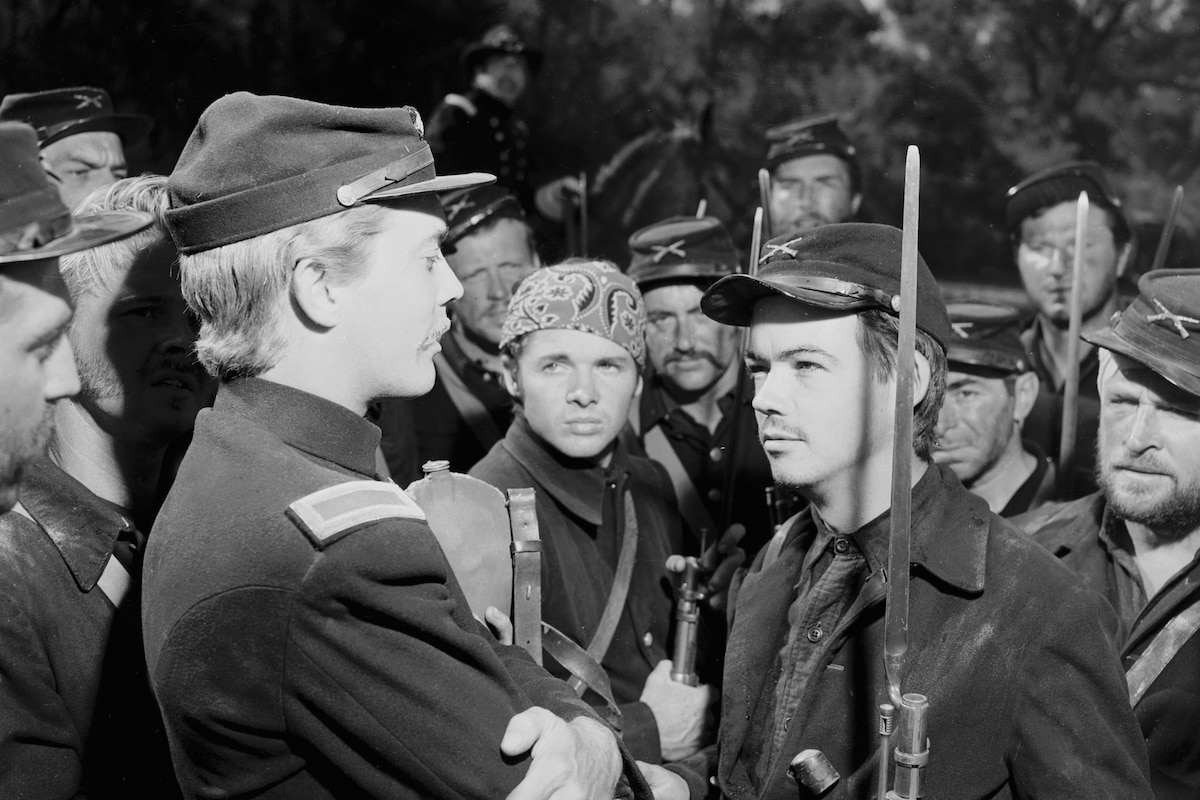
To cast extras for the crowd scenes, Huston sent his assistants into
the pool halls of nearby Chico, Calif., to find what he described as
"grizzled SOBs" to avoid giving the film a Hollywood look.
Although Audie Murphy usually went through life with a detached
languor, he erupted twice during filming. At one point one of the
assistant directors yelled at him the wrong way, and Murphy left the crowd
scene he was in, grabbed the man by the shirt and told him, "Don't you ever
talk to me like that again!" In another incident he stopped two men in a car from harassing some teens on motor
scooters. When the men tried to start a fight with him, he attacked both
with his riding crop. They had to go to the hospital, never knowing that
they'd been beaten up by World War II's most decorated
soldier.
Huston got around Murphy's insecurities by maintaining a cheerful air
at all times. Observers thought he had developed almost a paternal
relationship with the young man who, at 26, was still haunted by the
horrors he had witnessed during World War II.
At one point in the original script, the Loud Soldier (Bill Mauldin)
accused Murphy's character of cowardice. During repeated re-takes, the
accusation got to Murphy, who finally accused Mauldin of trying to get at
him with the line. Murphy also had trouble admitting that he was a coward
in the scene. Finally, Mauldin suggested, "I think Audie is having trouble
confessing to a Stars and Stripes cartoonist that he ran from
battle." Huston did a hurried re-write so that Mauldin would confess his
fear first, prompting Murphy's character to admit to his own
feelings.
Huston never looked at the film's rushes. When Reinhardt told him one
scene needed to be re-shot, Huston looked at it, then re-shot it in exactly
the same way.
Huston finished principal photography in 49 days.
When filming was completed, Huston held a special screening for the
cast and crew and invited directors and producers. They were overwhelmed,
and he declared it the best film he had ever made. Murphy couldn't believe
he had turned in such an impressive performance, and his mentor, Hedda
Hopper, declared it the best war film ever made.
Unfortunately, the film's public previews in February 1951 were
disastrous. Although some people loved the film, more hated it, and many
walked out during the screening. Some of the most serious scenes evoked
laughter. Huston ran off to London the day after the first preview. In a
panic, studio executives added a narration by James Whitmore, including an explanatory introduction written by studio production chief Dore Schary
to explain that the novel had been universally hailed as a classic. It
didn't help. Audiences at the third preview still hated the
film.
By this point, Huston was already in Africa doing extensive location
shooting for his next film, The African Queen (1951). In his absence,
Schary re-edited the film. He cut whole scenes, including the Tattered
Man's (Royal Dano) death scene, which had drawn laughs at previews. Many
on the production considered it the finest scene in the film and thought it
would win Dano an Oscar®. Schary also cut an entire cavalry charge and
many of the small touches that had deepened and humanized the film.
Putting together the now-mangled footage produced continuity errors.
Huston's best film ever was reduced from two hours and 15 minutes to a mere
69 minutes.
After seeing what MGM had done to the film, Huston instructed his agent
to include a clause in all future contracts guaranteeing that he would
receive a copy of his director's cut on all of his films.
The film's final cost was $1,642,017.33.
With continued poor results from test screenings, MGM sneaked the film
out as a second feature on double bills with an Esther Williams picture (Texas Carnival, 1951) and
then only in smaller theatres.
When the film played on the second half of a double bill in London, a
local critic caught it and was so impressed he arranged a press screening
for his colleagues. They all wrote columns demanding the film be given a
proper release. Finally, MGM gave in and booked the film into a West End
theatre, where it flopped.
Four years later, with the success of Murphy's film autobiography,
To Hell and Back (1955), he and some Texas friends tried to buy
The Red Badge of Courage from MGM so they could shoot new footage to
replace what had been cut. The studio turned him down.
In 1957, Huston and Reinhardt tried to get a copy of the original
negative only to learn that the studio had destroyed it. Almost 20 years
later, when he was directing The Man Who Would Be King (1975),
Huston received a cable from MGM management asking if he had a copy of his
original cut. He had struck a 16mm print, but by that time it had been
lost.
by Frank Miller
Behind the Camera - THE RED BADGE OF COURAGE (1951)
by Frank Miller | September 15, 2004
SIGN UP FOR OUR NEWSLETTERS

CONNECT WITH TCM