The Big Idea Behind THE RED BADGE OF COURAGE
Stephen Crane wrote The Red Badge of Courage in 1893.
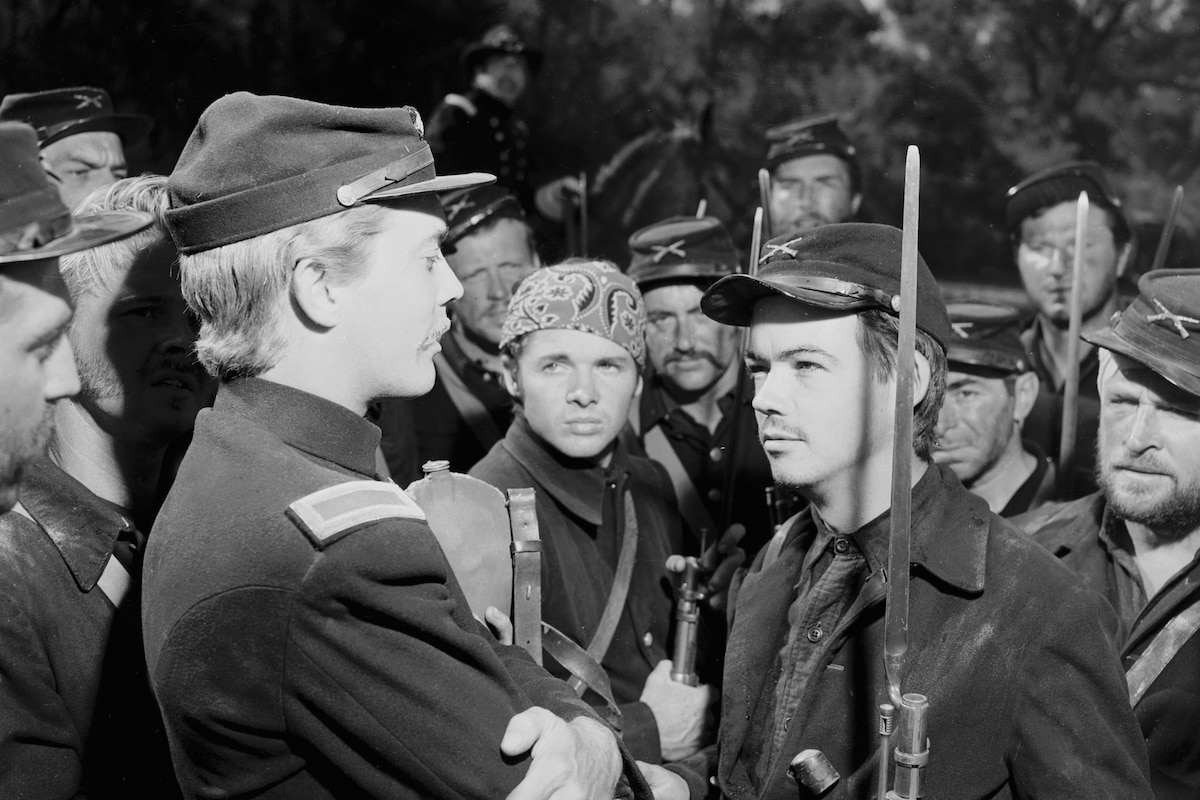
Although he had never fought in the Civil War, Crane captured the
atmosphere accurately by studying Matthew Brady's legendary photographs
from that era. Director John Huston would instruct cameraman Harold Rosson
to capture the same look for the film.
In 1950, Huston had just been pulled off MGM's big budget production of
Quo Vadis? (1951) after a fight over the film's direction between
production chief Dore Schary, who wanted to emphasize the picture's
contemporary political parallels, and studio head Louis B. Mayer, who
wanted a typical Hollywood spectacle. Mervyn LeRoy took over the film,
which became a huge hit.
Huston was a friend of producer Wolfgang Reinhardt from their days
together at Warner Bros. Reinhardt's younger brother, Gottfried, was
producing at MGM and approached Huston, who had just made The Asphalt
Jungle (1950) there, about working on a film version of Stephen Crane's
classic novel.
MGM bought the rights to Stephen Crane's book for $10,000.
Originally Huston and Reinhardt wanted Norman Mailer, currently enjoying the success of his best-selling novel, The Naked and the Dead, to write the screenplay.
When he wasn't available, Schary suggested that Huston write it
himself.
The first draft script was written by Huston's production assistant,
Albert Band, who would go on to become a prolific producer and director of
low-budget films, particularly in the '70s and '80s. Band simply
translated the book's dialogue and action into screenplay form. Huston
then did the re-write during a trip to Mexico. He took great pride in the
fact that two-thirds of the dialogue came directly from the
novel.
Mayer hated the film's script and tried to have the production
cancelled. He said, "I would rather shoot Huston than shoot the picture.
We could then put the money into a defense in court. No jury would convict
me." Finally he and Schary appealed to Nicholas Schenck -- head of MGM's
parent company, Loew's Inc. -- to choose between them. Schenck sided with
Schary.
Mayer then tried to talk Huston and Reinhardt out of making the film.
"How can you make a picture of boys with funny caps and popguns, and make
people think the war they are fighting is terrible?" he argued. When
Huston gave in too easily, however, he lectured him: "John Huston, I'm
ashamed of you! Do you believe in this picture? Have you any reason for
wanting to make it other than the fact that you believe in it?...Stick by
your guns! Never let me hear you talk like this again! I don't like this
picture. I don't think it will make money. I don't want to make it, and I
will continue to do everything in my power to keep you from making it. But
you -- you should do everything in your power to make it!."
Mayer continued badmouthing the picture, most notably in his interview
with Lillian Ross for her articles on the film's production in The New
Yorker (later republished as Picture in 1952) and at the first
preview. This unprecedented behavior for a studio executive would
contribute to his ouster from MGM in 1951.
Casting Audie Murphy in the lead was director John Huston's idea. He
was intrigued by the contrast between his war record and his physical
appearance: "This little, gentle-eyed creature. Why, in the war he'd
literally go out of his way to find Germans to kill. He's a gentle little
killer."
Reinhardt and Schary wanted an established star like Montgomery Clift
or Van Johnson in the leading role. They finally bowed to Huston's wishes
when gossip columnist Hedda Hopper, who was a friend of Murphy's, put
pressure on them. She later explained, "I called Dore and said it would be
nice seeing a real soldier playing the part of a screen soldier for a
change. With so many of our young men going to Korea, putting Audie in the
picture would aid in boosting their morale. Audie got the part."
Ironically, she had never read the original novel.
Murphy had been the most decorated U.S. soldier in World War II, a
distinction that put him on the cover of Life magazine and brought
him to Hollywood, where he made a series of low-budget Westerns at
Universal Studios. After six movies there, the offer to star as the Young
Soldier in The Red Badge of Courage was the first role he felt
suited for.
Murphy wasn't the only actor in the film on whom Huston was taking a
chance. He had met John Dierkes, cast as the Tall Soldier, in London
during the war and thought he was right for the part. Dierkes took a leave
from his job with the Treasury Department to make the film and never went
back, spending the rest of his life as an actor. Bill Mauldin -- who made
his name with his political cartoons for the U.S. military newspaper,
Stars and Stripes -- had met Huston while the director was filming
his documentary The Battle of San Pietro (1945). Huston told him
his role as the Loud Soldier was typecasting.
Murphy's salary for the film was $2,500 a week with a ten week
guarantee, relatively low for a leading man on a major studio production.
Huston was paid $137,334 for directing and another $28,000 for writing the
screenplay. Most of it had to be paid to him in advance so he could cover
his gambling debts.
by Frank Miller
The Big Idea - THE RED BADGE OF COURAGE (1951)
by Frank Miller | September 15, 2004
SIGN UP FOR OUR NEWSLETTERS

CONNECT WITH TCM