The Big Idea Behind SINGIN' IN THE RAIN
MGM producer Arthur Freed decided to make a "catalogue" picture, a musical sub-genre often based on a catalogue of music from a single songwriting source. In the case of Singin' in the Rain (1952), the source was Nacio Herb Brown and Freed himself (the producer had been a songwriter before producing films). Betty Comden and Adolph Green were commissioned to write a musical that would build upon Freed and Brown's extensive oeuvre of musical tunes. After being hired, Comden and Green decided that Hollywood during the 'Roaring Twenties' - the era of flappers, pinstripes, and early jalopies - would be the perfect setting for the film. They first thought about remaking Bombshell (1933), a satire about tinsel town starring Jean Harlow, with Howard Keel, one of the leading baritones on the screen, as the star. In fact, they toyed with the idea of having Keel play a two-bit western actor who becomes a singing cowboy. But this idea was abandoned after Gene Kelly expressed an interest in the project.
The idea of having the main character, Don Lockwood (played by Kelly), break into the motion picture business by performing stunts on movies has a kernel of truth to it. Most of the early stuntmen came from professions other than the movies, such as the rodeo circuit or the nascent aviation industry. Admittedly, not many of the stuntmen came from a musical background like Gene Kelly's character does in Singin' in the Rain. However, many established movie stars, such as Douglas Fairbanks Sr. and Buster Keaton, were known for their ability to perform daring stunts that even the most experienced professional stuntman would hesitate to perform.
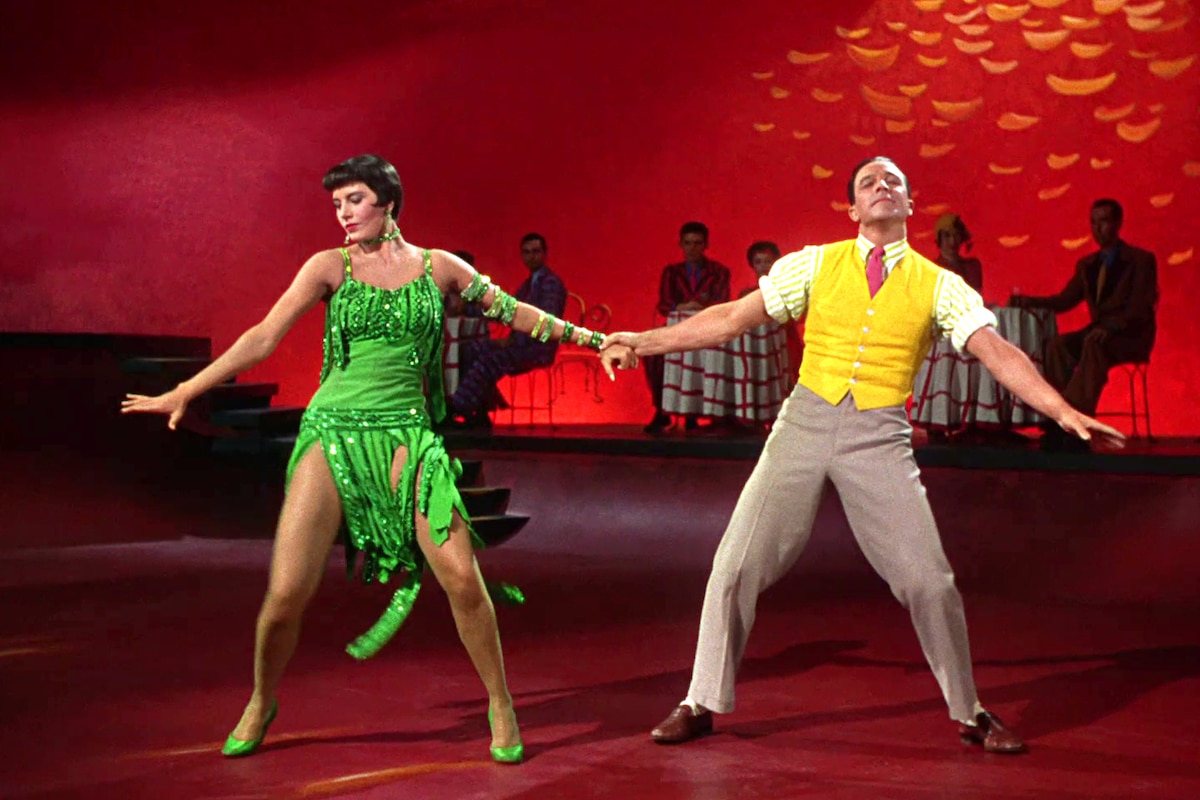
The original idea for a spectacular, pull-out-the-stops climax was not the "Broadway Ballet" sequence which is a highlight of Singin' in the Rain but an extravagant musical number set in the Wild West with Gene Kelly, Debbie Reynolds, and Donald O'Connor traveling across the plains in a covered wagon. The trio of piano playing pioneers would be attacked by Indians, somehow managing to save their own scalps by diverting their captors with the universal language of music and dance....at least, until the cavalry arrived to save the day. Fortunately, this idea was scrapped in favor of the superior "Broadway Ballet" sequence.
By Scott McGee
The Big Idea - SINGIN' IN THE RAIN (1952)
by Scott McGee | September 15, 2004
SIGN UP FOR OUR NEWSLETTERS

CONNECT WITH TCM