The Big Idea Behind CITIZEN KANE
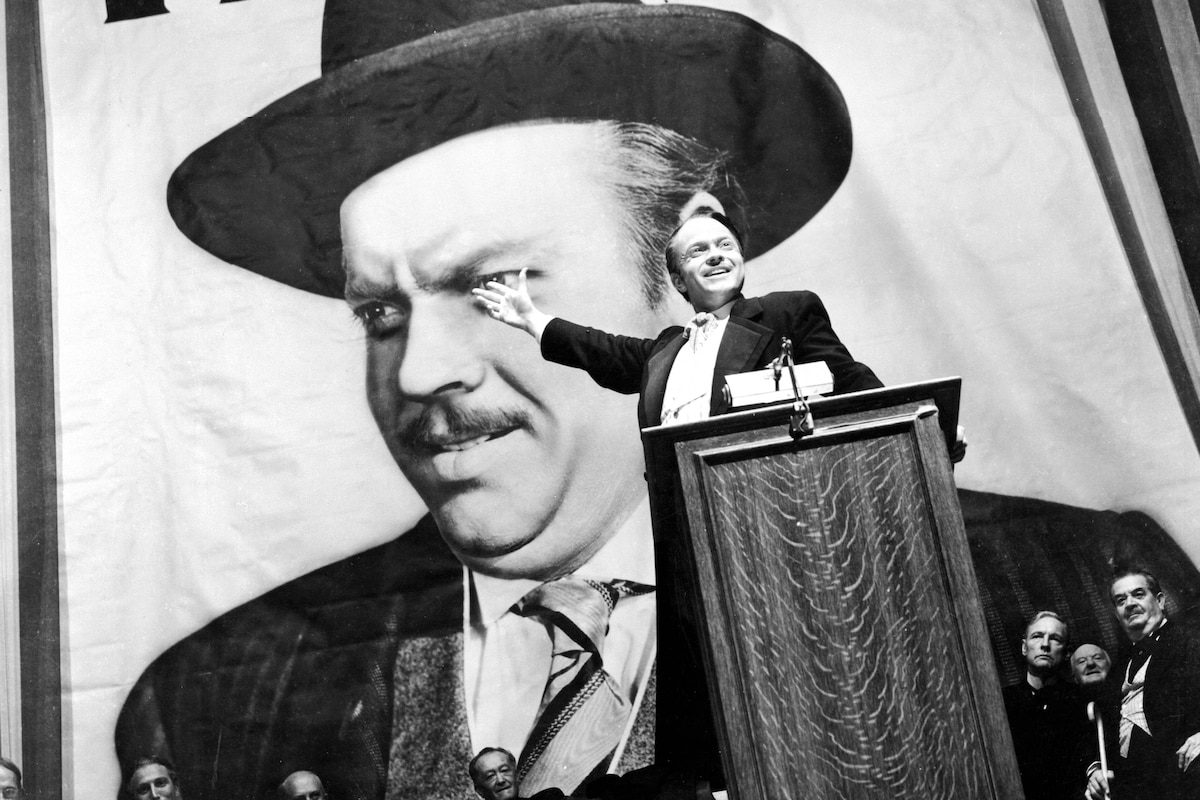
Orson Welles' patented recipe for creating the character, Charles Foster Kane, included these ingredients:
- one gallon of William Randolph Hearst, the billionaire newspaper baron whose waning power and influence left him vulnerable to young upstarts like the 25 year
old Orson Welles.
- two quarts of Orson Welles himself
according to John Houseman, the Mercury Theater co
founder and a producer on Citizen Kane, Charles Foster Kane was based largely on Welles. Houseman points out the scene where Kane demolishes Susan's dressing room. He maintains that the scene "was definitely inspired by the great final scene of separation between Orson and me when he threw four flaming dish warmers at me. The same kind of insane destruction at the loss of something that he really felt very strongly about was used there..." Furthermore, Kane's early life, his appetite, and his ascendancy to power resembles Welles more more than it does Hearst.
- 2/3 cup of munitions magnate Basil Zaharoff.
- 1/2 cup of millionaire stock swindler Ivar Kreuger.
- 4 tablespoons of Jules Brulatour, the Kodak chief who tried to turn his wife into a respected opera singer.
- 2 tablespoons of Henry Luce, founder of Time magazine. Although Citizen Kane was seen as an attack on W.R. Hearst, it also took aim at Luce's concept of faceless group journalism, as then practiced in Tim and the March of Time newsreels, which the "News on the March" deliberately parodies. The reason you do not see any of the reporters is that Welles and Mankiewicz were ribbing the anonymity of Luce's writers and editors.
- 10 ounces of Chicago newspaper czar Harold McCormick (of the Chicago Tribune family), who left his wife, Edith Rockefeller McCormick, after being seduced by a Polish prima donna named Ganna Walska. McCormick was the chief sponsor of the Chicago Opera Company and used his influence to have Walska cast in the opera Zaza. Frances Alda, one of the most expensive voice coaches in the world, was hired to make a singer out of Walska, a task that was in vain because Walska had an awful voice, and Zaza went down as one of the bigger disasters of 1920. Eventually, Walska walked out on McCormick, but he chased her to Europe where she convinced him that the only way to cure his impotence problem was to have thyroid glands from monkeys transplanted into his own body by a European quack. Word has it that Welles was fascinated with this story in his youth.
- Add a pinch of plot similarity to I Loved a Woman (1933), a story about a millionaire merchant who collects artwork and sponsors a struggling opera singer, and profits from selling $50 million dollars' worth of spoiled meat to soldiers in the Spanish
American War.
- Sprinkle a dash of flashback technique which was used in both A Man to Remember (1938), the story of a country doctor and his career, and The Power and the Glor (1933), starring Spencer Tracy as a railroad employee who rises to become the wealthy president of the company.
- Set the patented RKO
brand production oven to bake. Cook for several months. Serve to public on May 1, 1941.
by Scott McGee
The Big Idea - CITIZEN KANE (1941)
by Scott McGee | July 26, 2004
SIGN UP FOR OUR NEWSLETTERS

CONNECT WITH TCM