Synopsis
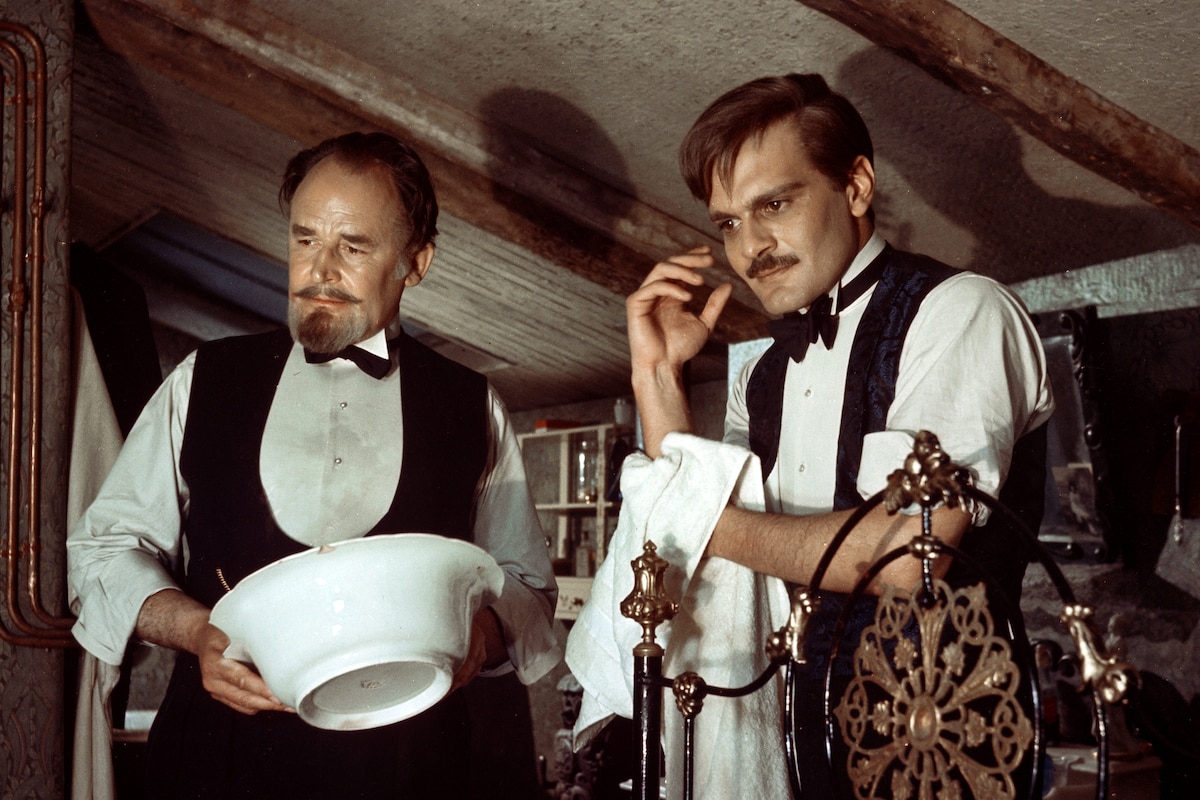
Promising young surgeon Yuri Zhivago is happily married to a wife from a good family when a world war, the Russian
Revolution and his growing passion for the beautiful Lara disrupt their
lives. Though Lara inspires his greatest poetry, they are kept apart
by the forces of history until Zhivago defies the Soviet government to flee
with his love to the snowbound countryside of his youth. There, they
snatch a few moments of happiness until she vanishes with their infant
daughter, leaving Zhivago to spend the rest of his life searching for her.
Years later, his half-brother, Yevgraf, tracks down a young factory worker
who knows little of her past except for her passion for music and poetry which
she inherited from her father, Yuri.
Director: David Lean
Producer: Carlo Ponti
Screenplay: Robert Bolt
Based on the novel by Boris Pasternak
Cinematography: Freddie Young
Editing: Norman Savage
Art Direction: John Box
Music: Maurice Jarre
Cast: Omar Sharif (Yuri Zhivago), Julie Christie (Lara), Geraldine Chaplin
(Tonya), Rod Steiger (Komarovski), Alec Guinness (Yevgraf), Tom Courtenay
(Pasha), Ralph Richardson (Alexander Gromeko), Siobhan McKenna (Anna
Gromeko), Rita Tushingham (The Girl), Klaus Kinski (Kostoyed), Jack
MacGowran (Petya)
C-180m.
Why Doctor Zhivago is Essential
Doctor Zhivago was the first major western film to capture the
turmoil of the Russian Revolution, leading the way for such later epics as
Nicholas and Alexandra (1971) and Reds (1981).
Doctor Zhivago was the second of three films teaming David Lean
with playwright Robert Bolt. Bolt had previously saved the Lawrence of
Arabia (1962) script. Their third collaboration would be Ryan's
Daughter (1970), starring Bolt's wife, Sarah Miles.
This was the third of four films Lean made with composer Maurice Jarre.
The others were Lawrence of Arabia, Ryan's Daughter and A
Passage to India (1984). Jarre won Oscars® for all his Lean
collaborations except Ryan's Daughter.
Along with the reissue of Gone With the Wind (1939), Doctor
Zhivago saved MGM from bankruptcy in the mid-'60s.
Doctor Zhivago marked a new path for the historical epic.
Previous films had simply focused on the scope of world-shaping events.
With Zhivago director David Lean and scriptwriter Robert Bolt
brought a new romantic sensibility to the epic. That Victorian ideal would
inform such later blockbusters as Mary, Queen of Scots (1971),
Lady Gray(1986) andTitanic (1997).
by Frank Miller
The Essentials - DOCTOR ZHIVAGO (1965)
by Frank Miller | July 26, 2004
SIGN UP FOR OUR NEWSLETTERS

CONNECT WITH TCM