MR. DEEDS GOES TO TOWN - Trivia and Other Fun Stuff
Director Frank Capra was paid $159,500 for making Mr. Deeds Goes to
Town, his contractual salary of $100,000 per picture plus a bonus. His
contract also gave him 10 percent of the film's profits, which over time
would amount to $299,406.
Rentals during the initial release of Mr. Deeds Goes to Town came to
a high for the time $1,040,767. By 1985, it had earned over $3 million,
most of it back when movie tickets cost less than a dollar.
Although Gary Cooper had a minimalist acting style that fit his
innocent, homespun heroes perfectly, the roles he played were a far cry
from the man off-screen. The real Cooper, despite his Montana roots, was a
worldly sophisticate who collected modern art and had off-screen romances
with some of the screen's most beautiful actresses, including Lupe Velez
and Patricia Neal.
Jean Arthur was so unsure of herself that though she saw the film's
rushes, she couldn't make herself watch Mr. Deeds Goes to Town in
its finished form until 1972, when she accompanied Capra to a screening at
the USA Film Festival in Dallas.
Other cast members who worked with Cooper frequently include Raymond
Walburn (Walter), who was in four of his films; H.B. Warner (Judge May),
who was in five and won an Oscar® nomination for Capra's Lost
Horizon (1937); and Ann Doran (Girl on Bus), who appeared in five but
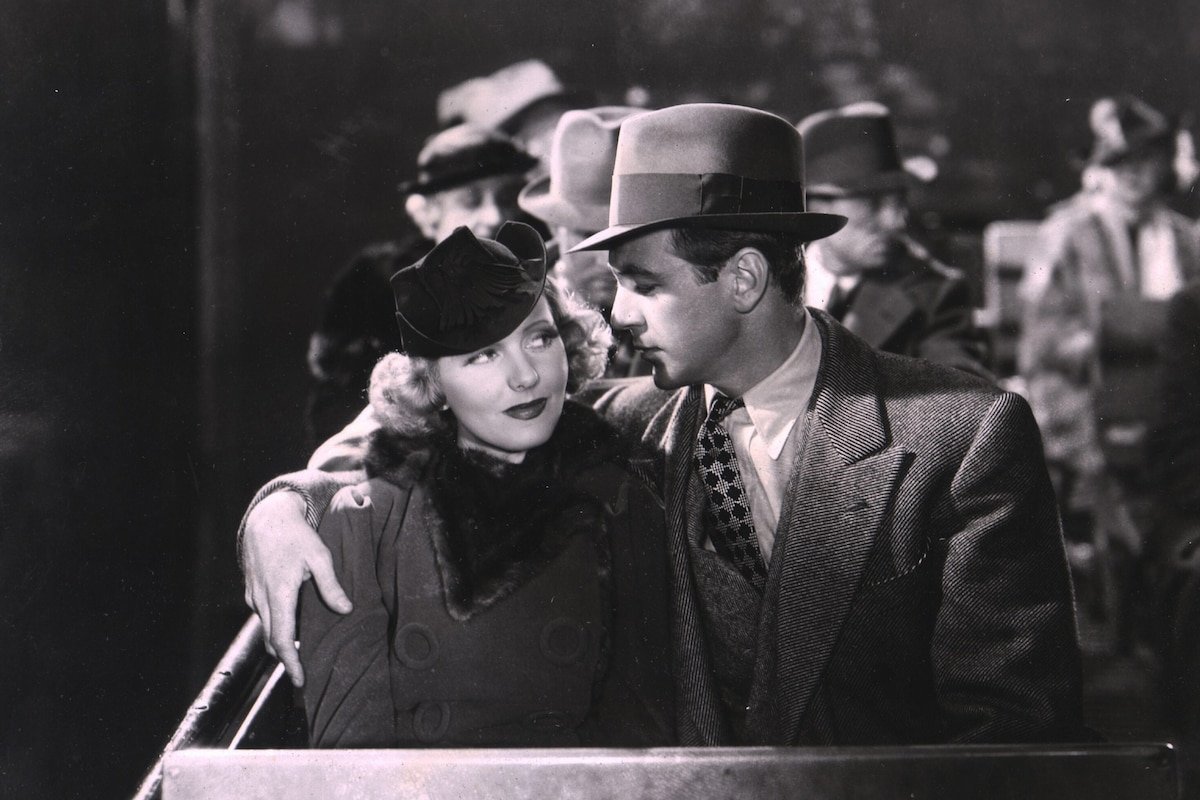
was only credited on You Can't Take It With You.
Cooper and Jean Arthur re-teamed later that year as Wild Bill Hickok
and Calamity Jane in Cecil B. DeMille's epic Western The
Plainsman (1937).
Babe's description of Deeds as "The Cinderella Man" in her newspaper
stories was borrowed from an earlier Capra-Riskin film, Platinum
Blonde (1931), in which a hard-nosed reporter earns the title when he
marries a beautiful heiress.
Despite the film's socially progressive tone, Capra was a Republican
who resented President Roosevelt and his New Deal for encroaching on his
newfound wealth. He also opposed the creation of the Screen Directors
Guild.
Cooper, too, was more conservative than his character. In 1947 he was
one of the "friendly witnesses" testifying before the House Un-American
Activities Committee (HUAC) about Communist infiltration of Hollywood.
Among the actors blacklisted as a result of HUAC's hearings was Lionel
Stander, who played the cynical press agent in Mr. Deeds Goes to
Town.
Famous Quotes from MR. DEEDS GOES TO TOWN
"WELCOME TO MANDRAKE FALLS
WHERE THE SCENERY ENTHRALLS
WHERE NO HARDSHIP E'ER BEFALLS
WELCOME TO MANDRAKE FALLS" -- Town sign for Mandrake Falls, written by Gary
Cooper as Longfellow Deeds.
"I wonder why he left me all that money. I don't need it." -- Cooper as
Longfellow Deeds, questioning his good fortune.
"Tell me, Walter, are all these stories I hear about my uncle true?"
Well, sir, he sometimes had as many as 20 [women] in the house at the same
time."
"Twenty! What did he do with them?"
"That is something I was never able to find out, sir." -- Cooper as Deeds,
questioning Raymond Walburn as his butler, Walter.
"People here are funny. They work so hard at living, they forget how to
live." -- Cooper as Deeds.
"I know I must look funny to you, but maybe if you went to Mandrake Falls,
you'd look just as funny to us, only we wouldn't laugh at you and make you
feel ridiculous, because that wouldn't be good manners. I guess maybe it
is comical to write poems for postcards, but a lot of people think
they're good. Anyway, it's the best I can do." -- Cooper as Deeds,
defending himself against the jeers of the New York literati.
"That guy is either the dumbest, stupidest, most imbecilic idiot in the
world, or else he's the grandest thing alive. I can't make him out." --
Jean Arthur as Babe Bennett, delivering her judgment of Deeds'
character.
"I just wanted to see what a man looked like that could spend thousands of
dollars on a party when people around him were hungry." -- John Wray as the
Farmer, threatening Deeds and inspiring his social conscience.
"He's been hurt, he's been hurt by everybody he met since he came here,
principally by me. He's been the victim of every conniving crook in town.
The newspapers pounced on him, made him a target for their feeble humor. I
was smarter than the rest of them: I got closer to him, so I could laugh
louder. Why shouldn't he keep quiet -- every time he said anything it was
twisted around to sound imbecilic! He can thank me for it. I handed the
gang a grand laugh. It's a fitting climax to my sense of humor....Certainly
I wrote those articles. I was going to get a raise, a month's vacation. But
I stopped writing them when I found out what he was all about, when I
realized how real he was. He could never fit in with our distorted
viewpoint, because he's honest, and sincere, and good. If that man's crazy,
Your Honor, the rest of us belong in straitjackets!" -- Arthur, as Babe
Bennett, defending Deeds in court.
"About my playing the tuba. Seems like a lot of fuss has been made about
that. If, if a man's crazy just because he plays the tuba, then somebody'd
better look into it, because there are a lot of tuba players running around
loose." -- Deeds defending himself on the witness stand.
"Why, everybody in Mandrake Falls is pixilated -- except us." -- Margaret
Seddon as Jane Faulkner, describing her hometown, herself and her sister
(Margaret McWade as Amy Faulkner).
"From what I can see, no matter what system of government we have, there'll
always be leaders and always be followers. It's like the road out in front
of my house. It's on a steep hill. Every day I watch the cars coming up.
Some go lickety-split up that hill on high, some have to shift into second,
and some sputter and shake and slip back to the bottom again. Same cars --
same gasoline -- yet some make it and some can't. And I say the fellows
who can make the hill on high should stop once in a while to help those who
can't. That's all I'm trying to do with this money -- help the fellows who
can't make the hill on high." -- Deeds explaining his plans to the
court.
"Mr. Deeds, there has been a great deal of damaging testimony against you.
Your behavior, to say the least, has been most strange. But in the opinion
of the court, you are not only sane, but you're the sanest man that ever
walked into this courtroom!" -- H.B. Warner as Judge May, delivering his
verdict.
"He's still pixilated."
"He sure is!" -- Seddon as Jane Faulkner and McWade as Amy Faulkner,
ending the film with their final judgment on Deeds.
Compiled by Frank Miller
Trivia - MR. DEEDS GOES TO TOWN (1936)
by Frank Miller | July 26, 2004
SIGN UP FOR OUR NEWSLETTERS

CONNECT WITH TCM