The Big Idea Behind MR. DEEDS GOES TO TOWN
After his blockbuster success with It Happened One Night (1934),
director Frank Capra considered several properties as a follow-up. A
serious illness left him determined to tackle more significant topics as a
way of justifying his growing good fortune. Among the works he read most
closely were Tolstoy's Anna Karenina, Dostoyevsky's Crime and
Punishment, Maxwell Anderson's historical play Valley Forge and
Clarence Buddington Kelland's short story "Opera Hat."
Ultimately he decided he didn't feel he understood the Russian spirit
enough to direct one of that country's classic novels and was too
contemporary for the historical story. That left "Opera Hat."
"Opera Hat" was the story of country boy Longfellow Deeds, who inherits
$20 million and an Opera House in New York City. The story focused
primarily on his dealings with the opera crowd.
Kelland was also the author of a series of comic stories about
Scattergood Baines, small-town businessman. They were filmed at RKO
Studios in the early '40s as a vehicle for character comic Guy
Kibbee.
Capra was drawn to the story because he found the premise intriguing.
He would later write: "I wanted to see what an honest small-town man would
do with $20,000,000 -- how he would handle it and how he would handle all
the predators that would surround him, and what good would come out of that
thing, what statements you could make about a man being his brother's
keeper."
He asked Harry Cohn, the production chief at Columbia Studios, where he
was under contract, to buy the story for him and assign Robert Riskin, who
had won an Oscar® for writing It Happened One Night, to write
the adaptation.
The first thing he and Riskin did was minimize the opera angle, which
Capra considered too highbrow for general audiences. Instead they focused on how Deeds would handle
his sudden fortune in the middle of the Great Depression. In place of an
innocent secretary with whom Deeds falls in love, they created Babe
Bennett, a cynical newspaper woman modeled on Clark Gable's character in
It Happened One Night.
Capra biographer Joseph McBride (Frank Capra: The Catastrophe of
Success, Simon & Shuster, 1992) has suggested that Capra's ideal of the
little man, first realized on film in Mr. Deeds Goes to Town, was
inspired by Mr. Blue, a 1928 novel by actor Walter Connolly, a
friend of Capra's who appeared in four of his films. The novel tells of a
modern Christ figure trying to maintain his purity in the midst of a modern
city.
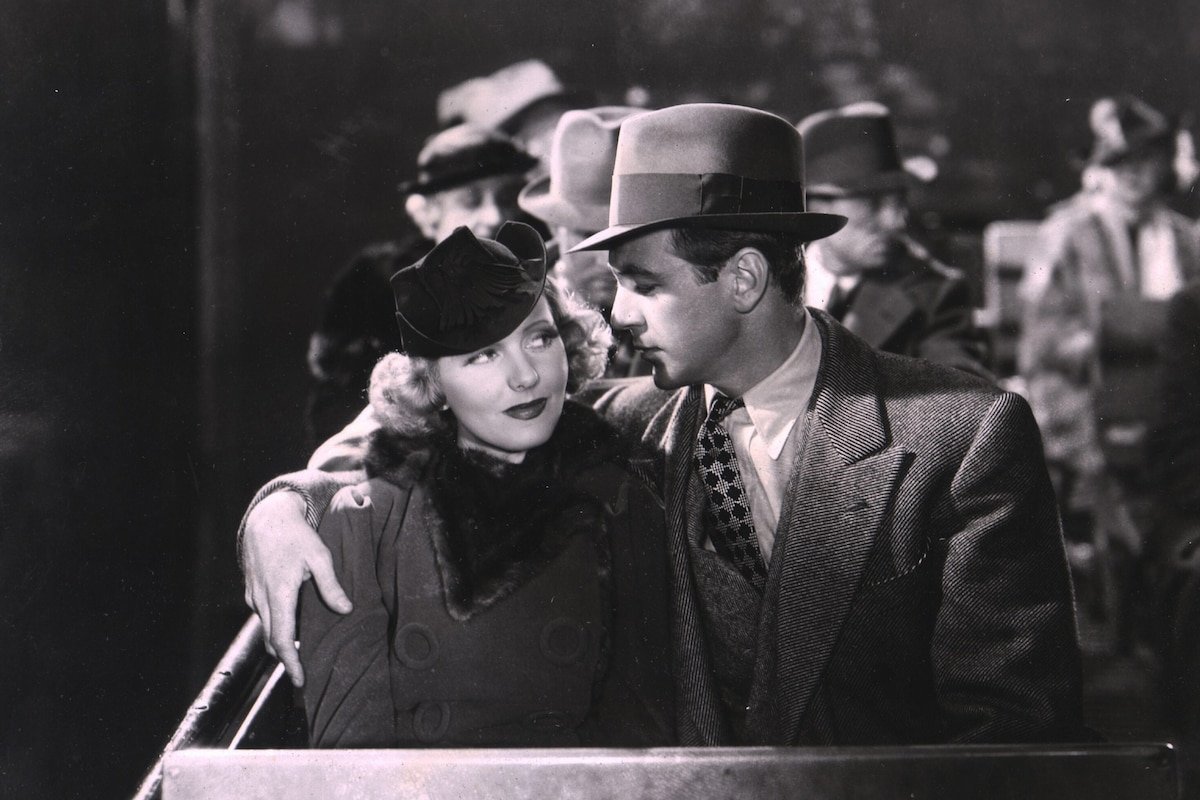
Director Frank Capra could only envision one actor as the
quintessential American hero of Mr. Deeds Goes to Town. "Who in
Hollywood could play honest, humble, 'corn tassel poet' Mr. Deeds," he
wrote. "Only one actor: Gary Cooper. Every line in his face spelled
honesty. So innate was his integrity he could be cast in phony parts, but
never look phony himself. Tall, gaunt as Lincoln, cast in the frontier
mold of Daniel Boone, Sam Houston, Kit Carson, this silent Montana
cowpuncher embodied the true-blue virtues that won the West: Durability,
honesty and native intelligence."
Capra had a much harder time finding a leading lady. Carole Lombard
turned the film down three days before shooting was scheduled to start
(shortly afterwards she turned down Riskin's proposal of marriage, too).
The role was still unfilled when Capra started shooting the film. He later
claimed he caught some rushes from a Jack Holt Western and was struck by
leading lady Jean Arthur's talents and her husky voice -- only she never
made a Western with Jack Holt and her previous film with him, The
Defense Rests (1934), was released a year before Deeds went into
production. More likely, he saw her performance in The Whole Town's
Talking, which had been co-written by Riskin. She had been in films
so long without any success, that he had to fight to get studio head Harry
Cohn to let him cast her.
by Frank Miller
The Big Idea - MR. DEEDS GOES TO TOWN (1936)
by Frank Miller | July 26, 2004
SIGN UP FOR OUR NEWSLETTERS

CONNECT WITH TCM