CASABLANCA - Trivia and Other Fun Stuff
"As Time Goes By" didn't win an Oscar® for Best Song in 1943. It wasn't even eligible to be nominated since it wasn't an original work. It was actually a much older song, written for a 1931 Broadway show called Everybody's Welcome.
Casablanca may have been a city of corruption, political intrigue, and pickpockets, but compared to an earlier film Michael Curtiz directed in his native Hungary, the North African city is positively puritan. Directed in a style that recalled D.W. Griffith's Intolerance, Curtiz's Sodom and Gomorrah (1922) was a biblical story that detailed the avarice, lust and greed that eventually brought ruin onto the twin cities. While Casablanca isn't quite that decadent, Curtiz did show an early knack for sinful cities.
Conrad Veidt and Paul Henreid, far from being murderous adversaries, were actually the best of friends. Veidt had intervened on Henreid's behalf to prevent the Austrian refugee from being interned in Britain near the beginning of World War II. Veidt appeared in another milestone of world cinema as the somnambulist Cesare in the silent German film, The Cabinet of Dr. Caligari (1919). He was also an exotic presence as the mysterious prince in The Indian Tomb (1921). After escaping Nazi Germany, Veidt settled into a Hollywood career doing his best to portray the Nazis in the worst possible light. Sadly, Veidt, whose performance as the villainous Major Strasser was completely different from his own character, died in April 1944, one month after Casablanca swept the Academy Awards®.
Notice some familiar faces from other films? Peter Lorre, Sydney Greenstreet, and Humphrey Bogart starred in The Maltese Falcon (1941). And Claude Rains and Paul Henreid had just completed Now, Voyager (1942) when they signed on for Casablanca.
How about that typo in the credits? Veteran character actor S.Z. Sakall, known to most people as "Cuddles" Sakall, is listed in the credits as "S.K. Sakall."
The opening montage sequence was created by Don Siegel, who went on to direct many important films himself, including Invasion of the Body Snatchers (1956) and Dirty Harry (1971).
Yes, that's the great Marcel Dalio as the croupier. Dalio had been a great star in French cinema during the 1930s and appeared in two key films of the French poetic realism movement of the 1930s for director Jean Renoir, Grand Illusion (1937) and The Rules of the Game (1939).
The famous last line in the film is heard while Rick and Louis walk off into the fog. Since their backs were to the camera, the studio had more time to come up with a suitable closing line to their scene. Before producer Hal Wallis came up with the perfect line ("Louis, I think this is the beginning of a beautiful friendship."), there were a few other possible lines considered:
"Louis, I begin to see a reason for your sudden attack of patriotism. While you defend your country, you also protect your investment."
"If you ever die a hero's death, Heaven protect the angels!"
"Louis, I might have known you'd mix your patriotism with a little larceny."
Another possible ending that was considered was to shoot a coda with Rick and Louis on a battleship taking the war to Hitler's front doorstep. Thankfully, the idea was scrapped when preview audiences responded enthusiastically to the airport-in-the-fog ending. Besides, a new ending would have required more time and money than their schedule allowed.
"Here's looking at you, kid," was originally written as "Here's good luck to you." Also, Bogart's line of resignation that he can't escape Ilsa was previously written as, "Of all the cafes in all the towns in the world, she walks into my cafe Both pieces of rephrasing are attributed to Bogart himself.
Bogart's final speech as he puts Ilsa on the airplane with Victor was allegedly written on the hood of a car at the studio. This legend is granted some merit by the fact that the Epsteins came up with Capt. Renault's famous line, "Round up the usual suspects," while driving to the studio to shoot the final scene.
There has been persistent confusion as to when Casablanca was actually released. The film premiered in New York City in November 1942, in what was called a pre-release engagement. This showing was rushed to theaters to capitalize on the recent events in North Africa, specifically the invasion of American troops into the real Casablanca. Because this kind of free publicity happens only once in a blue moon, Warner Bros. rushed Casablanca to just one theater in New York. But it was not seen by the rest of the country until early 1943, including Los Angeles. As luck would have it, the national release coincided with another Casablanca event, a summit meeting between President Franklin D. Roosevelt, Winston Churchill, and Joseph Stalin.
Casablanca was a big budget picture, produced at a final cost of $950,000. The initial $20,000 paid for the screen rights to an un-produced play called Everybody Comes to Rick's was a steal, especially when you consider that the picture turned in a tidy sum of $3,700,000 during the first year of release. However, the studio did not know before the national release what a gold mine they had on their hands. For the New York pre-release, Casablanc was advertised at the Hollywood Theater in Manhattan in a joint ad with Gentleman Jim (1942), an Errol Flynn movie about famed boxer Jim Corbett.
Famous Quotes from CASABLANCA
Captain Renault: What in heaven's name brought you to Casablanca?
Rick: My health. I came to Casablanca for the waters.
Captain Renault: The waters? What waters? We're in the desert.
Rick: I was misinformed.
Rick: Of all the gin joints in all the towns in all the world, she walks into mine.
Ilsa: Kiss me. Kiss me as if it were the last time.
Rick: And remember, this gun is pointed right at your heart.
Captain Renault: That is my least vulnerable spot.
Captain Renault: I'm afraid Major Strasser would insist.
Ilsa: You're saying this only to make me go.
Rick: I'm saying it because it's true. Inside of us, we both know you belong with Victor. You're part of his work, the thing that keeps him going. If that plane leaves the ground and you're not with him, you'll regret it. Maybe not today. Maybe not tomorrow, but soon and for the rest of your life.
Ilsa: But what about us?
Rick: We'll always have Paris. We didn't have, we, we lost it until you came to Casablanca. We got it back last night.
Ilsa: When I said I would never leave you.
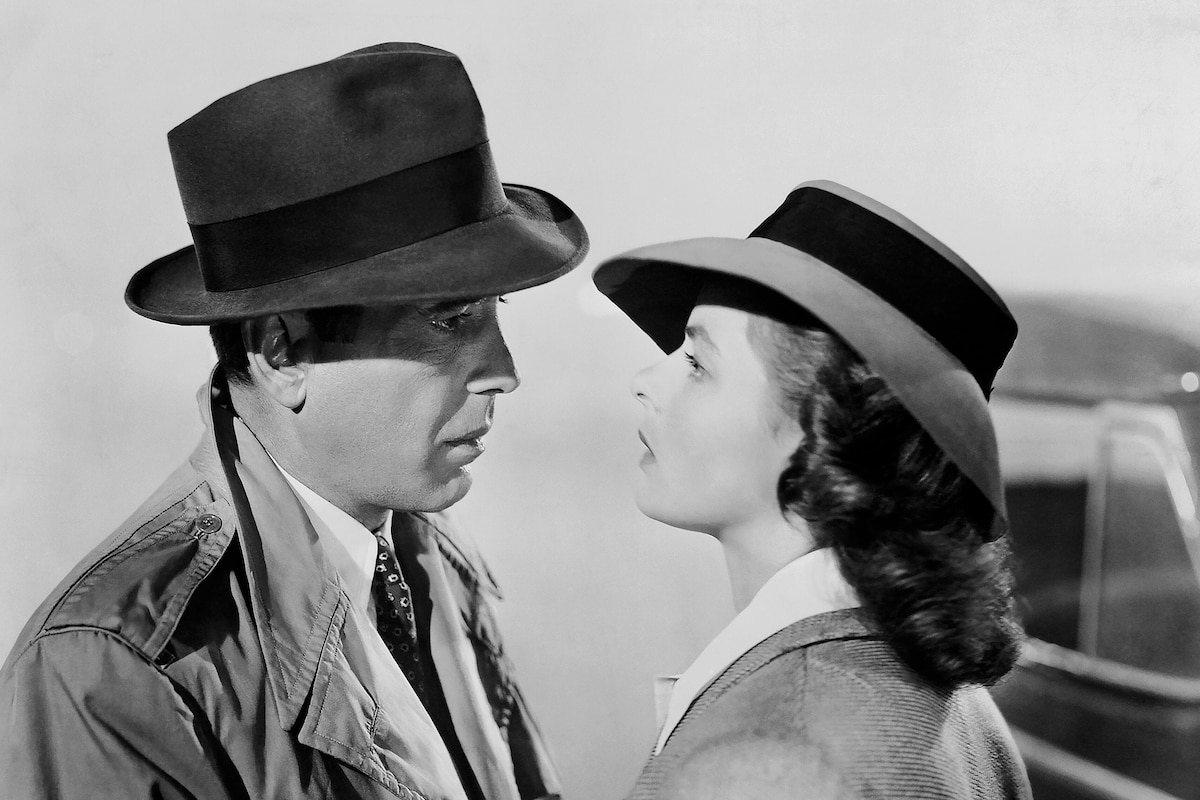
Rick: And you never will. But I've got a job to do, too. Where I'm going, you can't follow. What I've got to do, you can't be any part of. Ilsa, I'm no good at being noble, but it doesn't take much to see that the problems of three little people don't amount to a hill of beans in this crazy world. Someday you'll understand that. Now, now... Here's looking at you kid.
Captain Renault: Major Strasser has been shot. Round up the usual suspects.
Rick: Louis, I think this is the beginning of a beautiful friendship.
Rick: Last night we said a great many things. You said I was to do the thinking for both of us. Well, I've done a lot of it since then, and it all adds up to one thing: you're getting on that plane with Victor where you belong.
Ilsa: But, Richard, no, I... I...
Rick: Now, you've got to listen to me! You have any idea what you'd have to look forward to if you stayed here? Nine chances out of ten, we'd both wind up in a concentration camp. Isn't that true, Louie/
Ilsa: I wasn't sure you were the same. Let's see, the last time we met...
Rick: Was La Belle Aurora.
Ilsa: How nice, you remembered. But of course, that was the day the Germans marched into Paris.
Rick: Not an easy day to forget?
Ilsa: No.
Rick: I remember every detail. The Germans wore gray, you wore blue.
Rick: Don't you sometimes wonder if it's worth all this? I mean what you're fighting for.
Victor Laszlo: You might as well question why we breathe. If we stop breathing, we'll die. If we stop fighting our enemies, the world will die.
Rick: Well, what of it? It'll be out of its misery.
Victor Laszlo: You know how you sound, Mr. Blaine? Like a man who's trying to convince himself of something he doesn't believe in his heart.
v
Major Strasser: Are you one of those people who cannot imagine the Germans in their beloved Paris?
Rick: It's not particularly my beloved Paris.
Heinz: Can you imagine us in London?
Rick: When you get there, ask me!
Captain Renault: Hmmh! Diplomatist!
Major Strasser: How about New York?
Rick: Well there are certain sections of New York, Major, that I wouldn't advise you to try to invade.
Captain Renault: Rick, there are many exit visas sold in this cafe, but we know that you've never sold one. That is the reason we permit you to remain open.
Rick: Oh? I thought it was because I let you win at roulette.
Captain Renault: That is another reason.
Ugarte: You despise me, don't you?
Rick: If I gave you any thought I probably would.
Captain Renault: Carl, see that Major Strasser gets a good table, one close to the ladies.
Carl: I have already given him the best, knowing he is German and would take it anyway.
Woman: What makes saloonkeepers so snobbish?
Banker: Perhaps if you told him I ran the second largest banking house in Amsterdam.
Carl: Second largest? That wouldn't impress Rick. The leading banker in Amsterdam is now the pastry chef in our kitchen.
Banker: We have something to look forward to.
Yvonne: Where were you last night?
Rick: That's so long ago, I don't remember.
Yvonne: Will I see you tonight?
Rick: I never make plans that far ahead.
by Scott McGee
Trivia - CASABLANCA (1942)
by Scott McGee | February 01, 2007
SIGN UP FOR OUR NEWSLETTERS

CONNECT WITH TCM