The Critics' Corner on CASABLANCA
"The love story that takes us from time to time into the past is horribly wooden and cliches everywhere lower the tension."---William Whitebait, New Stateman, January 16, 1943.
The New York World Telegram
decided that Casablanca "is not the best of the recent Bogarts."
The New York Times chimed in by calling it "a picture which makes the spine tingle and the heart take a leap..they have so combined sentiment, humor, and pathos with taut melodrama and bristling intrigue that the result is a highly entertaining and even inspiring film."
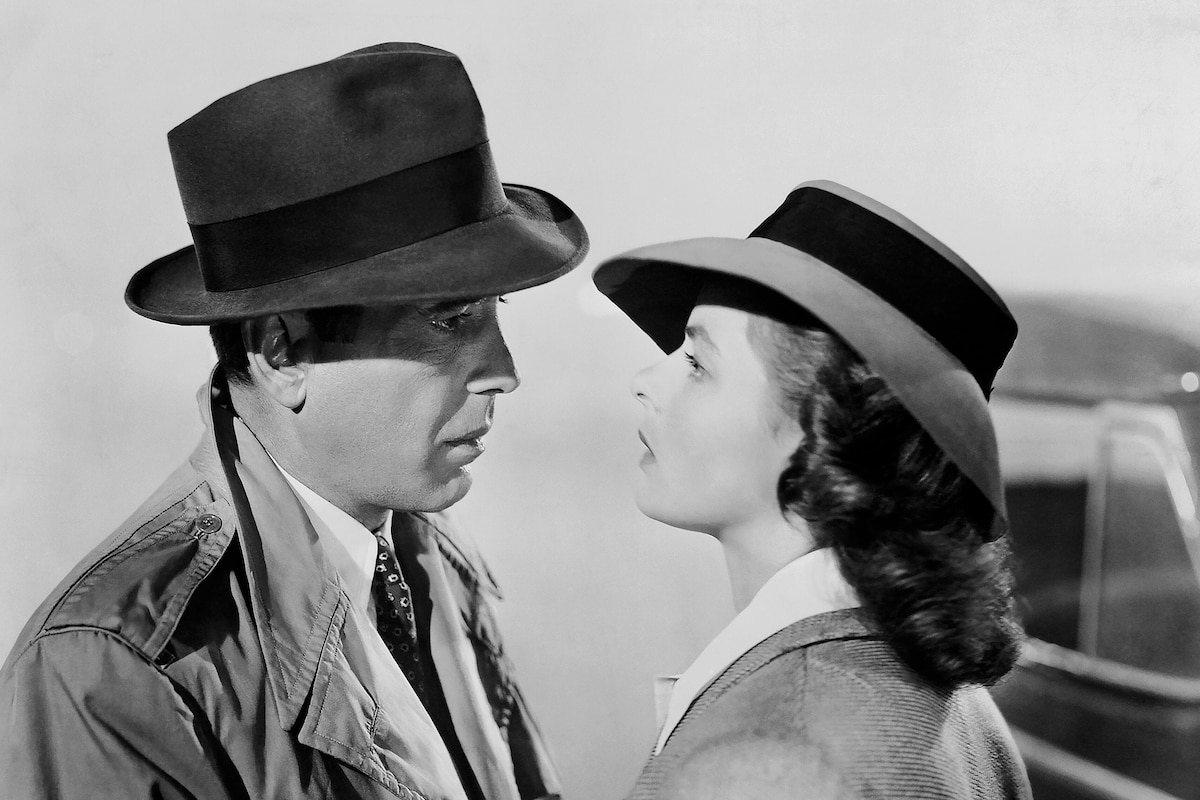
"In truth and contrary to popular impression, Casablanca isn't representative of what pictures were like "back then" but is maybe the only picture which succeeded in meeting those old-time studio heads' requirements for what all "entertainment" movies were supposed to be like. It contains almost every element that would appear on an audience checklist: action, adventure, bravery, danger, espionage, exotic locale, friendship, gunplay, humor, intrigue, a love triangle, a masculine hero, a mysterious heroine, patriotism, politics (without being too political), romance, sentimentality, a theme song, a time factor, a venomous villain, and war...Casablanca is that rare lucky film where everything came together, clicked and there was perfection." - Danny Peary, Cult Movies.
"In terms of entertainment value, Casablanca marks a high point in Hollywood production, and has withstood the test of time and fashion more impressively than such ponderous classics of the period as Jane Eyre and Sergeant York...Casablanca takes neither itself nor the war very seriously; the movie has a pre-Pearl Harbor innocence that, fused with the swashbuckling ethic behind Michael Curtiz's direction, makes it ineffably nostalgic and deliciously soft-centered." - Peter Cowie, Eight Years of Cinema.
"An incisive, witty, and enchanting film that is certainly Curtiz's best. It represents the ultimate in the Bogart myth: his Rich Blaine is cynical and tough, hardened by life's misfortunes, yet still sentimental and idealistic." - Georges Sadoul, Dictionary of Films.
Perhaps the greatest praise came from London, where General Charles de Gaulle, leader of the Free French forces, requested a print of Casablanca for a special showing to his staff.
Awards & Honors
1943 belonged to Warner Brothers. With twenty-seven Academy Award® nominations, the studio led all the other studios in the Oscar%reg; race for the first time. Casablanca and Watch on the Rhine (1943) were both Best Picture nominees, and Humphrey Bogart and Paul Lukas, the star of Watch on the Rhine, were both up for Best Actor. Lukas eventually won the Best Actor Oscar®, beating out Bogart who was running for his performance in Casablanca.
When film producer Sidney Franklin announced Casablanca as the Best Picture winner, the Los Angeles Herald-Examiner reported that the audience "gasped in amazement, then quickly regained composure and heartily applauded the unexpected results." The UPI labeled the Warner Bros. flick a dark horse winner and reported that studio head Jack Warner was "just as surprised as everyone else when the plaster Oscar® was thrust in his hand."
The actual producer of Casablanca, Hal B. Wallis, was surprised too. In fact, stunned might be a better word. When Jack Warner rushed the stage to accept the Oscar®, Wallis felt that he, not Warner, should have been on that stage receiving the Best Picture Oscar®. And rightly so. Wallis certainly earned it, not only for his superior production of Casablanca, but also for all his other 1943 productions: Watch on the Rhine, Air Force, Princess O'Rourke, and This is the Army, all of which had won at least one Academy Award®. When Wallis left to go to Paramount in 1944 after two decades at Warner Bros., insiders noted that his motivation was probably Jack Warner's selfish Oscar® night usurpation.
Michael Curtiz was also surprised that Casablanca walked off with Oscars® for Best Picture, Best Director, and Best Adapted Screenplay at the March 2, 1944 Academy Award® ceremonies. The Hungarian-born Curtiz gave an unprepared speech at the ceremony in his best broken English. He said, "So many times I have a speech ready but no dice. Always a bridesmaid, never a mother."
According to Academy Award® rules, a film has to play in Los Angeles in order to be eligible for that year's Academy Awards®. Because Casablanca did not play in L.A. until 1943, it was ruled out of the 1942 competition. It's a good thing, too, since Mrs. Minivier (1942), another drama set during World War II, walked off with the Best Picture Oscar® for 1942. But the next year's Best Picture Oscar® was fated to be Casablanca. Due to the confusing release dates, Casablanca is often listed in reference books as being released in either 1942 (the correct date) or 1943, the year it went into general release.
Compiled by Scott McGee
The Critics Corner - CASABLANCA (1942)
by Scott McGee | February 01, 2007
SIGN UP FOR OUR NEWSLETTERS

CONNECT WITH TCM