The Critics' Corner on DR. STRANGELOVE
"No Communist could dream of a more effective anti-American film to spread abroad than this one." - The Washington Post
"Beyond any question, the most shattering sick joke I've ever come across."
"There is so much about it that is grand, so much that is brilliant and amusing, but much that is grave and dangerous."
"Somehow, to me, [the ending] isn't funny. It is malefic and sick."
"I am troubled by the feeling, which runs all through the film, of discredit and even contempt for our whole defense establishment, up to and even including the hypothetical Commander in Chief."
- Bosley Crowther, The New York Times, January 21, 1964.
"It is not this film that is sick; what is sick is our supposedly moral, democratic country, which allowed this [nuclear arms] policy to be formulated and implemented without even the pretense of open public debate. The film is the first break in the catatonic cold war trance that has so long held our country in its rigid grip."
- social critic Lewis Mumford in a letter to The New York Times, March 1, 1964.
"Seen after 30 years, "Dr. Strangelove" seems remarkably fresh and undated - a clear-eyed, irreverant, dangerous satire. And its willingness to follow the situation to its logical conclusion - nuclear annihilation - has a purity that today's lily-livered happy-ending technicians would probably find a way around. Its black and white photography helps, too, putting an unadorned face on its deadly political paradoxes. If movies of this irreverence, intelligence and savagery were still being made, the world would seem a younger place." - Roger Ebert, Chicago Sun-Times.
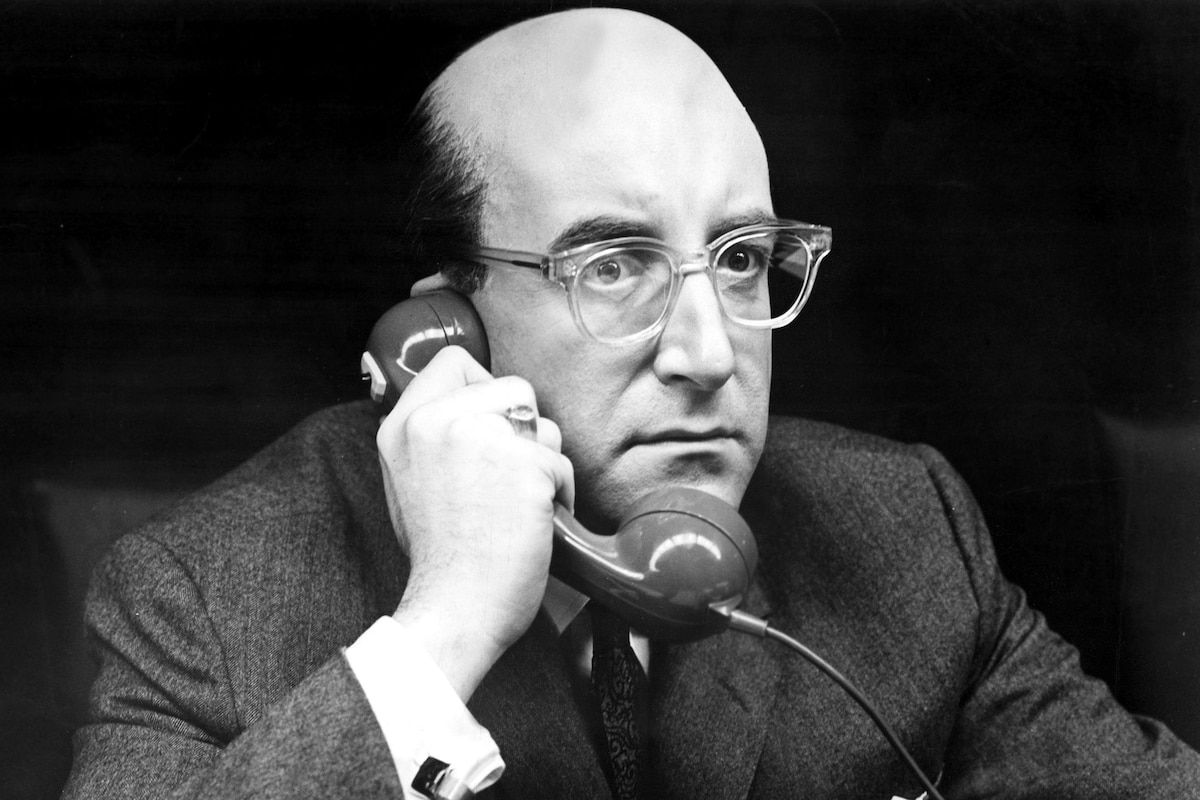
"Of the great nightmare he has made a lafforama that leaves one with a painful grin on the face and a brassy taste in the mouth...Dr. Strangelove is a machine constructed to deliver the maximum punch. The intercutting throughout of the American plane's progress with the "meanwhile back at the air base (or the President's war room) sequences, for instance, are beautifully handled for suspense, and the plane's theme song, When Johnny Comes Marching Home, is exactly right in its cockiness and its outdatedness. But it is Kubrick's direction of the actors that I most admired: he has made them into commedia dell'arte grotesques, but grotesques that take off from a solid foundation of what one uneasily recognizes as our everyday American reality. Peter Sellers, as the President, is disturbingly right....But the heart of the film is the military grotesques, and I wonder if Kubrick, even with Columbia Pictures behind him, will get away with it." - Dwight MacDonald, Dwight MacDonald on Movies.
"Kubrick manages this bewildering slither from real to unreal and back again with total mastery. Unlike Paths of Glory with its lazy sweep of tracking shots, or Lolita with its arrogantly sensual arabesques, Dr. Strangelove is choppy, abrupt, at times as urgently graceless as a newsreel, at others breathtakingly well lit and shot...A film which maintains the courage of its convictions to the bitter end is rare enough; even rarer is one which pursues its course with such relentless logic...A tough film, then, which makes one think, laugh and weep in equal proportions, and which ends on an image which makes every other film about The Bomb look like a pretty game...A sick film? I think, rather, one of bitter denunciation and hopeful warning. A lot of Americans, unfortunately, are likely to find it hard to take." - Tom Milne, Sight and Sound.
"The best American picture that I can remember since Chaplin's Monsieur Verdoux and Huston's The Treasure of the Sierra Madre...It is so truthful a film, so unsparing, so hopeless in the last pit-bottom depths of that word, that the very blackness has a kind of shine. It is to the vestige or promise of the Olympian in us that it speaks, and it is that possibly saving remnant in us that it makes laugh." - Stanley Kauffman, The New Republic.
"An outrageous, daring, inventive, devilish, macabre, and scintillating comedy - one that is not quite successful in fitting all its parts into a whole as it tries for unusualness, but one that is successful in making its caustic comments on the hydrogenic world we live in...No one thinks our ingeniously destructive world-destroying bombs are a laughing matter. I'm very sure Kubrick doesn't think so. But on some fairly safe planet, out of range, maybe this is the way they would view our predicament. I'm inclined to think that this mordant young director, Kubrick, has carried American comedy to a new high ground." - Hollis Alpert, Saturday ReviewA.
"An outrageously brilliant satire - the most original American comedy in years and at the same time a supersonic thriller that should have audiences chomping their fingernails right down to the funny bone...And it fulfills Stanley Kubrick's promise as one of the most audacious and imaginative directors the U.S. cinema has yet produced." - Time.
"While there are times when it hurts to laugh because somehow there is a feeling that the mad events in Strangelove could happen, it emerges as a most unusual combination of comedy and suspense...Peter Sellers is excellent, essaying a trio of roles. George C. Scott offers a top performance, one of the best in the film. Odd as it may seem in this backdrop, he displays a fine comedy touch. Sterling Hayden is grimly realistic and emerges a tragi-comic figure." - 'Daku,' Variety.
"Dr. Strangelove is irreverent to a point of savagery; it is funny and it is engrossing. And it's heady stuff for moviegoers, for Kubrick, boy genius that he is, assumes that we're grown-up enough to share his bitter laughter." - Judith Crist, N. Y. Herald Tribune.
"Conservatives will find it subversive, liberals will find it irresponsible, utopians will find it bleak, humanitarians will find it inhuman - Dr. Strangelove is all these things. But it also releases, through comic poetry, those feelings of impotence and frustration that are consuming us all; and I can't think of anything more important for an imaginative work to do." - Robert Brustein, New York Review of Books.
Awards and Honors:
Dr. Strangelove received Oscar® nominations for Best Picture, Best Actor (Peter Sellers), Best Director, Best Adapted Screenplay (Kubrick, Peter George, Terry Southern).
Some said Peter Sellers should have been nominated three times. Oscar® campaign ads on his behalf were submitted for Best Actor for all three roles and three times as Best Supporting Actor for each role.
Other Awards:
- New York Film Critics Award for Best Director: Stanley Kubrick.
- British Academy Award Best Picture and Best
British Picture.
Compiled by Rob Nixon
The Critics Corner - DR. STRANGELOVE (1963)
by Rob Nixon | March 30, 2004
SIGN UP FOR OUR NEWSLETTERS

CONNECT WITH TCM