Behind the Camera on ANNIE HALL
Annie Hall is a semi-autobiographical story about Diane Keaton and Woody Allen's own romantic relationship. At the time of the film's release, Allen revealed that he and Keaton had not been lovers for at least four years (They stopped living together in March 1970 when Keaton got her own apartment on East 68th Street). Their professional relationship started in earlier co-starring roles in Play it Again, Sam (1972), Sleeper (1973), Love and Death (1975), and has continued in Interiors (1978), Radio Days (1987), and Manhattan Murder Mystery (1993).
When Allen and Keaton first worked together on the stage play Play it Again, Sam in 1969, they had problems keeping a straight face while in character on-stage. They encountered the same problem while shooting Annie Hall. An example of the uncontrollable laughter between the two was the lobster dinner scene. It was the first scene shot for the movie and neither Woody nor Diane had to do much acting for the scene, for their laughter was completely spontaneous.
Woody Allen and co-writer Marshall Brickman came up with the majority of the Annie Hall screenplay by walking up and down the streets of New York City, specifically between Lexington and Madison Avenues. Annie Hall almost arrived on the screen under a different title, Anhedonia, a word that refers to the psychological condition when one is unable to experience joy, no matter how pleasant one's circumstances. Just a few weeks prior to the film's release was writer/director Allen persuaded to change the title. But up until the release, the press and exhibitors could not even get a working title out of the writer/director. They only knew the new Woody Allen film as the "new Woody Allen Film," the working title of most of Allen's projects since then. After Annie Hall premiered at Filmex, the annual film festival held in Los Angeles, Allen made himself more accessible to the press and theater chains and revealed the final title of his film. He also discussed the genesis of the project, saying, "I wanted it to be about...real people, real problems besetting some fairly neurotic characters trying to exist in male-female relationships in America in 1977. So it turns out to be more serious than anything I've ever tried before."
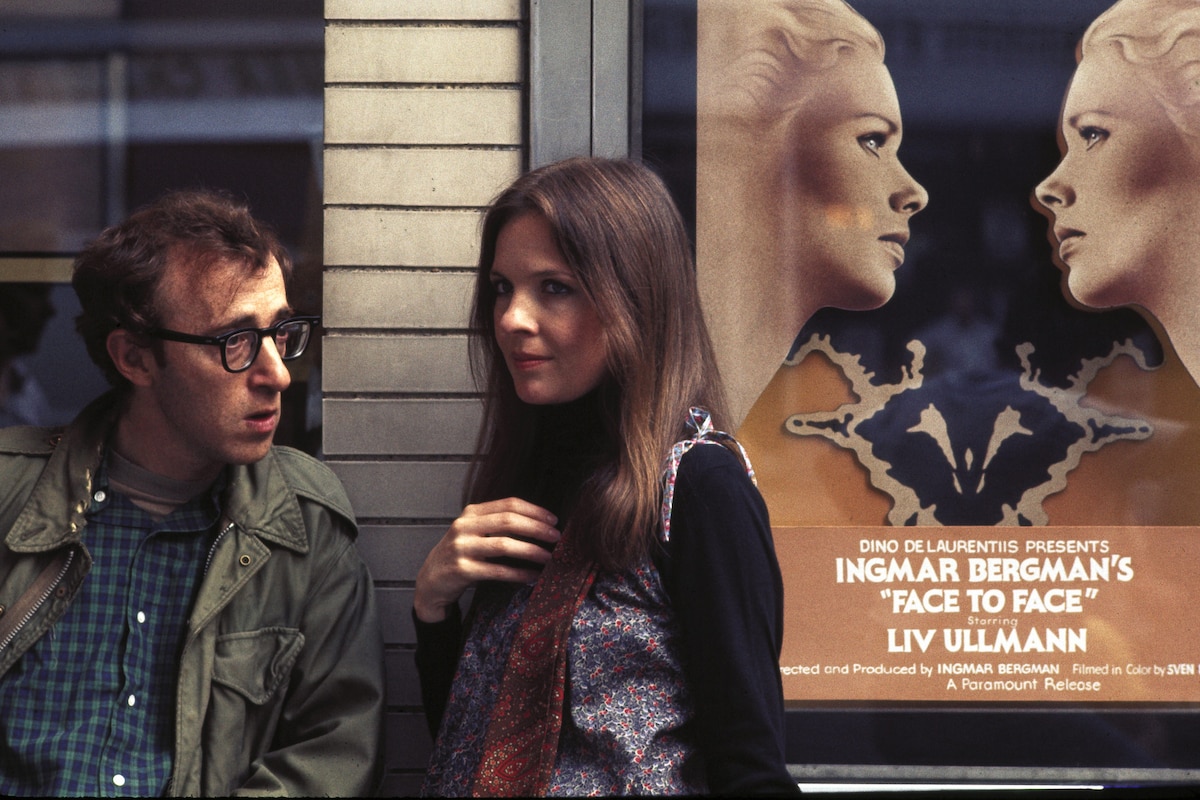
The budget for Annie Hall was $3 million when production began and slowly swelled to $4 million. The shooting schedule began at Long Island's South Fork and was kept secret from the media. Soon, Allen and his crew were filming all over New York City - Coney Island, the Upper West Side, St. Bernard's School in West Village (for Alvy's elementary school scenes), the Statler Hilton Hotel (the Adlai Stevenson rally sequence), Grand Finale on West 70th Street (the nightclub where Annie sings her songs), and the South Street Seaport Museum by the East River. There were also several scenes featuring popular New York cinemas such as the Thalia, the Beekman, The New Yorker, and the Paris. The beach scenes were shot at Amagansett, Long Island and Englewood, New Jersey was used as a stand-in for Chippewa Falls.
The first cut of Annie Hall ran 2 hours and 20 minutes and took almost six weeks to assemble, although Allen had shot enough footage to make three movies! Editor Ralph Rosenblum and his assistant Susan E. Morse were assigned the task of condensing 100,000 feet of footage to a 93-minute running time. But their first cut was severely disappointing to Allen and Brickman who quickly saw the strengths and weaknesses of their concept magnified. In fact, Brickman considered the first twenty-five minutes "a disaster." But Allen quickly stepped in to restructure and whittle down numerous sequences: The opening monologue was reduced to six minutes, sections dealing with Alvy's first and second wives (Carol Kane and Janet Margolin) were reduced to brief flashbacks, and the tennis club sequence toward the beginning of the film was placed 24 minutes into the film. Some scenes were completely eliminated like a French Resistance fantasy, a spoof on Invasion of the Body Snatchers (1956), an elaborate sports fantasy involving the Knickerbockers' and shot on location at Madison Square Garden, and a surreal takeoff on the 1946 film, Angel on My Shoulder.
For a sequence set at Coney Island, Allen once kept a crew of 200 extras hanging around for an entire morning and never found the inspiration to shoot that day.
According to author Julian Fox in his biography, Woody: Movies From Manhattan, "There were difficulties with the famous scene where Marshall McLuhan in the New Yorker lobby 'annihilates' the bore who is waiting in line to see The Sorrow and the Pity. Woody had tried to persuade several different celebrities to fill the McLuhan spot, his first choice having been Fellini. This was logical 'casting,' as it linked up with a previous dialogue but, said Woody, Fellini was unwilling to come to the United States for just this one sequence. In the event, McLuhan was not very convincing, even playing himself, and the scene was later reshot. At which point, Woody, according to one observer, 'didn't want to talk to him any more. It was very embarrassing.'"
The ending of Annie Hall also proved to be highly problematic for Allen. He wanted to end the film with the jailhouse scene where he is desperate to be reunited with Annie in Hollywood. Rosenblum urged him to reconsider and Allen eventually shot new footage for the final segment. In his biography, Woody: Movies From Manhattan, Julian Fox wrote "One sequence, where Alvy and Annie meet awkwardly outside the Thalia, again showing The Sorrow and the Pity, was, said Rosenblum, 'a real downer,' and was eventually confined to a single long shot, reducing Sigourney Weaver's cameo as Alvy's date to an imperceptible walk-on...Another sequence, shot on the last day of filming, had Alvy in Times Square wondering what to do about Annie, when he looks up at a flashing sign which reads, 'What are you doing, Alvy? Go to California. It's OK. She loves you.' Viewing the scene in dailies, Woody hated it so much he went to the nearest reservoir and threw the reels in. It was Rosenblum, prompted by Woody's chance remark on the denouement of the original murder script, who finally suggested ending the film on a continuation of Alvy's opening monologue - with a brief series of flashbacks to the Annie affair, accompanied by Alvy's final voice-over."
Behind the Camera - ANNIE HALL (1977)
by Scott McGee & Jeff Stafford | March 30, 2004
SIGN UP FOR OUR NEWSLETTERS

CONNECT WITH TCM