The Critics' Corner on REAR WINDOW
"As in Dial M for Murder [1954], Mr. Hitchcock uses color dramatically. Without any gory demonstrations, he strongly suggests the stain of blood. In the polychromes seen from a rear window on steaming hot summer days and nights, and in the jangle and lilt of neighborhood music, he hints of passions, lust, tawdriness, and hope." - Bosley Crowther, New York Times, August 1954.
"It is rare to find such a precise idea of the world in a film." - Francois Truffaut, The Films in My Life (Simon & Schuster, 1975).
"In no other Hitchcock film, perhaps not even in Notorious [1946], do the events of the adventure play such an integral part in the development of the love story." - Vincent Canby, New York Times, October 9, 1983.
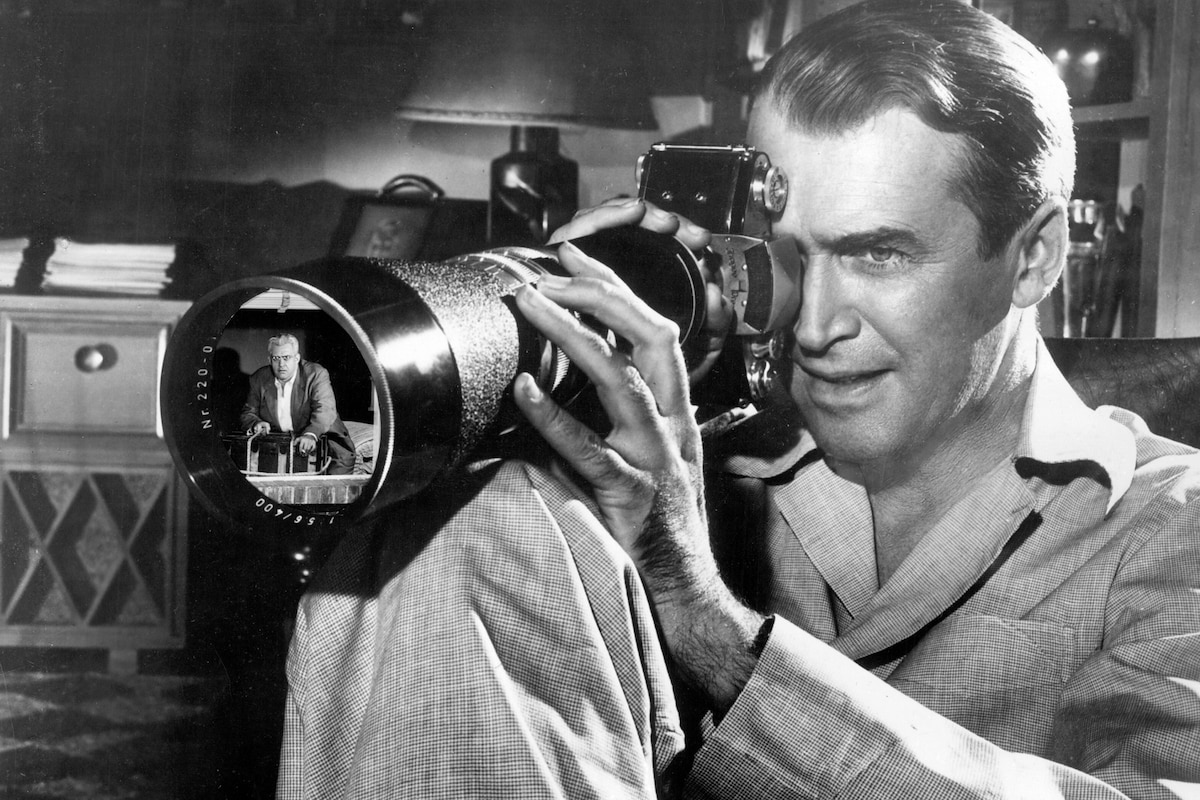
"The method of Rear Window - a voyeur in the dark inspecting other lives - is the principle of cinematic spectacle. Hitchcock's best films all grow out of his instinctive employment of our impulses and fantasy life in the cinema. And his moral seriousness consists of showing us the violent, psychotic fruits of some of those impulses and shyly asking us to claim them as our own." - David Thomson, A Biographical Dictionary of Film (Knopf, 1994).
"This level of danger and suspense is so far elevated above the cheap thrills of the modern slasher films that Rear Window, intended as entertainment in 1954, is now revealed as art." - Roger Ebert, Chicago Sun Times, February 20, 2000.
"Of all Hitchcock's films, this is the one which most reveals the man...There is suspense enough, of course, but the important thing is the way that it is filmed; the camera never strays from inside Stewart's apartment, and every shot is closely aligned with his point of view...Quite aside from the violation of intimacy, which is shocking enough, Hitchcock has nowhere else come so close to pure misanthropy, nor given us so disturbing a definition of what it is to watch the 'silent film' of other people's lives, whether across a courtyard or up on a screen." - Chris Preachment, TimeOut.
"Hitchcock often oversold Rear Window as an experience of 'delicious terror,' but it's also a subtle romantic comedy." - Wesley Morris, San Francisco Examiner, February 4, 2000.
"An undisputed masterpiece...Much has been written about this film being about how we are all Peeping Toms, and indeed we do watch his neighbors with curiosity and concern....A related and equally important theme (central to most Hitchcock films) is that even the most predictable people are capable of doing wildly unpredictable things; Burr can commit murder, the stacked blonde neighbor can fall for a shrimp who likes to eat, and Kelly, who's the type to fret over a broken fingernail, can be gallant enough to climb up a railing into a murderer's apartment." - Danny Peary, Guide For the Film Fanatic.
"Rear Window showcases another side of Hitchcock's vulgar modernism. It's a blatantly conceptual movie, self-reflexively concerned with voyeurism and movie history, the bridge from Soviet montage to Andy Warhol's vacant stare, as well as a construction founded on the 20th-century idea of the metropolis as spectacle - or, more specifically, on the peculiar mixture of isolation and overstimulation the big city affords." - J. Hoberman, Village Voice, January 19-25, 2000
Awards and Honors
Rear Window was chosen in 1997 to be one of the motion pictures preserved on the National Film Registry at the Library of Congress.
It received Academy Award® nominations for Best Director, Screenplay, Color Cinematography and Sound Recording.
Other honors included:
-British Academy Award nomination for Best Film.
-National Board of Review and New York Film Critics Circle Best Actress awards to Grace Kelly.
Edgar Allan Poe (mystery writers) Award to screenwriter John Michael Hayes.
Writers Guild of America nomination for John Michael Hayes.
Compiled by Rob Nixon & Jeff Stafford
The Critics Corner - REAR WINDOW (1954)
by Rob Nixon & Jeff Stafford | March 30, 2004
SIGN UP FOR OUR NEWSLETTERS

CONNECT WITH TCM