Behind the Camera on REAR WINDOW
By the time Rear Window went before the cameras, Hitchcock had dropped more than 150 pounds and was at perhaps the happiest stage of his life and career. "I was feeling very creative," he later told Francois Truffaut. "The batteries were well-charged."
Hitchcock briefly considered shooting on location in Greenwich Village but abandoned the idea in favor of recreating the setting on Paramount's Stage 18. To get the proper Village flavor, he sent four photographers to New York to shoot from all angles and under all weather and lighting conditions.
The picture was shot on a specially constructed set that took 50 men two months to build and cost somewhere between $75,000 and $100,000. It was 38 feet wide, 185 feet long and 40 feet high. In order to get the scale right, the soundstage floor had to be removed so the courtyard could be built in a former storage space in the basement. Therefore Stewart's apartment, which appears to be on the second floor, was actually at street level. The set included 31 apartments, of which 12 were fully furnished. The whole thing became a marvel that visitors to the studio were eager to see, and it was featured in magazine spreads while shooting was still in progress.
The set had to have four lighting set-ups always in place for various times of the day. Remote switches located in Jeff's apartment controlled the lighting. Virtually every piece of lighting that wasn't employed on another Paramount picture had to be used (by some counts 1,000 huge arc lights and 2,000 smaller ones). At one point, the lights caused the sprinkler system to go off, which shut everything down and plunged the set into total darkness. Hitchcock calmly told an assistant to bring him an umbrella and let him know when the "rain" stopped.
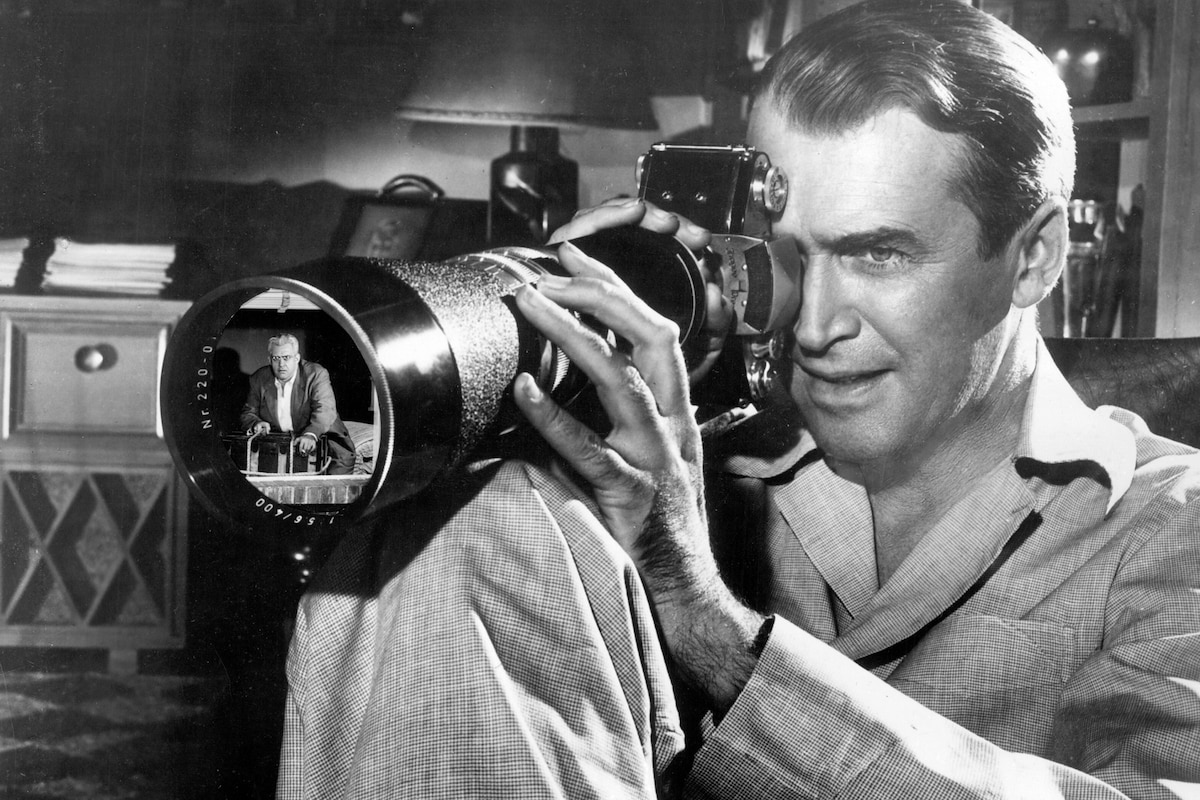
Cinematographer Robert Burks devised a system using a camera with a telephoto lens mounted on a crane to bring the camera close enough to film small details through the windows across the courtyard.
Because all but a few scenes are actually shot from inside Jeff's apartment, Hitchcock remained in that part of the set, communicating with his actors across the way via short wave radio broadcast to their flesh-colored earpieces.
The director had a bit of fun and achieved a memorable effect using the short-wave system. Giving directions in the scene where the couple with the dog are sleeping on their fire escape and get caught in the rain, he had the wife, actress Sara Berner, turn off her earpiece while he gave one set of instructions to Frank Cady, playing her husband. Then he asked Cady to turn off his earpiece and gave an opposite set of directions to Berner. When the rain started and they were supposed to grab their mattress and run inside, they each moved in separate directions, resulting in a comically bumbling bit that ended with Cady falling through the window into their apartment.
Hitchcock worked closely with Edith Head on the costume designs, being sure to give the more distant characters a very specific look, not only so audiences could always identify them but also to point up their connection to the main characters. For example, Miss Lonelyheart was given emerald green outfits to identify her, and because Lisa later appears in a green suit, Miss Lonelyheart's romantic woes are linked to the story's examination of Lisa and Jeff's problematic relationship.
Hitchcock spent a great deal of time with Head on Kelly's look, which was characteristic of his often obsessive relationship with his leading ladies. One costume he fretted over was the negligee Lisa wears to spend the night at Jeff's. He quietly pulled Head aside and suggested falsies to give Kelly a bustier look. The designer and the actress, however, made only a few changes in costume construction and posture. Hitchcock was fooled into thinking Kelly had been padded and approved the look.
Hitchcock had Raymond Burr made up in short curly white hair and glasses, costumed in white button-down shirts, and depicted as a heavy smoker - all to evoke Hitchcock's first American producer David O. Selznick, with whom he had a complex and contentious relationship.
Thelma Ritter said Hitchcock never told you if he liked what you did in a scene, and if he didn't like it, "he looked like he was going to throw up."
Hitchcock and Stewart had a friendship that was oddly intimate while being somewhat proper and distanced. They rarely socialized outside work and didn't talk much on the set but communicated in unspoken glances. Stewart said Hitchcock didn't discuss a scene with an actor but preferred to hire people who would know what was expected of them when he said "action." The most Hitchcock would say to Stewart, according to the actor, was something like, "The scene is tired," thereby communicating that the timing was off.
The director liked working with Stewart, especially in comparison to his other most frequent star, Cary Grant, who was fussy and demanding. Stewart, in Hitchcock's eyes, was an easy-going, workmanlike performer. But Wendell Corey, who appeared with Stewart in several films, said the actor also had a "whopping big ego" and could intimidate even Hitchcock by out-shouting and out-arguing him if he thought a scene wasn't going well. "There was steel under all that mush," Corey said.
By most accounts, everyone was crazy about Grace Kelly. "Everybody just sat around and waited for her to come in the morning, so we could just look at her," Stewart said. "She was kind to everybody, so considerate, just great, and so beautiful." Stewart also praised her instinctive acting ability and her "complete understanding of the way motion picture acting is carried out."
Kelly may have been a bit too beautiful and friendly, at least for the Paramount publicity department and James Stewart's wife. Known privately as a sexually free young woman, Kelly often had affairs with her leading men, including William Holden and Bing Crosby. She made everyone nervous by confessing to gossip columnists that she found Stewart one of the most masculinely attractive men she ever met.
Behind the Camera - REAR WINDOW (1954)
by Rob Nixon | March 30, 2004
SIGN UP FOR OUR NEWSLETTERS

CONNECT WITH TCM