The Big Idea Behind REAR WINDOW
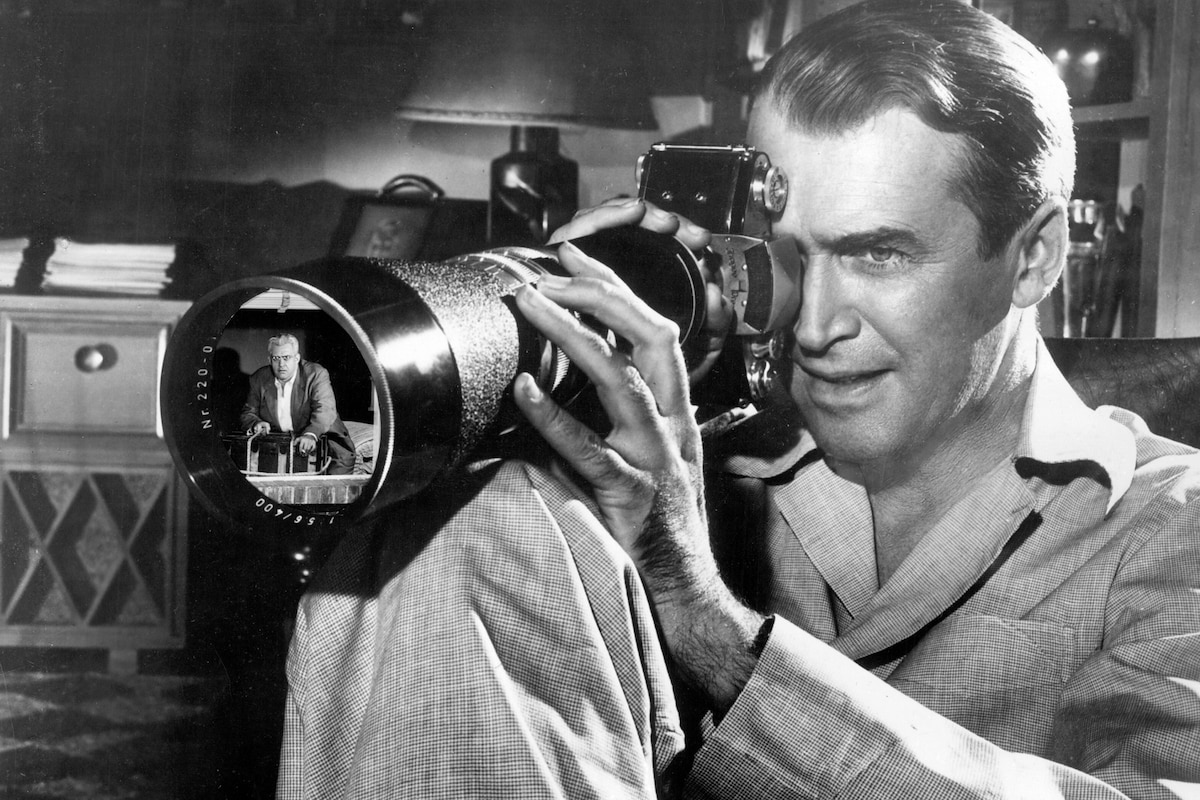
Cornell Woolrich's story "It Had to Be Murder" first appeared in Dime Detective Magazine in February 1942, credited to one of his pseudonyms, William Irish. Told in the first person, it featured a man named Jeff confined to his apartment with a broken leg who spends the day staring at his neighbors' apartments through his back window and discovers that one of them may have murdered his wife. The story gave Jeff a close friend, a police detective whose investigative help he enlists, and a black man attending to him during his incapacitation. According to Woolrich's biographer, Francis Nevins, he was inspired to write the story after being spied on in his New York apartment by two little girls.
The screen rights were optioned shortly after publication by producer Buddy DeSylva and sold after his death in 1952 to theater director Joshua Logan and producer/agent Leland Hayward. The project was to have been a "trial balloon" for Logan, a screen directorial debut before taking on the task of putting his stage hit Mr. Roberts on film.
The characters of insurance nurse Stella and Jeff's girlfriend Lisa were not in the story and the details of the other (non-murderous) neighbors were rather sketchy. Logan's first treatment added a girlfriend named Trink, an actress determined to keep her career despite Jeff's insistence she quit the business to marry him. Trink, little more than a charming bubblehead in Logan's version, gets to prove her acting mettle by venturing into murderer Thorwald's apartment and having to talk her way out.
To Logan's dismay, his agent Lew Wasserman sold the rights to the story (which had since been published in a book under the title Rear Window) right out from under his nose to Hitchcock. (Wasserman also sold Logan's stage play to John Ford.) It was then announced that Logan and Hayward would produce the Hitchcock picture for Warners with James Stewart in the lead.
Prior to this project, Hitchcock had often worked with multiple writers and relied heavily on his wife Alma Reville for script development. When she withdrew from day-to-day film work in the early 50s, he decided to trust the script of the Woolrich story to one man, John Michael Hayes, primarily a radio writer. Hitchcock was familiar with his work because Hayes had written for the radio show Suspense, which Hitchcock had helped to create.
From the beginning, Hitchcock had decided he wanted to transform Woolrich's simple mystery story into another Lifeboat (1944), in his view "a small universe" that encompassed "a real index of individual behavior." He later told Francois Truffaut that what appealed to him about the story was "the possibility of doing a purely cinematic film."
Hitchcock decided to keep the girlfriend Logan added to the story (although she would become drastically changed) and focus on the relationship between the two leads, not only on the characters but on the actors who would play them. When he first made the deal with Hayes, Hitchcock told him the roles would have to be written for James Stewart, the star of his earlier three character study, Rope (1948), and Grace Kelly, who was then working with the director on Dial M for Murder (1954).
Hitchcock told Hayes that Kelly was charming and talented but went "through the motions as if she is in acting school." He charged his writer with spending some time with the actress to "bring something out of her." Kelly enjoyed Hitchcock professionally and personally and liked the script, so she turned down the female lead in On the Waterfront (1954) to do this picture.
Hitchcock found inspiration for the actual murder in two real-life crime stories (of which he was an avid follower): the case of Patrick Mahon, who killed a girl, chopped her up, and burned her head in a fireplace; and Dr. Crippen, who murdered his wife, told people she had moved, and was tripped up when he allowed his secretary/mistress to wear some of his wife's jewelry.
Hayes claimed it was his idea to beef up the part of the sarcastic insurance nurse Stella (although Hitchcock had already cast Thelma Ritter, long known for her wisecracking character parts). Hayes said he told Hitchcock the way to unite the audience in the experience right from the start was with humor, and that's why he wrote the comic opening conversation between Stella and Jeff.
It was Hitchcock's idea to turn Lisa into a model and Jeff into a Robert Capa-style photojournalist, and he has been credited with adding and fleshing out the other neighbors missing from Woolrich's story and Logan's treatment.
Although Hayes always insisted Hitchcock left it up to him to create the scenes, his version has been disputed by both Grace Kelly and assistant director Herbert Coleman. Kelly talked about how Hitchcock described ideas for Rear Window in great detail while they were still making Dial M for Murder together. And Coleman insisted Hitchcock worked with Hayes just as he had done with others: outlining the story scene by scene, generating specific story ideas and visual instructions, with Hayes often taking dictation in these detailed initial meetings. The director laid out every detail except the dialogue, Coleman said, but would tell his writer, "Now, Mr. Hayes, the dialogue must convey this meaning."
As with many movies by great directors, it's hard to sort out who gets credit for much of the initial script work. Hitchcock rather flatly claimed Hayes was only brought in to do dialogue, as Coleman's story seems to support. By Hayes' own admission, dialogue was his "strong point, rather than construction." The truth most likely lay more in a later statement by the writer: "The stamp of Hitchcock's genius is on every frame of the finished film, but the impression that he did every bit of it alone is utter nonsense."
Regardless of who was responsible for which idea, Hitchcock and Hayes worked well together. Hayes was a fast writer who could keep up with the director's breakneck pace, and the two continued "writing by camera," according to Hayes, going over the script line by line while Hitchcock sketched out each shot on a large pad. The relationship was so pleasing to Hitchcock, he hired Hayes for three more pictures.
The initial script ran into problems with Production Code Administrator Joseph Breen, who criticized a number of elements of the story: Miss Torso's sexiness, the physical actions between Miss Lonelyheart and the pick-up she brings home, Stella's toilet humor, the incessant sex between the newlywed couple and the strong suggestion of a sexual relationship between Jeff and Lisa, especially when she announces she's spending the night with him and unveils a sexy negligee. By the time the film was ready to begin production, however, Breen was nearing retirement and his replacement, an Englishman named Geoffrey M. Shurlock, was more liberal and didn't follow through on Breen's objections.
Warner Brothers ended up not making the picture. Instead, Hitchcock signed with Paramount for what would become perhaps the most fruitful period of his American career. Stewart's company, Patron Films, partnered with Hitchcock, with the star taking a smaller salary in favor of percentages that paid off handsomely.
by Rob Nixon
The Big Idea - REAR WINDOW (1954)
by Rob Nixon | March 30, 2004
SIGN UP FOR OUR NEWSLETTERS

CONNECT WITH TCM