SYNOPSIS
Professional photographer L.B. "Jeff" Jeffries is confined to a wheelchair in his Greenwich Village apartment after an on-the-job accident, attended by Stella, an insurance nurse, and his fashion-industry girlfriend Lisa Fremont. Passing the time by looking out of his window into all the other apartments surrounding his rear courtyard, Jeff comes to believe that one of his neighbors has killed his wife, chopped up her body and disposed of it. At first, Lisa and Stella are skeptical, but eventually they get swept up in the mystery. Although Jeff has always felt his relationship with Lisa was doomed by her urban refinement and unrealistic expectations, when she puts herself in jeopardy to help him solve the crime, he begins to see her in a new light.
Producer/Director: Alfred Hitchcock
Screenplay: John Michael Hayes, based on the story "It Had to Be Murder" by Cornell Woolrich
Cinematography: Robert Burks
Editing: George Tomasini
Art Direction: Joseph MacMillan Johnson, Hal Pereira
Music: Franz Waxman, Jay Livingston
Cast: James Stewart (L.B. "Jeff" Jeffries), Grace Kelly (Lisa Fremont), Thelma Ritter (Stella), Wendell Corey (Lt. Tom Doyle), Raymond Burr (Thorwald), Judith Evelyn (Miss Lonelyheart).
C-113m. Letterboxed.
Why Rear Window is Essential
A simple plot synopsis of Rear Window cannot reveal what makes this Alfred Hitchcock film a constant delight after repeated viewings but also a serious object of study for film students and theorists. It works on so many levels: as a crowd-pleasing exercise in suspense, an insider study of the act of watching a film and a bleakly humorous love story. And, as director/film scholar Peter Bogdanovich and others have observed, it is "perhaps the best example of what Hitchcock's cinema stood for." According to the director's daughter Pat, this is "Hitchcock 101 - you have the anti-hero, the cool blonde, the humor, a grisly murder, a love story, and dialogue about food."
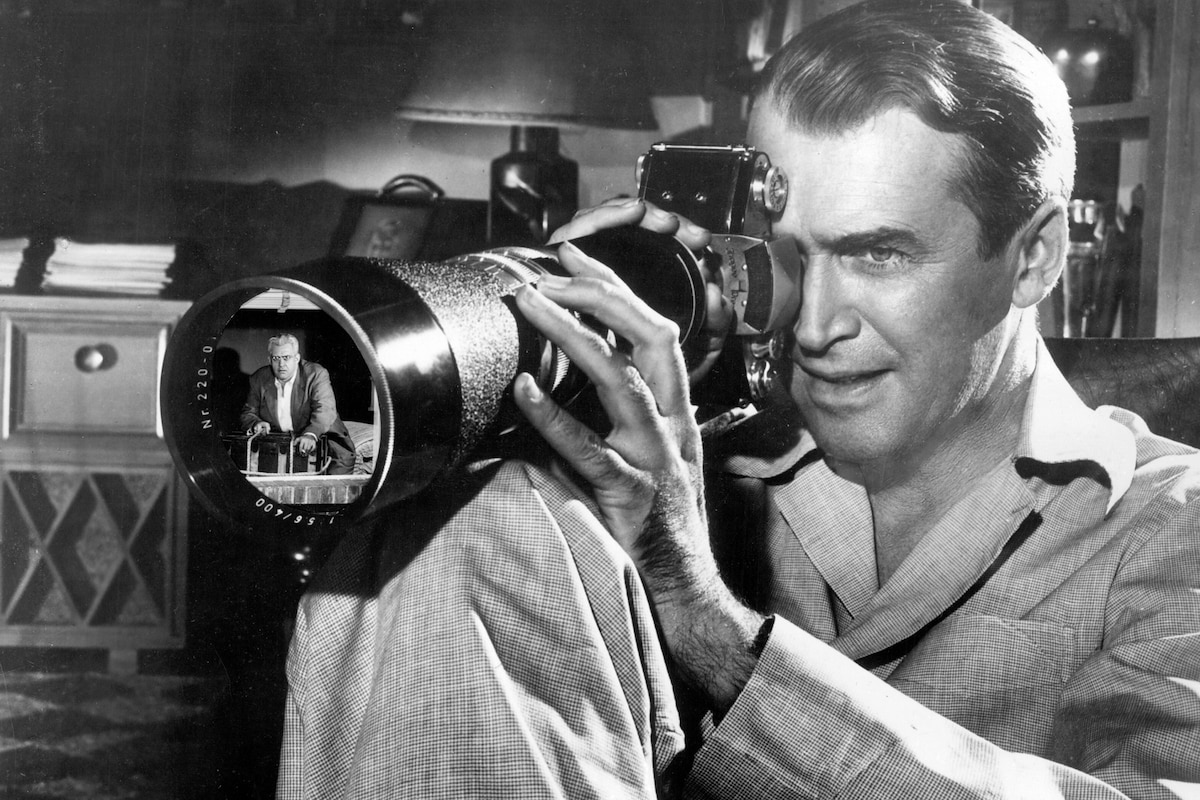
You also have Hitchcock's examination of what the act of making and viewing a movie is all about. By now, everyone is familiar with the myriad comments on how skillfully the movie puts us in the position of voyeur by filming all but a couple very brief moments from James Stewart's point of view looking out from his character's apartment. Rear Window was also Hitchcock's greatest demonstration of Kuleshov's theories of how editing effects perception. The Russian film theorist noted how you could take a shot of an actor's essentially blank face and, depending on what you intercut with it, change what the audience believes to be the emotion the actor is expressing. By showing us what Stewart sees (or thinks he sees) and cutting back to him, Hitchcock makes us complicit in his voyeurism and in his emotional responses. On the other hand, by giving us a quick glimpse of what Stewart misses, Hitchcock demonstrates his manipulation of suspense: let the audience in on a plot point the characters don't know and you get a much bigger payoff than relying on the simple and fleeting element of surprise.
By Hitchcock's own admission, Rear Window is his most fully cinematic work, and he was very pleased with the way he was able to tell so much of the story visually (as when we are introduced to James Stewart's character in a pan of his apartment that gives us all the information we need about his profession, his injury and the kind of man he is). But beyond the visual look and pace of the film, the use of sound is equally and impressively cinematic. Everything we hear on screen after the opening title sequence is diagetic, meaning there is no music or sound effect that isn't supposed to be coming from a source within the story. The sounds pop in and out of our ears, some loud and demanding our focus, others barely heard, fragments drifting by, offering not only clues to the mystery plot but amplifying and coloring the characters and their relationships. Not surprisingly, the studio sound technicians were honored with an Academy Award nomination for their work.
No one comes away from this film, however, feeling as if they've just witnessed a mere technical stunt. What makes it a great movie is the way the director's use of technique, suspense, even humor, work so strongly in the service of the human story beneath the mystery plot -- the complex, obviously sexual relationship between Jeff and Lisa, as played by Stewart and Grace Kelly. The murder in this case is more or less the MacGuffin, rather like the bottled uranium in Notorious (1946), another Hitchcock movie in which the plot is really the framework for a darkly intricate love story. All of the lives Jeff observes from his rear window have one common denominator; they all in some way reflect different aspects of love and relationships. They all have a bearing on Jeff's view of love and marriage. Even when Lisa goes into the murderer's apartment, the proof she finds of his crime is his wife's wedding ring, which she places on her finger and points to for the benefit of the watching Jeff. On one level, she's letting him know she found the vital clue; on another, she's challenging him (now that she's "proved" herself) to stop coming up with excuses and marry her.
Everyone has a different favorite Hitchcock film, but regardless of preference, just about everyone has affection and admiration for this movie. In its perfect wedding of pure cinema to a rich and enjoyable human story, Rear Window is arguably the most characteristic Hitchcock, the kind of movie that, in critic David Thomson's view, led the director to become "a way of defining film, a man exclusively intent on the moving image, and the compulsive emotions of the spectator."
by Jeremy Arnold, Rob Nixon and Jeff Stafford
The Essentials
by Jeremy Arnold | March 30, 2004
SIGN UP FOR OUR NEWSLETTERS

CONNECT WITH TCM