Enticing his brother Terry away from the California Institute of Technology in Pasadena to UCLA in West Los Angeles with promises of entre into a renaissance for American cinema, film student Denis Sanders parlayed the fraternal partnership into his Master's thesis, A Time Out of War (1954). Based on Robert W. Chamber's 1896 short story "The Pickets," the $2,700 venture became the first student film to win an Oscar when it was named the Best Short Subject (Two-Reel) at the 1955 Academy Awards. The film was honored at the Venice Film Festival that year, prompting actor-turned-director Charles Laughton to hire both brothers for his The Night of the Hunter (1955), with Terry placed in charge of the second unit and Denis acting as dialogue director and uncredited rewrite man. The brothers were put to work again by Laughton, adapting Norman Mailer's The Naked and the Dead (1958) as a feature film for RKO, albeit one ultimately released by Warner Brothers and directed by Raoul Walsh, who rewrote much of the 620-page Laughton-Sanders draft. The brothers' next collaboration was another adaptation, this time of Fyodor Dostoyevsky's classic novel Crime and Punishment.
First serialized in twelve parts in the prestigious literary journal The Russian Messenger in 1866, Crime and Punishment was published in its entirety the following year. The book met with critical success and was translated into English in 1885, just prior to the dawn of motion picture-making. The property was first adapted for cinema in 1913, in pre-Soviet Russia, and was reworked for American moviegoers in 1917. Trading the opulence of Paramount for the limited means of Columbia Pictures, Viennese auteur Josef von Sternberg had a go at the material in 1935, with German émigré Peter Lorre playing Dostoyevsky's student antihero Raskolnikov not too many degrees separated from his iconic turn as the child-killer of Fritz Lang's M (1931). There were subsequent adaptations produced in Germany, France, and Mexico, but Crime and Punishment USA (1959) marked only the second sound film made in English from the Dostoyevsky novel. With Denis signed to direct and Terry acting as producer, the Allied Artists release got under way with an adaptation by radio writer turned Hollywood scenarist Walter Newman. Newman had pitched the concept of Ace in the Hole (1951) to Billy Wilder and also contributed to the script for Otto Preminger's The Man with the Golden Arm (1955).
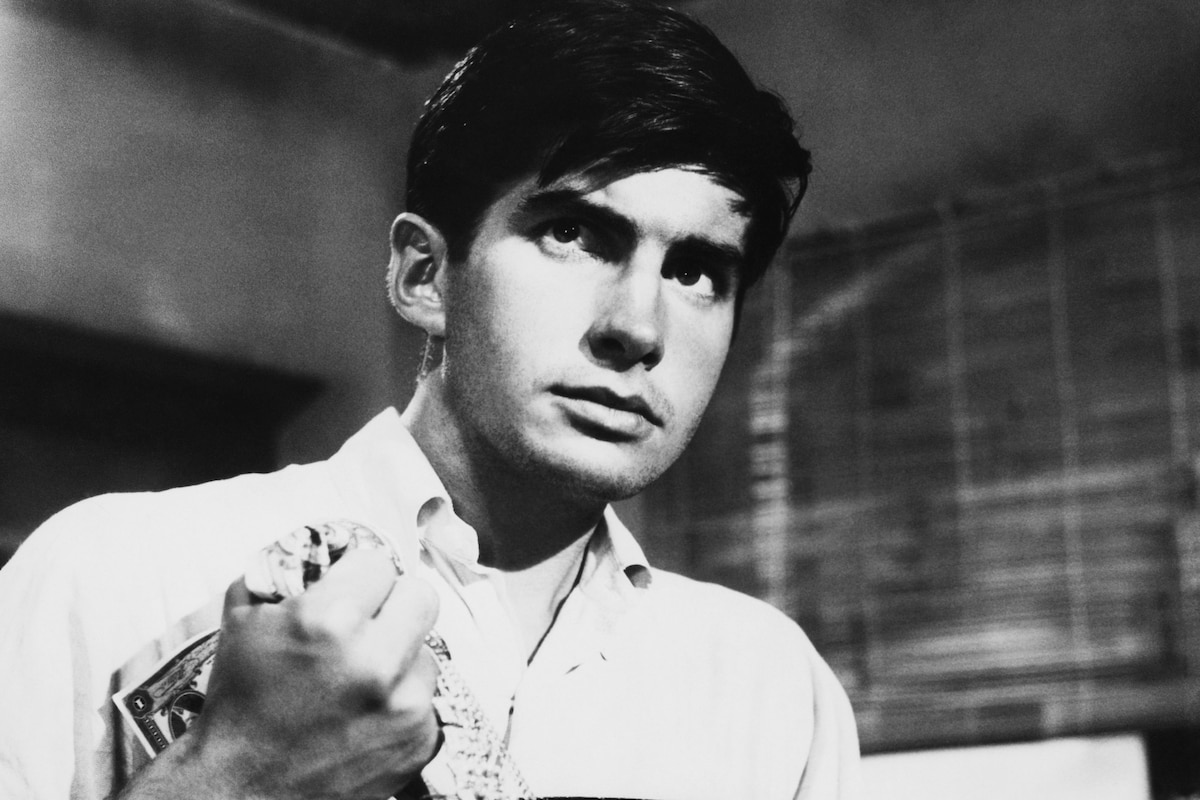
Whereas Peter Lorre had played Raskolnikov as a popeyed paranoiac, the Sanders brothers were instead offered an almost impossibly handsome young actor to play the part, a 19 year-old touted in certain Hollywood circles as the next John Barrymore. Though Denis Sanders would have preferred Anthony Perkins (a year before Perkins was cast by Alfred Hitchcock as Norman Bates in Psycho, 1960), he was obliged to settle for George Hamilton. Namesake son of Biltmore Hotel bandleader George "Spike" Hamilton, the Memphis-born actor manqué had spent some formative years in Beverly Hills (where he acted for the first time at the tony Hawthorn School on Rexford Drive) until a reversal in family fortunes drove the family back to the Deep South. Hamilton had returned to Hollywood on his own initiative and secured an agent in Hy Sieger, a junior associate at the Mitchell Gertz Agency. It was Sieger who set Hamilton up with his feature film debut in Crime and Punishment USA, for a promised fee of five hundred dollars. Also brought on board were Mary Murphy (Marlon Brando's waitress girlfriend in The Wild One [1953], cast as Hamilton's love interest), character actor Frank Silvera (as the police detective shadowing Hamilton's intellectual first-time killer), and Marian Seldes, reprising a role she had played on Broadway opposite John Gielgud in 1949, that of the protagonist's sister (with a name change from Dounia to Debbie).
Production of Crime and Punishment USA began in June 1958, with exteriors captured verité-style in and around Venice Beach (where Orson Welles had just shot Touch of Evil, 1958) and interiors at Centaur Studios. The Sanders also made use of the Santa Monica Pier and the then-famous Pacific Ocean Park, a nautical-themed rival to Disneyland that opened in July of that year. (Nearly a decade later, P.O.P. was the backdrop for the final episode of TV's long-running The Fugitive, where David Janssen's wrongly-accused protagonist came face to face with his wife's killer.) Credited separately as director and producer, Denis and Terry Sanders worked as co-directors (similar to the contemporary Coen Brothers) and attempted to fold their adaptation of Crime and Punishment into the emerging Beat Generation. (Jack Kerouac's seminal Beat novel, On the Road, had been in print less than a year.) John Parker's experimental horror film Dementia (aka, Daughter of Horror, 1955) had already squeezed the Venice location for its weight in existential dread, while the community would serve as the setting for such subsequent films as Roger Corman's A Bucket of Blood (1959), George Blair's The Hypnotic Eye (1960) and Curtis Harrington's Night Tide (1961).
Though production went smoothly through the summer of 1958 (apart from George Hamilton's near-thrashing at the hands of Mary Murphy's jealous lover, married talent agent Kurt Frings, who had caught the actors rehearsing behind closed doors and assumed the worst), the star of Crime and Punishment USA received no further offers of work. Hamilton ultimately resorted to bribing a contact at Screen Gems Television with a bottle of Jack Daniels to get him a guest part on The Adventures of Rin Tin Tin. Further TV work followed until a plum role in Vincente Minnelli's Home from the Hill (1960) opposite Robert Mitchum set Hamilton's career in motion. Denis and Terry Sanders went on to make War Hunt (1962), which provided early feature film credits to fledgling actors Robert Redford and Sydney Pollack, before splitting up the partnership; Denis would share a 1970 Academy Award with Robert M. Fresco for the documentary Czechoslovakia 1918-1968 (1969) while Terry would go on to a distinguished career as a producer, and win his own Oscar (shared with wife and partner Freida Lee Mock) for the documentary Maya Lin: A Strong Clear Vision (1994). Screenwriter Walter Newman collaborated with Frank Pierson on the script for Elliot Silverstein's Cat Ballou (1965), resulting in an Academy Award nomination for Best Screenplay.
By Richard Harland Smith
Sources:
Don't Mind If I Do by George Hamilton and William Stadiem (Touchstone, 2008)
Heaven and Hell to Play With: The Filming of Night of the Hunter by Preston Neal Jones (Limelight Editions, 2004)
Some Like It Hot: The Life and Controversial Films of Billy Wilder by Gene D. Phillips (The University Press of Kentucky, 2009)
On Sunset Boulevard: The Life and Times of Billy Wilder by Ed Sikov (Hyperion Press, 1999)
Robert Redford: The Biography by Michael Feeney Callan (Alfred A. Knopf, 2011)
Raoul Walsh: The True Adventures of Hollywood's Legendary Director by Marilyn Ann Moss (The University of Kentucky Press, 2013)
Otto Preminger: The Man Who Would be King by Preston Hirsch (Alfred A. Knopf, 2007)
"A Tale of Two Brothers: Oscar-winning student film added to the National Registry" Point of View Magazine (Spring 2007)
Crime and Punishment, U.S.A. (1959)
by Richard Harland Smith | October 03, 2013
SIGN UP FOR OUR NEWSLETTERS

CONNECT WITH TCM