Joan Crawford's screen status had begun to decline in the late '40s, when
Jack Warner decided to make lightning strike twice by re-teaming her with
the director, producer and leading man of her Oscar®-winning hit
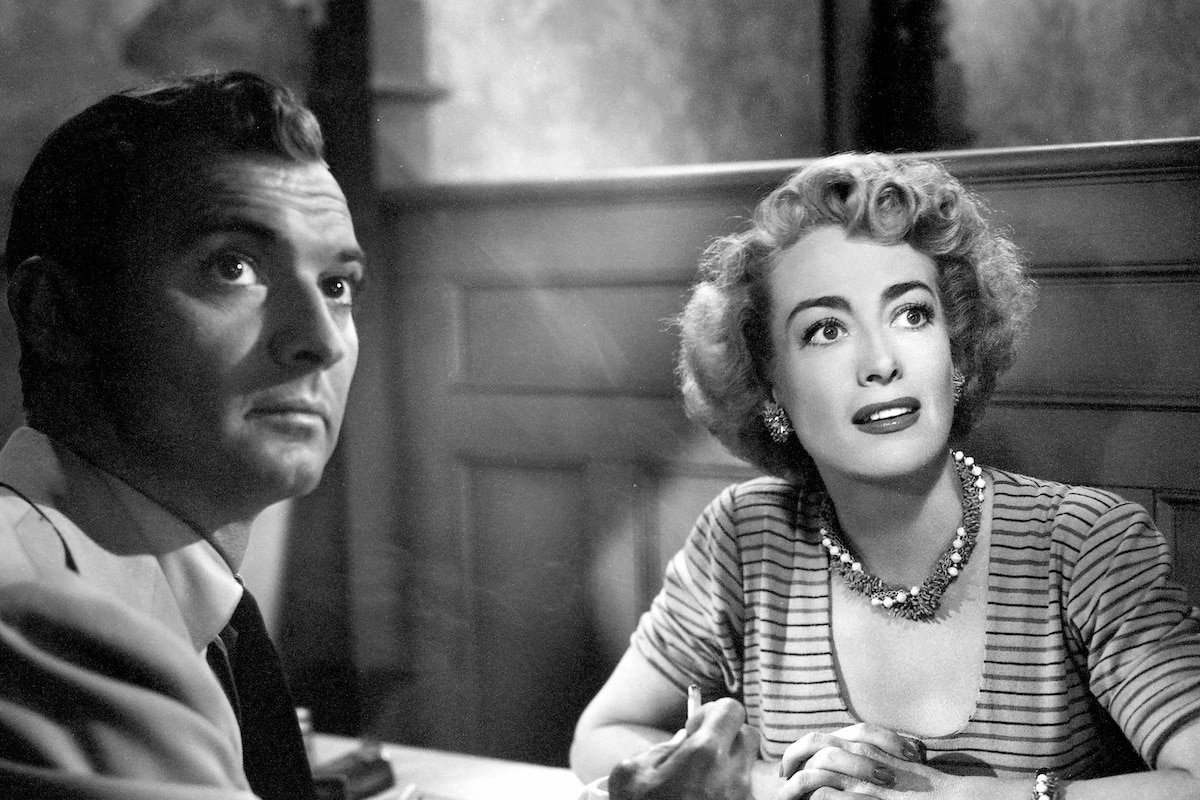
Mildred Pierce (1945). Although Flamingo Road (1949) was hardly the
comeback the earlier film had been -- still ranked as one of the greatest
in film history -- it helped Crawford bounce back and maintain her hold on
the box office for a few more years.
In truth, Flamingo Road brought back the formula that had stood
Crawford in good stead since the early days of talking films. In what is
basically a rags-to-riches tale, she stars as a carnival dancer marooned in
a small Southern town. It's love at first sight when she meets sheriff's
deputy Zachary Scott, a young man with political ambitions, but hate at
first sight when she meets his boss, corrupt sheriff Sydney Greenstreet.
When Greenstreet keeps her from finding work in town, she signs on to sing
at a juke joint just outside his jurisdiction. There, she attracts the
attention of local political boss David Brian, whom she marries for prestige and power - and to take revenge on Greenstreet.
Mildred Pierce, in which she rose from impoverished housewife to
business magnate, had put her back on top after being labeled box office
poison. But her subsequent films, though quite well made, had broken the
formula. Although each turned a small profit, Humoresque (1946), in
which she gives arguably her best performance, and Possessed (1947),
which brought her another Oscar® nomination, had been less successful
than Mildred Pierce. Concerned that he had an aging star of limited
appeal on his hands, studio head Jack L. Warner instructed his minions to
keep an eye out for any sign of temperament he could use as an excuse to
cancel her contract.
At the time, the failed stage play Flamingo Road was floating around
the studio. Director Vincent Sherman (who had an affair with Crawford) turned it down, preferring to deal
with Errol Flynn's ego on Adventures of Don Juan (1948).
Meanwhile, director Michael Curtiz was looking for another project. To
keep him from jumping ship and accepting an invitation to join fellow
directors Frank Capra, George Stevens and William Wyler in the newly formed
Liberty Pictures, Warner had offered him his own production unit.
Curtiz's major accomplishment as a producer had been the discovery of Doris
Day, whom he had signed to a personal contract and introduced to the screen
in Romance on the High Seas (1948). With Flamingo Road, he
had a chance to return to the feminist film noir he had helped create with
Mildred Pierce and prove that Crawford was still a viable star.
Helping tremendously was the supporting cast. Zachary Scott, who had
excelled as the oily society charmer who woos then betrays Crawford in
Mildred Pierce, got a role closer to his Southern roots as the
small-town sheriff plagued by insecurities. And Sydney Greenstreet, an
accomplished Shakespearean actor on stage, brought his authority and
impressive girth to the role of the evil sheriff. Many critics think it
almost matched his work as Kasper Gutman in The Maltese Falcon
(1941), one of the screen's greatest villainous performances.
With lots of moody, dark shadows, a tried-and-true rags-to-riches story and
plenty of the Crawford pizzazz (she even showed her still attractive legs
in the early carnival scenes), Flamingo Road was a box office success and guaranteed her a few more years at Warners. The
film's soap opera elements made it a natural for television during the
height of the prime-time soap opera. A new version of Flamingo Road
debuted on NBC in 1980, first as a TV movie, then as a weekly series.
Cristina Raines took over Crawford's role, with Mark Harmon as the deputy
and Howard Duff as the sheriff. Crawford's original role was far
overshadowed, however, when a supporting character not even in the original
film generated more buzz, making Morgan Fairchild, as the tempestuous
Southern belle who steals Harmon from Raines, the series' true star. It
was the kind of performance Crawford herself would have given in her
prime.
Director: Michael Curtiz
Producer: Michael Curtiz, Jerry Wald
Screenplay: Robert Wilder, Edmund H. North
Based on the play by Wilder and Sally Wilder
Cinematography: Ted D. McCord
Art Direction: Leo K. Kuter
Music: Max Steiner
Principal Cast: Joan Crawford (Lane Bellamy), Zachary Scott (Fielding
Carlisle), Sydney Greenstreet (Sheriff Titus Semple), David Brian (Dan
Reynolds), Gladys George (Lute Mae Sanders), Virginia Huston (Annabelle
Weldon), Fred Clark (Doc Waterson), Gertrude Michael (Millie), Iris Adrian
(Women's Prison Inmate), Dale Robertson (Tunis Simms).
BW-94m. Closed captioning.
by Frank Miller
Flamingo Road
by Frank Miller | February 24, 2004
SIGN UP FOR OUR NEWSLETTERS

CONNECT WITH TCM