The Shopworn Angel really shouldn't have worked. This 1938 remake
of an earlier hit from before the days of Production Code enforcement was
so cleaned up critics who remembered the 1928 original considered it a
major letdown. The leading lady for whom MGM had bought the rights was
dead. The star they finally got (after lots of re-casting) was hardly a
mass audience favorite. The director had just given independent producer
Sam Goldwyn one of his biggest flops. And yet it all came together, thanks
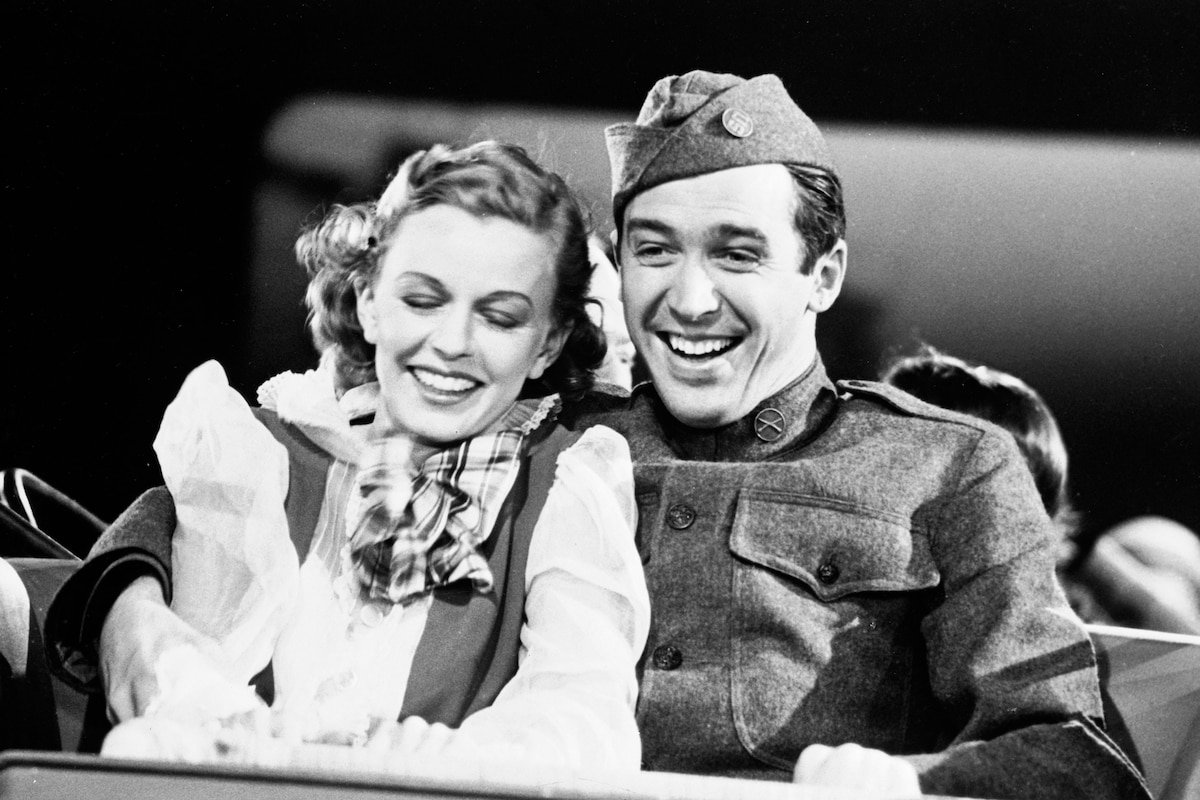
primarily to the on-screen chemistry generated by co-stars Margaret
Sullavan and James Stewart. In fact, the film helped make Stewart a star
and clearly established the screen persona that would dominate the rest of
his career.
Dana Burnet's 1918 story "Private Pettigrew's Girl" told the slim tale of a
GI on his way to World War I who falls for a Broadway chorus girl who, out
of pity, marries him. She even gets her gangster lover to go along with
the ruse so that Private Pettigrew can go off to almost certain death with
a smile. It had first been filmed, using the story's title, in 1919. Then
in 1928, Paramount re-made it with Nancy Carroll as the chorus girl, Gary
Cooper as the GI and Paul Lukas as her gangster lover. The film was a huge
success, winning Carroll an Oscar® nomination and establishing Cooper
and Lukas as leading men.
The 1928 film was still fondly remembered when MGM bought the rights in the
mid-'30s, hoping to turn it into a vehicle for their resident blonde
bombshell, Jean Harlow. Her death in 1937 required some frantic recasting.
First Joan Crawford and one-time bit player Dennis O'Keefe were announced
for the leads. But executives decided they had other things for Crawford
to do and assigned the starring role to Rosalind Russell. When the studio
decided they needed a strong leading lady for their British production
The Citadel (1938), however, she was shipped off to England, and the
role went to Margaret Sullavan, who had just signed a short-term contract
with MGM. Melvyn Douglas was originally announced as her true love, but
the role went to Walter Pidgeon instead. And relatively new screen actor
James Stewart won the role of the naive soldier. Similar shuffling went on
with the directing assignment, as the project passed from Richard Thorpe to
Julien Duvivier and finally Goldwyn contract director H.C. Potter, who had
just completed The Goldwyn Follies (1938).
Meanwhile, screenwriter Waldo Salt, another relative newcomer, was trying
to get the story past the Production Code censors. To do so, he had to
remove most of the leading lady's hard edge, in the process transforming
her from chorus girl to musical star (Sullavan would be greatly helped in
creating this illusion by the vocals dubbed by future Broadway legend Mary
Martin). Her gangster lover became a producer with an unconsummated
romantic interest in her, and Salt had to make it clear that the
Sullavan-Stewart relationship remained just as pure.
But for all these problems, the studio scored a big bonus by pairing
Sullavan and Stewart on screen. The two were old friends, having worked
together in The University Players, a summer theatre including such other
future greats as Henry Fonda and director Josh Logan. Sullavan had been
one of their leading ladies when Stewart started work there as an usher in
the summer of 1932. He quickly moved up to bits and featured roles, which
won him his first Broadway shot later that year, convincing him to continue
with acting. By the time Stewart moved to Hollywood in 1935, Sullavan was
already established there as a star. She even used her position to foster
his career, requesting him as leading man for the romance Next Time We
Love (1936) at Universal. The film would turn him into a leading man,
though his home studio, MGM, still wasn't entirely sure what to do with
him. The Shopworn Angel would show them just that, as he turned in
a simple, natural performance as the stammering, all-American
doughboy.
The Shopworn Angel was a box office success, although it received only mixed reviews from the critics. It also led to two more teamings for Stewart and
Sullavan, the anti-Nazi drama The Mortal Storm (1940) and their best
film together, the gentle romantic comedy The Shop Around the Corner
(1940). Although they only made four films together, their rapport has
made them a particular favorite among connoisseurs of screen acting. Their
teamwork may have indicated more than just friendship, at least on
Stewart's part. Some biographers have claimed he carried a torch for
Sullavan for almost two decades, using that to explain the fact that he
never married until 1949. And when he did wed, few could miss the
resemblance between his wife, former model Gloria Hatrick McLean, and
Sullavan.
Producer: Joseph L. Mankiewicz
Director: H.C. Potter
Screenplay: Waldo Salt
Based on the story "Private Pettigrew's Girl" by Dana Burnet
Cinematography: Joseph Ruttenberg
Art Direction: Cedric Gibbons, Joseph C. Wright
Music: Edward Ward
Principal Cast: Margaret Sullavan (Daisy Heath), James Stewart (Bill
Pettigrew), Walter Pidgeon (Sam Bailey), Nat Pendleton (Dice), Alan Curtis
(Guy with Thin Lips), Sam Levene (Guy with Leer), Hattie McDaniel (Martha
the Maid), Charley Grapewin (Wilson the Caretaker), Virginia Grey (Chorus
Girl).
BW-86m. Closed captioning.
by Frank Miller
The Shopworn Angel
by Frank Miller | February 24, 2004
SIGN UP FOR OUR NEWSLETTERS

CONNECT WITH TCM