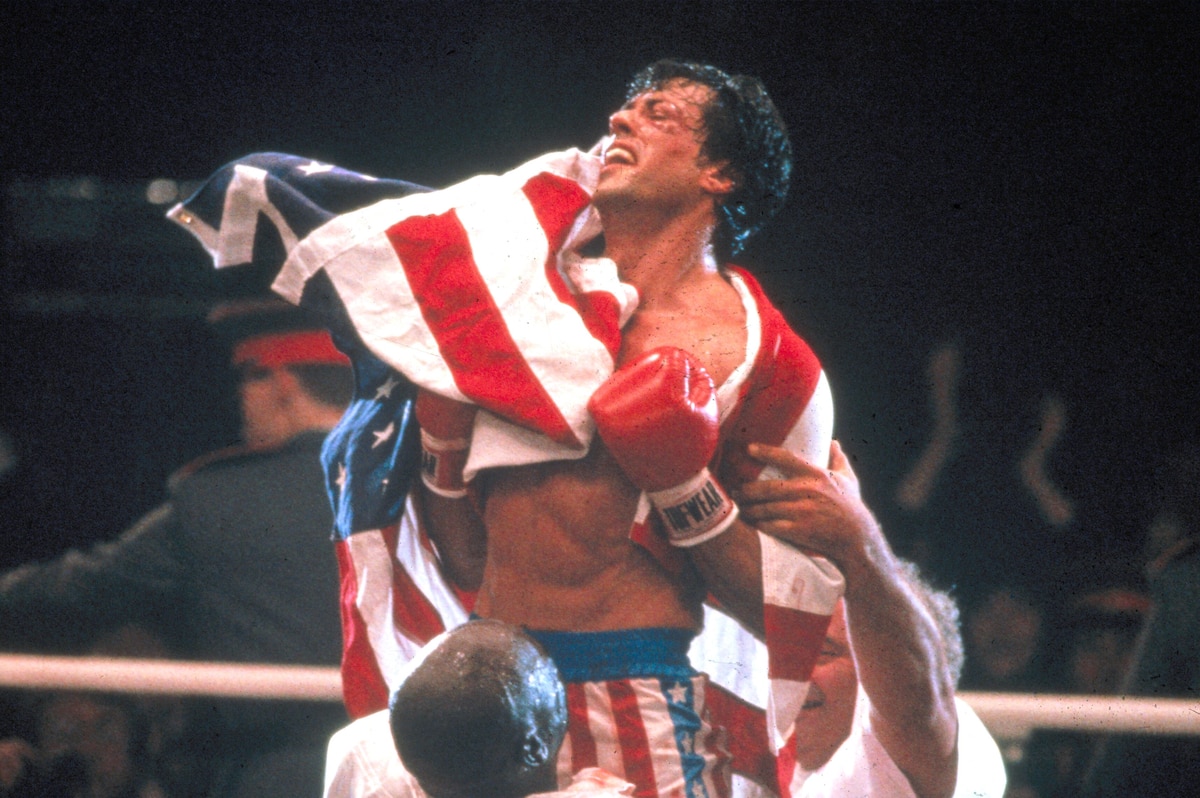
By the mid-'80s, Sylvester Stallone's career-making project Rocky (1976) was no longer merely a small-budget effort that walked away with the Best Picture Oscar, but the launching point of a profitable franchise. Audiences returned again and again to see the pug from Philly triumph against impossible odds, even as the formula became more transparent with every sequel. For Rocky Balboa's fourth entry into the ring, writer-director-star Stallone needed to up the stakes with an opponent more formidable than even Mr. T, and he'd settle for no less than a battle between the American Way and that 'evil empire' behind the Berlin Wall as the backdrop for Rocky IV (1985).
The narrative picks up with the Balboa clan living a life of quiet prosperity since Rocky regained his championship belt; onetime nemesis Apollo Creed (Carl Weathers) is now a part of Rocky's inner circle, sparring with the champ to keep him sharp. There are few credible challengers to his title, although one starts to pique the global community's interest. The Soviet Union has been trumpeting an amateur boxer, a sculpted 6'6" brute named Ivan Drago (Dolph Lundgren), as the end product of the nation's cutting-edge fitness science, and the true champion of the world. While the American boxing community is dismissive, Creed wants the opportunity to make a point, and an exhibition bout in Las Vegas is arranged.
The gaudy spectacle of the match goes horribly wrong. Prepared to wear Drago down by sticking and moving, Apollo is instead brutally pummeled by the impervious giant. The fight is stopped, but Creed dies as a result of the beating. Doing what he has to do, Rocky agrees to an unsanctioned confrontation with Drago in Moscow to be held on Christmas Day. The champ opts to perform his training on enemy soil, working out at a barren Russian farmhouse. His Spartan, low-tech regimen--lifting boulders, dragging sledges, running up the Steppes in lieu of the Art Museum steps--is juxtaposed with Drago's extensively calibrated (and apparently chemically-enhanced) preparations. At zero hour, in front of a capacity crowd of hostile Muscovites, the Italian Stallion is ready to lock up, and let the best man--and ideology--win.
Is the outcome ever really in doubt? Of course not. At a tidy 90 minutes, which included not one but two montages from the prior three films, Rocky IV is patently the work of a director with a story to tell and with only so many different ways to tell it. No matter how savage a pounding Rocky took at the hands of Drago, it was nothing compared to the one that was forthcoming from the critics. "[E]ach succeeding movie has become bigger, emptier, more preposterous. Noisier, too," wrote Sheila Benson of the Los Angeles Times. "Stallone has become a maniacally obvious pop demagogue--a cartoon master so manipulative that the whole audience can join in the joke of how dumb his films are," stated New York's David Denby.
The jingoism might have been all too obvious, and out in the real world, as Rocky IV was being prepped for release, the Geneva Summit between the superpowers had brought U.S./Soviet tensions to their lowest ebb in generations. Still, Stallone showed that while he had savvy at punching his cinematic ring opponents, he was even better at punching the buttons of the mass audience. Rocky IV pulled in big box-office receipts during the 1985 holiday season. "[T]here's only one proper way to experience this," wrote Newsday's Mike McGrady, "and that with a full house of screaming, whistling, applauding fans who aren't inclined to be what you'd call overly critical."
In the well-educated onetime bouncer/bodyguard/kickboxing champion Lundgren, Stallone found a fearsome and wholly credible Goliath for his parable. Over the years since, Lundgren has taken the cachet he gained from the role and parlayed it into a long string of leads in B-level actioners. Cast as Drago's Olympian wife and mouthpiece was Brigitte Nielsen, the six-foot Swedish model who was then the woman of the moment in Stallone's life. "She has heart, humor, beauty, athletic prowess, maternal instincts," Stallone told Rolling Stone from the set in 1985. "And she's classically true to her man--I mean, really dedicated to the maintaining and prolonging of this relationship. There's a permanency about it." For what it's worth, the couple wound up divorcing in 1987.
Producer: James D. Brubaker, Robert Chartoff, Arthur Chobanian, Irwin Winkler
Director: Sylvester Stallone
Screenplay: Sylvester Stallone
Cinematography: Bill Butler
Film Editing: John W. Wheeler, Don Zimmerman
Art Direction: Bill Kenney
Music: Bill Conti, Vince DiCola, John Cafferty, Richard Drummie, Jim Peterik, Frankie Sullivan
Cast: Sylvester Stallone (Rocky Balboa), Talia Shire (Adrian Balboa), Burt Young (Paulie), Carl Weathers (Apollo Creed), Brigitte Nielsen (Ludmilla), Dolph Lundgren (Drago).
C-91m. Letterboxed.
by Jay S. Steinberg
Rocky IV
by Jay S. Steinberg | February 27, 2004
SIGN UP FOR OUR NEWSLETTERS

CONNECT WITH TCM