The composer biography was a Hollywood staple when MGM took on the life of
songwriters Bert Kalmar and Harry Ruby for Three Little Words (1950). And for once, the studio actually got it right.
The genre had been pioneered by Warner Bros., who had scored hits with
Rhapsody in Blue, with Robert Alda as George Gershwin, in 1945 and
Night and Day, with Cary Grant as Cole Porter, in 1946. Since then,
however, the genre had performed spottily at the box office. MGM had
scored a hit with Robert Walker as Jerome Kern in Till the Clouds Roll
By (1946) but had fared less successfully with Tom Drake and Mickey
Rooney as Rodgers and Hart in Words and Music (1948). One problem
was that most songwriters hadn't led very interesting lives or had done
things Hollywood didn't deem appropriate for the movies (no Hollywood film
of the period would have dealt with Porter or Hart's homosexuality).
Another was that the films' stars rarely had the musical chops to carry a
musical, leading to tacked-on assemblages of guest stars who often stole
the movie for one number.
With Three Little Words, those problems didn't exist. For once, the
film's subjects had an interesting problem that translated easily to film
-- they never really got along. Both had interests outside of songwriting
-- Kalmar was a magician and wannabe playwright; Ruby dreamed of playing
ball -- that ultimately came between them. With that hint of a story and
the promise that Ruby, the team's surviving member, would share his stories
with writer George Wells, producer Jack Cummings managed to convince Louis
B. Mayer that this was one film that couldn't fail.
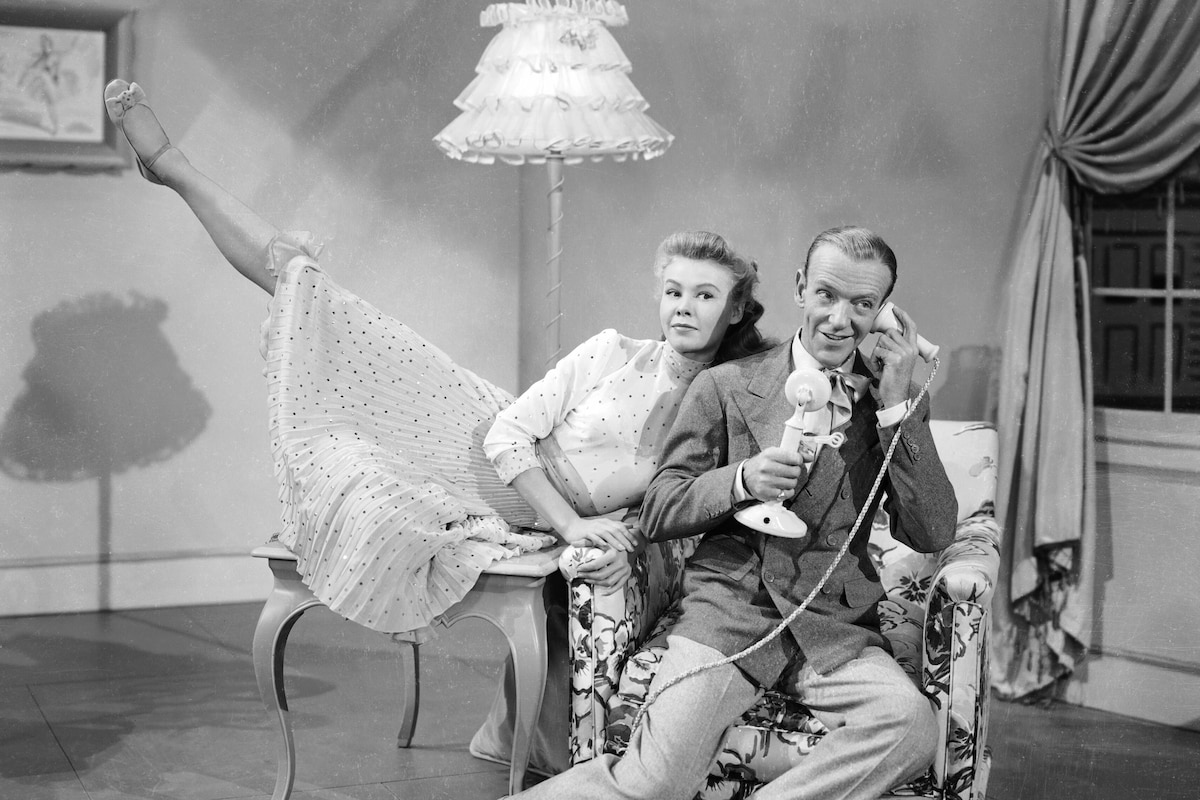
Just to insure the picture's success, he also landed three stars who could hold their own musically. Fred Astaire was committed to co-star with
Betty Hutton at Paramount, but the film wouldn't be ready to shoot for six
months. When Cummings sent him the script, he decided it was worth giving
up the long vacation he had planned. Helping him agree to the project was
the fact that he had known Kalmar and Ruby from his Broadway days. He and
his sister, Adele Astaire, had even modeled part of the act that made him a
star on Kalmar's vaudeville act with his future wife, Jessie Brown. To
play Brown, Cummings enlisted another dancing star, Vera-Ellen, who had
recently scored a hit in MGM's version of On the Town (1949). For
Ruby, Cummings went after an actor who actually resembled the composer, Red
Skelton. Then he had to convince Skelton to take a script that didn't
allow for his usual frantic comic business. Fortunately, Skelton's wife,
Georgia, saw the wisdom of his trying a change-of-pace role and helped
Cummings sell him on the project. The film still featured some guest stars
-- most notably Gloria DeHaven, who played her own mother, who had
introduced "Who's Sorry Now?" -- but most of the musical numbers were
carried by Astaire, Vera-Ellen and Skelton.
Three Little Words also provided a boon for two relative newcomers
to the screen. Composer Andre Previn had been doing orchestrations for MGM
since before he graduated from high school. Now, he had his first opportunity
to score a major film. The fact that it was a Fred Astaire musical added
to the assignment's prestige. Previn forged an instant bond with Ruby, who
shared his passion for rare books, and was impressed with Astaire's ability
to deliver a song. Previn was still young enough to be as much a fan as a
filmmaker and eventually asked Astaire for an autograph. The star turned
him down, claiming he never signed autographs, but when the film was
finished he sent Previn one of the black canes he'd used in the film. He'd
even scraped away some of the paint and signed the exposed wood. Another
bonus Previn got from the film was his first Oscar® nomination. By the
time the nominations were announced, he had been drafted. In fact, he was
digging a latrine when he was called to Orderly Room to receive the
telegram notifying him of the honor. Although he would be nominated for 14
Oscar®, winning four times, this was the only instance in which he
could remember exactly what he was doing when he learned of his
nomination.
Also given a big boost from the film was Debbie Reynolds. She was under
contract at Warner Bros. but was clearly on her way out after playing only
three short roles in six months. Then the studio talent scout who had
discovered her took her to MGM to show off her ability to impersonate
singers while miming to their recordings. She was cast on the spot to play
Helen Kane, who had introduced Kalmar and Ruby's "I Want to Be Loved by
You" and would perform the number on the soundtrack. Reynolds only had two
scenes. In one Kalmar and Ruby discover her when she interrupts their work
on the song by interjecting "boop-boop-a-doop" after each line. Then she
performs the song on Broadway while vamping another screen newcomer,
Carleton Carpenter. The first scene was a total fiction. Kane was already
a Broadway star when the song was added to the score of a show she was
working on. She hated the song and had interjected her famous
"boop-boop-a-doop"'s during performances to spoof it, only to see it become
her biggest hit. But the fiction paid off for Reynolds. By the time her
fan mail started coming in, MGM had signed her to a contract and cast her,
along with Carpenter, in a flashier role in Two Weeks With Love
(1950).
Producer: Jack Cummings
Director: Richard Thorpe
Screenplay: George Wells
Based on the lives and songs of Bert Kalmar and Harry Ruby
Cinematography: Harry Jackson
Art Direction: Cedric Gibbons, Urie McCleary
Music: Andre Previn
Principal Cast: Fred Astaire (Bert Kalmar), Red Skelton (Harry Ruby),
Vera-Ellen (Jessie Brown Kalmar), Arlene Dahl (Eileen Percy), Keenan Wynn
(Charlie Kope), Gale Robbins (Terry Lordel), Gloria DeHaven (Mrs. Carter
DeHaven), Phil Regan (Himself), Debbie Reynolds (Helen Kane), Carleton
Carpenter (Dan Healy), Harry Mendoza (Mendoza the Great), Billy Gray (Boy),
Helen Kane (Singing Voice of Debbie Reynolds), Anita Ellis (Singing Voice
of Vera-Ellen), Harry Ruby (Ballplayer).
C-103m. Closed captioning.
by Frank Miller
Three Little Words
by Frank Miller | February 26, 2004
SIGN UP FOR OUR NEWSLETTERS

CONNECT WITH TCM