Director Anthony Mann's first film for RKO, Two O'Clock Courage (1945), is
a lesser footnote in this great American director's career, but well worth a
look. He made this film and the musical Sing Your Way Home (1945) briefly
at RKO before returning to more familiar ground at Republic Studios. The
director would soon go on to make Strange Impersonation (1946), a low
budget gem at Republic.
Mann was handed the script of Two O'Clock Courage from RKO's writers after
leaving MGM, and the screenplay was an undistinguished hybrid: half marital
comedy and half Film Noir; it lacked the zip of other B efforts spilling out from
the studio at the time. Critics such as Bosley Crowther of The New York
Times were quite dismissive, calling it "second rate cinematic fun."
The story is certainly a mixed bag. The film begins with a man stumbling
through a foggy dockside with his head split-open, and ends with a priggish
boarding house superintendent turned away at the door by a marriage certificate
and a 'Do Not Disturb' sign unknowingly placed on her receding backside.
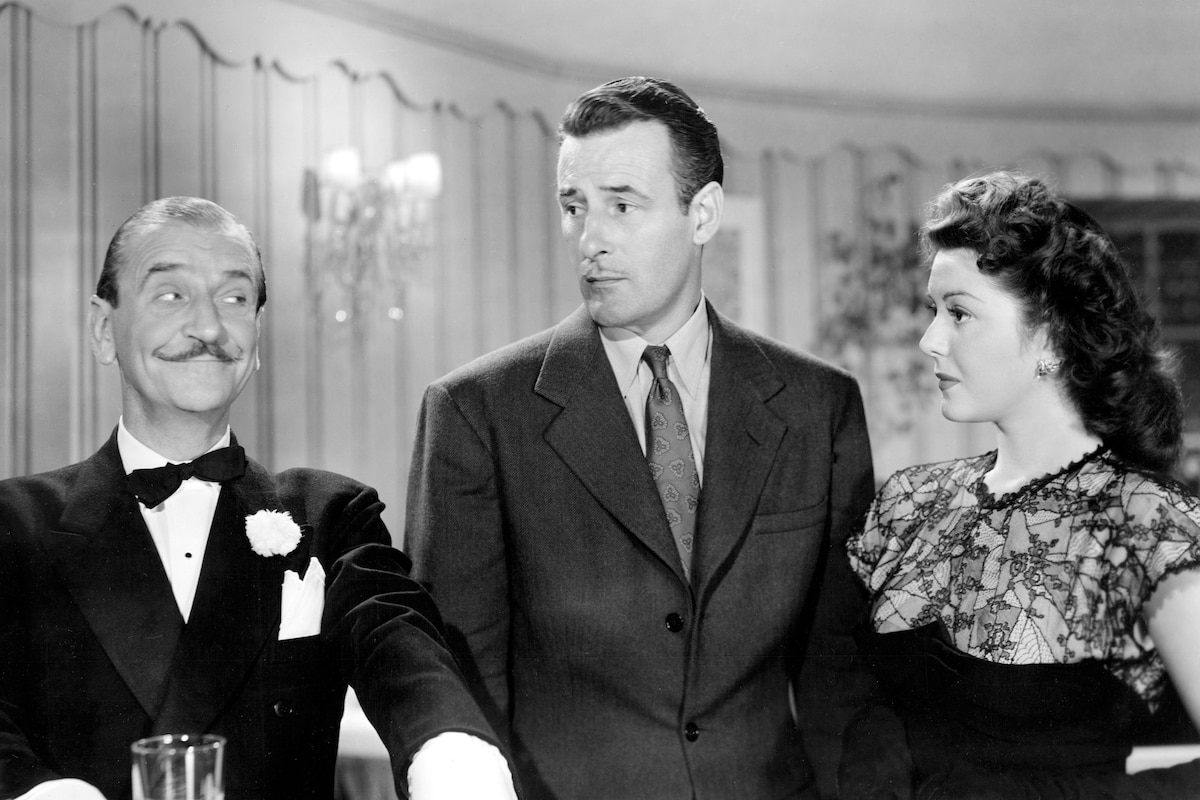
Tom Conway spends a great deal of time looking convincingly like "The
Falcon," and Ann Rutherford, mostly MIA in the film's second half, is stuck with
dialogue running from poor wisecracks to jealous fits, but she's able to still
find a vein of charm. Jean Brooks nearly steals the movie with only a few
scenes, exuding psychotic guilt. Conway, whose real name is Robert Conroy
Sanders, bares such a frightening resemblance to his brother that surely some
1945 audience members must have blurted "Oh look, it's the guy from The
Picture of Dorian Gray!" Jane Greer (here billed as Bettejane Greer) flashes
on the screen like a comet - a radiant, convincing "other woman" that looms over
all her scenes; she leaves a wake of sharp glass in every scene.
Of Mann the stylist, there are glimpses of greatness. Two O'Clock
Courage was a journeyman's exercise, where he was clearly restrained from
unleashing or developing any of the genuinely expressive powers quickly emerging
with the director and which would fine fruition in films such as T-Men
(1948), Raw Deal (1948), Desperate (1947), and The Tall
Target (1951). The film contains tantalizing moments such as its
disorienting opening tracking shot (Mann had opened with a similar sequence in
his previous film, The Great Flamarion in 1945) and some
better-than-average cross cutting in a key flashback sequence - but it's evident
the director was just beginning to think about how gritty story elements might be
expressively told.
Mann never dealt with scripted comedy; he simply didn't "get it" (see his
atrocious Sing Your Way Home (1945)), and the comedy in Two O'Clock
Courage crackles with the energy of a rubber tire. But it's fun watching
this film nonetheless, and if you can get past some of the lame dialogue, there
are pockets of real enjoyment here as you watch a director play with scenes,
clearly flirting with the movie camera and trying to discover what possibilities
it may hold.
Producer: Benjamin Stoloff
Director: Anthony Mann
Screenplay: Gelett Burgess (story), Robert Kent, Gordon Kahn
Cinematography: Jack MacKenzie
Film Editing: Philip Martin
Art Direction: Lucius O. Croxton, Albert S. D'Agostino
Music: Roy Webb
Cast: Tom Conway (The Man), Anne Rutherford (Patty Mitchell), Richard Lane
(Haley), Lester Matthews (Mark Evans), Roland Drew (Steve Maitland), Emory
Parnell (Inspector Bill Brenner).
BW-66m.
by Richard Steiner
Two O'Clock Courage
by Richard Steiner | February 26, 2004
SIGN UP FOR OUR NEWSLETTERS

CONNECT WITH TCM