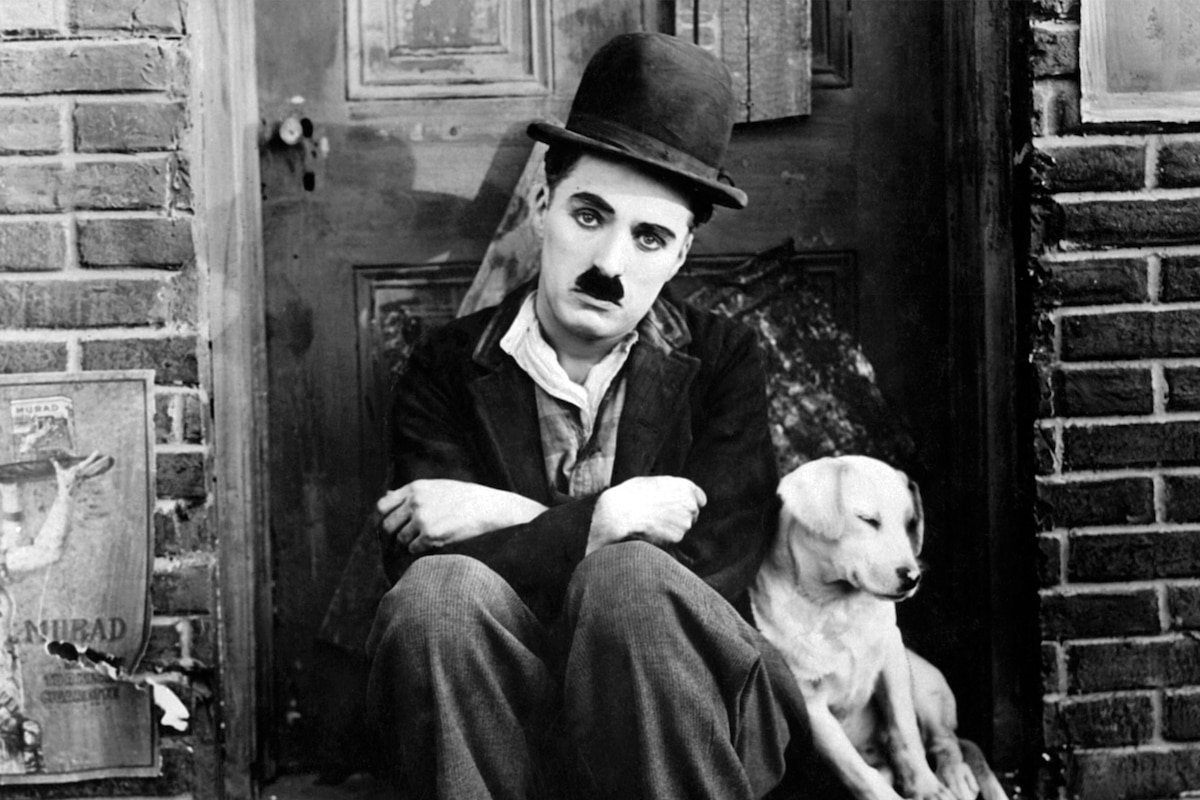
Charles Chaplin took a big step forward with the short, A Dog's Life (1918), both artistically,
historically and commercially. It was both the longest
Chaplin production to that time and, he would later claim, the first in
which he seriously considered comic plot construction. Historically, the
film was the first to come from his new studios at Sunset and La Brea.
Commercially, it was his biggest hit to date, often advertised as his first
film to make $1 million.
Chaplin told the press he had been considering the comic possibilities of
working with a dog for over a year before making the film, though his
brother Syd had introduced canine comedy to Fred Karno's Troupe, the
vaudeville company in which both had performed as young men. With the
opening of his new studios, he decided this was the perfect time for his
dog film. Only he had to find the right dog. He tried a dachshund, a
Pomeranian, a poodle, a Boston bull terrier and an English bulldog before
realizing that what he needed was just a mongrel. The film was already in
production when he picked up 21 dogs from the Los Angeles pound and brought
them to the set. When neighbors complained, he cut the number to 12 and
finally picked one adorable creature, Mutt, to be his new co-star.
The plot was simple, but revealed much more thought than many of his
previous films. Once again cast as his popular tramp character, Chaplin
saves a stray from a group of attacking dogs, then fights to keep them both
alive despite unemployment and starvation. When he sneaks the dog into a
dance hall, it helps him save singer Edna Purviance (Chaplin's principal
leading lady at the time) from mobsters and recovers a stolen wallet that
gives them the money to start a new life. Throughout all this, Chaplin
linked the tramp's and the singer's actions to the dog's, often cutting
between scenes in which they appeared in similar dilemmas. This use of
association as the basis for plot construction gave him a way to string
together what in earlier films had been simply a series of disparate gags.
Years later, he would say that though it restricted his ability to use any
gag he thought of, it ultimately made his films funnier and deeper. In
addition, he used his comedy to explore some harsh realities of life:
poverty, unemployment and prostitution among them.
The opening of a new film studio for one of the world's most famous actors
was a major news event, and Chaplin's studio was flooded with visitors. At
first, he imposed no restrictions on the guest list. Then two men claiming
to be journalists were caught eavesdropping on a production meeting. A
quick search revealed that in three days they had stolen sketches of sets
for A Dog's Life, notes from story meetings and character
descriptions. From then on Chaplin had to approve of visitors, though
there was still a stream of guests, including Scottish stage comic Harry
Lauder, who shared gags with Chaplin as cameras recorded the meeting of two
comic legends. By some accounts, it was Lauder who suggested the film's
title. Chaplin had started production under the title I Should
Worry, but Lauder's statement, "It's a dog's life you're leadin' these
days, Charlie" fit the film perfectly. Many critics have noted that the
film contrasts the dog's life led not just by Mutt, but by Chaplin and
Purviance's characters as well.
The dogs themselves posed some problems in production. Some were more
independent than most human actors, leading to fights on set. Along with
receipts for dog's meat, the props department's records include orders for
a large syringe and 65 cents' worth of ammonia to be used to break up dog
fights.
Chaplin's new studio included a standard set used in many of his films, a
T-shaped street similar to the one he had first used at Mutual Films while
making Easy Street (1917). Variously dressed, the street would turn
up in several of his films representing cities from around the world. The
technicians did such a good job of making the street look real that Chaplin
had no problem cutting in scenes shot at various street locations around
Los Angeles. For A Dog's Life, he shot for a day in front of the
Palace Market, which became part of the studio street during
editing.
A Dog's Life was a big hit for Chaplin, allowing him to continue
working at his own studio and encouraging him to try ever-longer films. He
would produce his first feature, The Kid (1921), three years later.
Purviance would continue starring for Chaplin until 1923, when the failure
of his A Woman of Paris and her desire to move into dramatic roles
led him to seek other leading ladies. Nonetheless, he kept her on the payroll
for the rest of her life. Even Mutt enjoyed the success of A Dog's
Life. He was adopted by Chaplin and spent the rest of his life as a
valued staff member at the star's studio.
Producer-Director: Charles Chaplin
Screenplay: Charles Chaplin
Cinematography: R.H. Totheroh
Art Direction: Charles D. Hall
Music: Charles Chaplin
Principal Cast: Charles Chaplin (Tramp), Edna Purviance (Bar Singer), Mutt
(Scraps), Syd Chaplin (Lunchwagon Owner), Charles Reisner (Employment
Agency Clerk), Granville Redmond (Dance Hall Proprietor), Alf Reeves (Man
at Bar).
BW-33m.
by Frank Miller
A Dog's Life
by Frank Miller | February 27, 2004
SIGN UP FOR OUR NEWSLETTERS

CONNECT WITH TCM