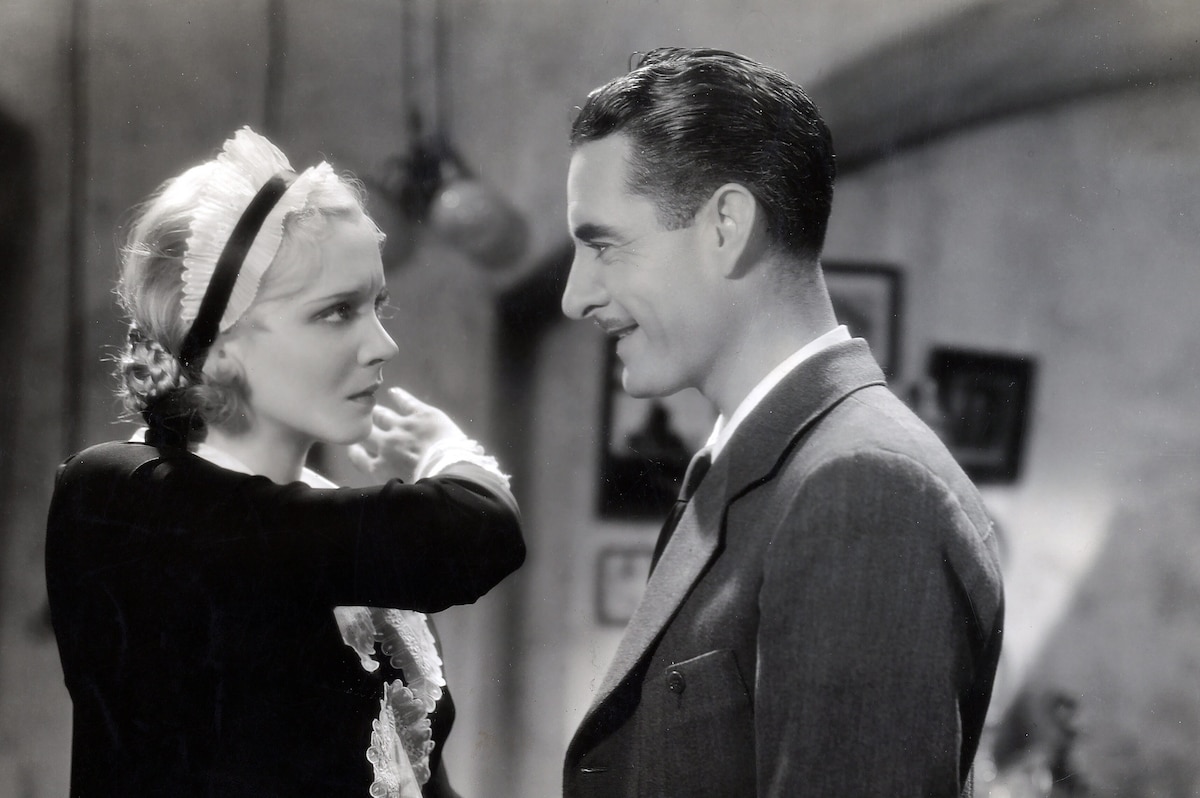
"I thought I had given Madame complete satisfaction," chauffer John Gilbert says with a smirk to countess (and former employer) Hedda Hopper. The double entendre is completely intentional -- and representative of the cheeky, outrageously entertaining quality of Downstairs (1932) as a whole. A fine pre-Code melodrama newly available on DVD from Warner Archive, as part of its Forbidden Hollywood Volume 6 collection, Downstairs may be the best talkie that John Gilbert ever made.
Gilbert, a supreme matinee idol of the silent era, famously did not well survive Hollywood's transition to sound, appearing in ten talkies until his death in 1936. Most were of middling quality, but a few, like Downstairs, were quite strong. Still, this is not quite the same John Gilbert of The Big Parade (1925) or Flesh and the Devil (1926). He is lecherous, lewd, and downright evil here as a philandering chauffeur who sleeps his way through rich Austrian households. Bored baronesses, chaste maids, busty cooks -- he doesn't discriminate. The movie establishes him as a heel right from the start, as he flips a coin to his carriage-driver, forcing him to get down and pick it up off the ground. Gilbert then arrives at a mansion as the new chauffeur and wastes no time leering at every woman he encounters, no matter her age or position. He is smooth-talking and has a modicum of initial charm, so he is successful. (It's a role that Zachary Scott would have been perfect for a dozen years later.)
Eventually Gilbert sets his sights mainly on a pretty young chambermaid (Virginia Bruce, outstanding) who has just married the household's older and boring butler (Paul Lukas). Naturally she presents a challenge to Gilbert, and his slow conquering of her, as well as her gradual giving-in, is a pre-Code sight to behold. What seems sleazy yet almost harmless at first, as if Gilbert were just an overgrown frat boy, turns much more dangerous and menacing as the story wears on and he starts playing with the feelings of the mansion cook (Bodil Rosing) in order to fleece her of her savings, and blackmailing the lady of the house (Olga Baclanova) when he discovers her own adultery. Throughout, the glee and delight with which Gilbert slinks through these people's lives makes this one of the most fun pre-Code movies out there, on a par with Baby Face (1933).
When Paul Lukas eventually gets wind of Gilbert's seductive ways and confronts his wife about it, Virginia Bruce unleashes one of the ultimate speeches in all of pre-Code filmdom, telling Lukas that now she knows "there's a way of making love that drives you mad and crazy, so that you don't know what you're doing. You think you can make love in the same frozen way you do everything else! I thank heaven I found there IS something else, something that makes you so dizzy you don't know what's happened and you don't care." Bruce is fantastic, and adding a layer of irony to this speech is the fact that in real life, Gilbert was pursuing her with wild abandon during the making of this film. He gave her jewelry, clothes and a car, and after a week (still during production), he proposed. Two months later -- and barely a week after Downstairs opened in theaters -- they were married. They later had a child, but divorced within two years.
Gilbert starred in only three more films, all representing a career decline that had come about with Hollywood's transition to sound, before he died of a heart attack at the age of 38. Film historian and author Jeanine Basinger made the good point in her 1999 book Silent Stars that Gilbert's career was indeed killed by sound, but not because he was unable to act in talkies or because he had a bad voice. Downstairs is proof enough that those notions are false. What happened instead was that sound "diminished John Gilbert" by somehow taking away his swagger, fire and intensity. He gives a solid performance in Downstairs, and he's right for the part, but he just doesn't burn up the screen like he used to in silents.
Downstairs, in fact, was quite a personal endeavor for Gilbert. He had written the screen story himself in 1927 and had tried to set it up ever since. Finally in 1931 he convinced Irving Thalberg to produce it. According to Gilbert biographer Eve Golden (John Gilbert, 2013), Gilbert said during the making of Downstairs, "I am happier than I've been in years. It's a psychological study, a cross-section view of two strata in life. The chauffer is a swaggering Don Juan who makes up in audacity what he lacks in conscience. He is an outright villain, but nevertheless, a fascinating chap." Gilbert even wrote some of his own dialogue for the film. Strangely, the entertaining and sexy Downstairs was not that well received by critics or audiences, and it lost money. Time has been much kinder, and it is simply a must-see for fans of pre-Code cinema.
Forbidden Hollywood Volume 6 (as well as Volume 7, also just released) are the latest in the Warner Brothers series of pre-Code DVD collections that started in 2006 as pressed DVDs, and have continued as burn-on-demand DVD-Rs through the Warner Archive label. The collections have lost none of their interest. The other titles in Volume 6, for instance, are all very worthwhile: The Wet Parade (1932), directed by Victor Fleming, is a long melodramatic look at alcoholism and Prohibition, a two-part story set first in the south, then in the north, with a powerhouse cast including Walter Huston, Myrna Loy, Robert Young, Lewis Stone, Neil Hamilton, and Jimmy Durante.
Mandalay (1934), directed stylishly by Michael Curtiz, is an hour-long melodrama starring chic Kay Francis as a woman abandoned in Rangoon and seemingly doomed to become a prostitute there for Warner Oland. And Massacre (1934) is a fascinating look at the plight of the American Indian told through the prism of a 1930s Warner Bros. social-conscience picture, with Richard Barthelmess as a college-educated Sioux who returns to his reservation and fights for social justice all the way to Washington, D.C.
Forbidden Hollywood Volume 7 features four more pre-Coders: The Hatchet Man (1932) stars Edward G. Robinson as a Chinese hit man, and while neither he nor Loretta Young look or sound even the tiniest bit Chinese, it's still rough and raw going with some gripping sequences. The fine Robert Florey-directed Ex-Lady (1933) is a witty, racy, marital sex comedy starring a prime Bette Davis and Gene Raymond. And two absolutely top-drawer Warren William titles round out the set: Skyscraper Souls (1932) and Employees' Entrance (1933), which are worth the price of the collection alone. Take a look at William's delicious turns as leering, powerful businessmen in these films and you will immediately want to see everything else he ever did in pre-Code Hollywood. (William's characterizations are more charming than John Gilbert's scummy chauffeur.) It's also worth noting that these melodramas probably say more about Depression-era life than other, more serious, "prestige" pictures that were overtly about the Depression.
Picture and sound quality are generally of the high quality we've come to expect from Warner Archive. Both volumes are very highly recommended.
By Jeremy Arnold
Downstairs on DVD
by Jeremy Arnold | August 29, 2013
SIGN UP FOR OUR NEWSLETTERS

CONNECT WITH TCM