Although considered a minor musical in its time, Nancy Goes to Rio (1950)
marked important transitions for three of the musical genre's most
memorable stars. For Jane Powell, it was the last of the juvenile roles
that had built her popularity at MGM. For Ann Sothern and Latin sensation
Carmen Miranda, it marked an end to their associations with the
studio.
Powell had signed with MGM in 1944 at the age of 15 after impressing talent
scouts with her surprisingly mature soprano voice on the radio. After two
years of loan-outs to other studios, she was handed to producer Joe
Pasternak, who had made a star of child soprano Deanna Durbin at Universal
Pictures. Durbin had originally been under contract at MGM, but the studio
had released her, only to see her save Universal from bankruptcy in the
late '30s. From that point, studio executives at Metro had been consumed
with finding a Durbin of their own, and Powell fit the bill perfectly.
They even bought remake rights to some of Durbin's hits. That Certain
Age (1938) became Powell's first MGM picture, renamed Holiday in
Mexico (1946), followed by a remake of Three Smart Girls (1936)
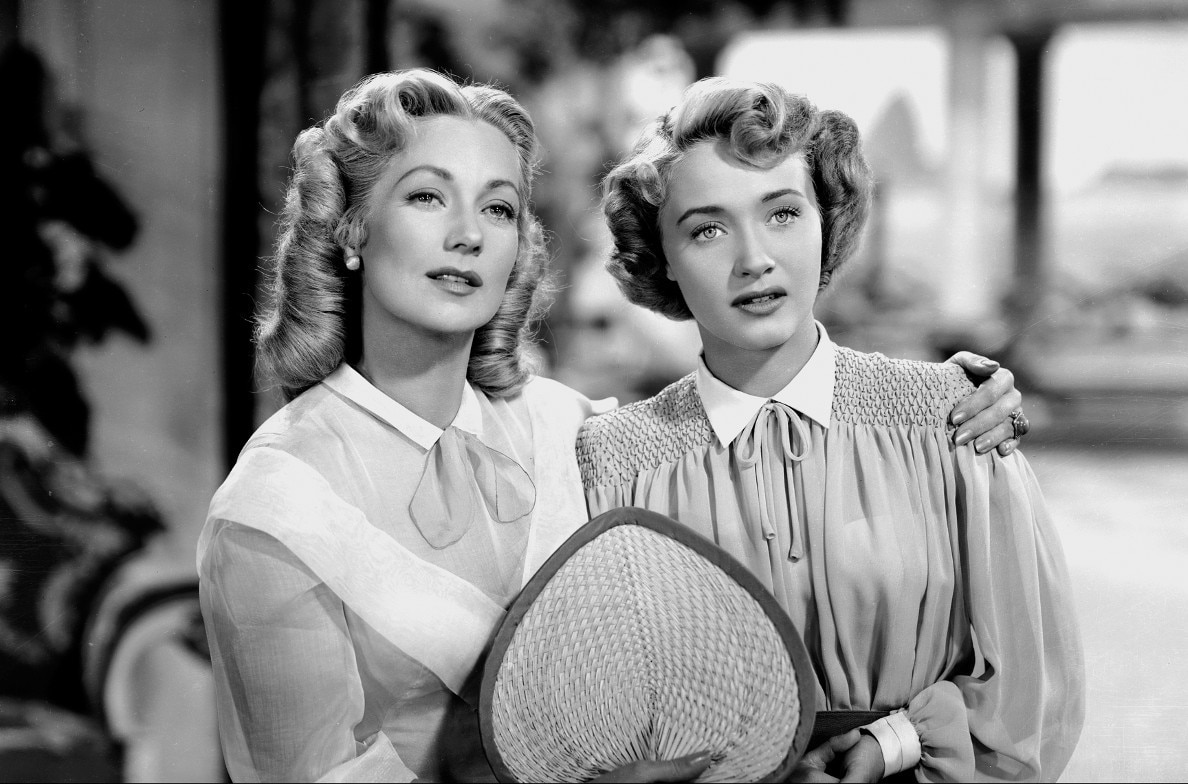
as Three Daring Daughters (1948). In 1950, they remade It's a
Date (1940) -- about an aspiring actress who finds herself competing
with her mother (Sothern) for the same role and the same man (Barry
Sullivan) -- as Nancy Goes to Rio. Complicating matters was the
false suspicion that Powell's character was pregnant, a bow to the fact
that MGM's little singing star was growing up.
She was growing up off-screen, too. She had married former ice skater
Geary Anthony Steffen II a year earlier, and would have her first child in
1951. She underwent another rite of passage during rehearsals, when she
raised her arms during a dance number, and choreographer Nick Castle
realized that she had never been told to shave under her arms. Powell
would later write in her memoirs (The Girl Next Door...and How She
Grew) that her mother had never really explained adult life to her.
Castle took her aside and explained that it was time she started shaving
her legs and under her arms. MGM would finally admit that Powell was an
adult with her next film, Two Weeks With Love (1950), in which she
shared billing with her first grown-up romantic interest, Ricardo
Montalban.
For Sothern, Nancy Goes to Rio marked the end of her long
association with MGM. Although she had appeared in a few of their films
while under contract to other studios, Metro had finally signed her in 1939
to play the title role in Maisie, a comic adventure written for the
late Jean Harlow. Sothern starred in six more Maisie films, all of
them low budget, though they actually were more popular than many of the
studio's A pictures. She also toplined some major films there, including
the musicals Lady Be Good (1941) and Panama Hattie (1942),
though bad luck and bad timing kept her out of some roles that could have
thrust her into the studio's top ranks. She finished her contract with
Undercover Maisie in 1947. Nancy Goes to Rio would mark her
last appearance at the studio and her final big-screen musical before
finally hitting the big time with the television series Private
Secretary in 1953.
Nancy Goes to Rio marked the end of Miranda's tenure at MGM, too,
though she had only been with the studio for two films. She had spent most
of her U.S. film career at 20th Century-Fox, helping the studio develop a
large audience in Latin America to replace the European markets lost in the
'40s because of World War II. When the war ended, however, Hollywood's
fascination with all things Latin began to decline, and Miranda found her
image as the "Brazilian Bombshell" limited her screen possibilities, even
though she had been the highest paid entertainer of the '40s. She signed
with MGM for the Powell musical A Date With Judy (1948), in which
her tempestuous comedic presence and exotic musical numbers provided a perfect
contrast to Powell's more homespun charms. For her second MGM picture, she
was just about the only authentic thing about the film's Rio de Janeiro
setting. The picture never left the backlot, where most of the landmarks
were painted backdrops. When the film was released, Brazilian audiences
couldn't miss the fact that such well-known landmarks as Sugar Loaf and the
Corcovado Mountain were shown almost side by side, even though they're
miles apart in reality. Miranda's big number was the traditional song
"Caroon Pa Pa," for which costume designer Helen Rose replaced the fruit
the singing star usually wore in her famous "tutti frutti" hats with tiny
umbrellas. Despite getting some of the film's strongest reviews, Miranda
had no future projects at MGM. She would only make one more film, the Dean
Martin-Jerry Lewis comedy Scared Stiff (1953), before her sudden
death from a heart attack in 1955.
Producer: Joe Pasternak
Director: Robert Z. Leonard
Screenplay: Sidney Sheldon
Based on a story by Jane Hall, Frederick Kohner & Ralph Block
Cinematography: Ray June
Art Direction: Cedric Gibbons, Jack Martin Smith
Music: George Stoll, Ray Gilbert
Principal Cast: Jane Powell (Nancy Barklay), Ann Sothern (Frances Elliott),
Barry Sullivan (Paul Berten), Carmen Miranda (Marina Rodriguez), Louis
Calhern (Gregory Elliott), Scotty Beckett (Scotty Sheldon), Hans Conried
(Alfredo), Frank Fontaine (Masher).
C-100m. Closed Captioning.
by Frank Miller
Nancy Goes to Rio
by Frank Miller | December 23, 2003
SIGN UP FOR OUR NEWSLETTERS

CONNECT WITH TCM