A brilliant experiment into the possibilities of the camera, Dziga
Vertov's Man With a Movie Camera (1929) is a vital document of a time and place - a day in the life of Moscow. Running for
six reels without a single intertitle, the film visualizes the ordinary, from
passengers racing through the streets in horse drawn carriages and
factory workers, to the extraordinary, like a dramatic representation
of childbirth and a visible corpse in a funeral procession.
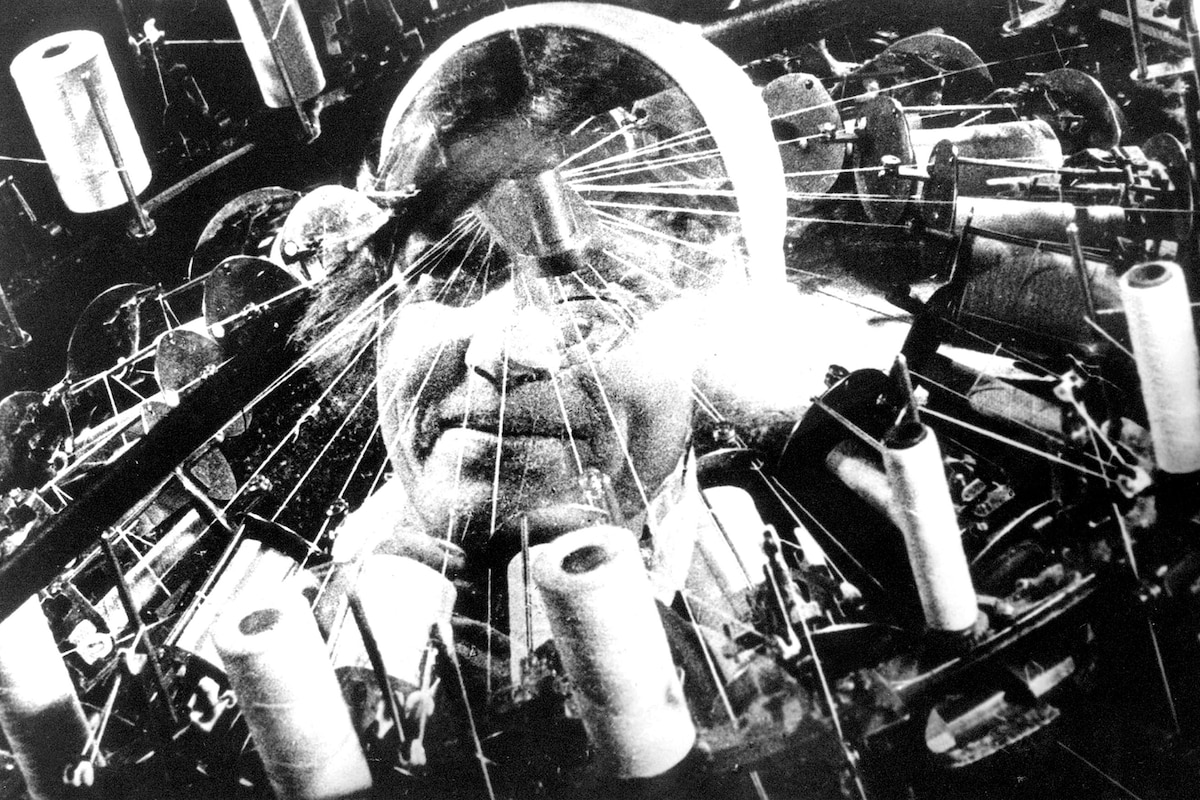
In order to use the cinematic apparatus to full advantage, Vertov
experimented wildly with his camera, strapping it to motorcycles and to
trains, using multiple exposure, time lapse photography, still imagery,
dissolves, superimposition, and making the camera an obvious
participant in what is being filmed. The film's attention to form
angered Vertov's Soviet contemporaries like Eisenstein, who called it
"purposeless camera hooliganism" and complained that his film work
alienated a mass audience. But international audiences, and directors
including Chaplin, Grierson, Godard and Vigo, were astounded and
influenced by his radical vision.
But the continued disapproval of the Soviets affected Vertov's future
in the industry. Vertov continued to make great films including the
highly regarded Three Songs of Lenin (1934), which was
nevertheless delayed in its release because Stalin was overlooked.
Vertov's stature within the Soviet film industry slipped in the
mid-1930s, as Lenin and the Soviet ideal crumbled under the influence
of Stalin and bureaucracy.
Born Denis Arkadievitch Kaufman, the director and film theoretician
adopted the name Dziga Vertov, meaning spinning top. Though he
initially studied medicine, wrote poetry, and experimented with sound
recording, after the Russian Revolution of 1917, Vertov became involved
in film. As a member of the Russian avant-garde Vertov was a
contemporary of Alexandr Rodchenko and Vladimir Mayakovsky and also
linked to the futurist philosophy which celebrated machinery and
dynamic movement. He became an editor and writer for first the Soviet
newsreel group the Moscow Cinema Committee, and later worked under Lev
Kuleshov on Kino-Nedelia (Cinema Weekly) a screen
periodical, before moving into filmmaking.
Experimentation was always foremost for Vertov, who subtitled an early
film (now lost) of fighting between the Red and White armies around the
city of Tsaritsyn - Battle of Tsaritsyn (1920), "an experimental
study." That film was also Vertov's first project with editor
Elizaveta Ignat'evna Svilova, who would later become his wife.
Vertov's creation of the Kinopravda newsreels made him an early
advocate of the power of documentary, 40 years before cinema verite
came into existence. What he called "Life Caught Unawares," demanded
an end to actors, sets, studios, scripts and other manifestations of
the "bourgeois imagination." Of interest to Vertov and his disciples
instead were "the ordinary people, filmed in everyday life and
work."
Both of Vertov's brothers - Mikhail and Boris Kaufman - also worked in the film industry, with Mikhail going on to become a well-known cameraman on Vertov's films. Boris won an Oscar for his cinematography on Elia Kazan's On the Waterfront (1954) and earned critical praise for his work on other Hollywood films (The Fugitive Kind, 1959, The Pawnbroker, 1964).
Director: Dziga Vertov
Screenplay: Dziga Vertov
Cinematography: Mikhail Kaufman
Film Editing: Yelizaveta Svilova
Music: Pierre Henry, Nigel Humberstone, Konstantin Listov, Michael Nyman, Caleb Sampson.
BW-61m.
by Felicia Feaster
Man With a Movie Camera
by Felicia Feaster | December 23, 2003
SIGN UP FOR OUR NEWSLETTERS

CONNECT WITH TCM