In these days of blood-splattered slasher films, it's easy to forget that
Alfred Hitchcock's precedent-setting Psycho seemed downright exploitive
back in 1960. Having long been considered the master of suspense,
Hitchcock, in a move that was perverse even by his standards, seemingly veered into schlock-meister William Castle's territory. He even went so far as to announce in
newspaper ads that no one would be seated in the theater after Psycho's
opening credits, a Castle move if ever there was one.
The film seemed every bit as sensationalistic as its marketing campaign. Instead of
Technicolor, Hitchcock shot it in flat black & white. Instead of sweeping
shots of characters barreling across open landscapes, the majority of the
story takes place in the front seat of a car and in a handful of cramped
rooms. And, instead of allowing the audience to root for the main character
as she struggles to escape a tense situation, she's brutally murdered
half-way through the story. This was hardly the expected follow-up to
North by Northwest (1959), and many people were appalled. The fact that
Psycho was the first studio film to actually show a toilet in a
bathroom seemed oddly appropriate.
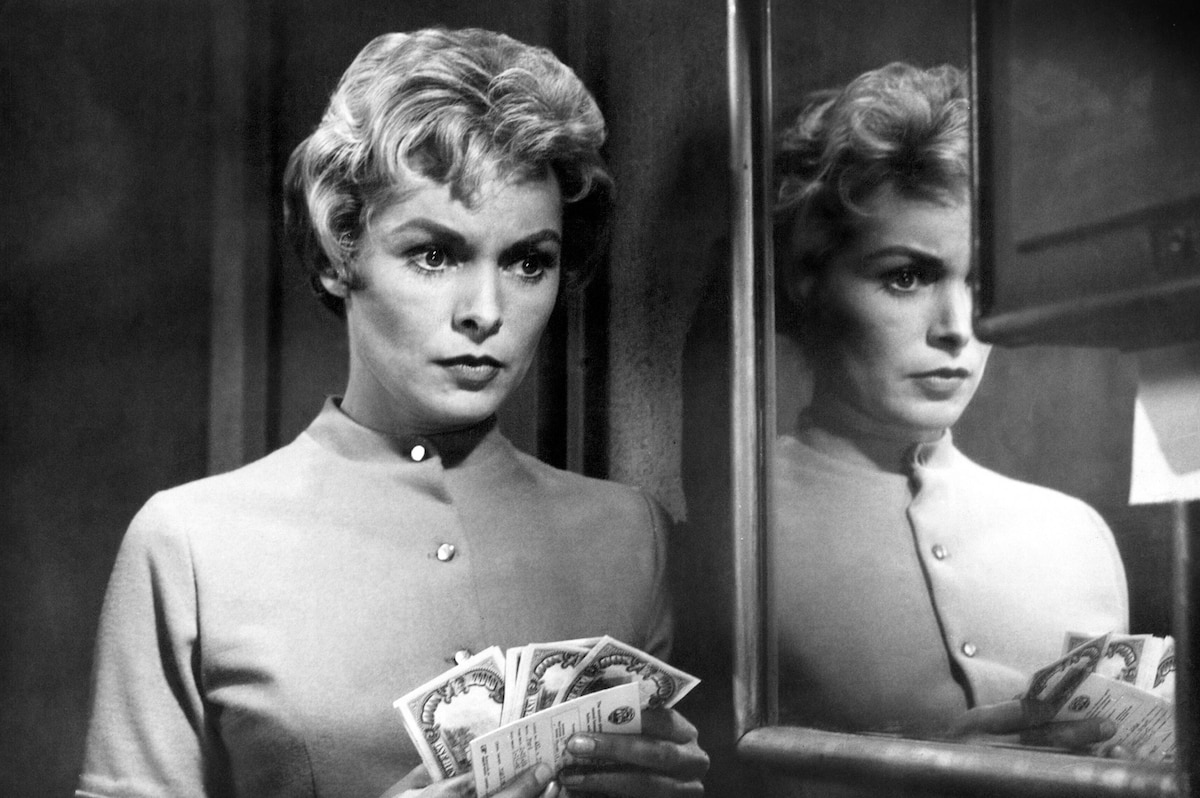
Janet Leigh plays Marion
Crane, a real estate office secretary who steals $40,000 from her boss'
loud-mouthed client (Frank Albertson.) In a desperate attempt to start her life
over again, Marion buys a car and heads out of town with the remaining cash.
The audience assumes that she'll eventually hook up with her adulterous
lover (John Gavin), but Hitchcock has other plans. When she stops at a
barren roadside motel, Marion makes the acquaintance of its proprietor, a
lonely young man named Norman Bates (Anthony Perkins.) Norman, shall we
say, suffers from a rather strange mother fixation. And he owns a large
kitchen knife. If you don't know what happens next, you might also get a
kick out of the surprise burning of Atlanta in Gone With the
Wind (1939).
From the start, Hitchcock seemed intent on creating a stark, disturbing portrait of a psychopath and his victims. Paramount was stunned when he said he wanted to adapt the lurid Robert Bloch novel, Psycho, which was based on the exploits of Ed
Gein, the cannibalistic serial killer. Realizing that the studio expected
the film to fail miserably at the box office, Hitchcock offered to finance
it with his own money, in return for 60% of the profits. Relieved,
Paramount jumped at the chance to simply distribute the finished product.
Even Hitch's long-time associate producer, Joan Harrison, refused a cut of
the projected profits, opting instead for a straight salary.
That, it turned out, was a big mistake. Hitchcock shot everything on a
shoestring budget, using the fast-working crew from his TV show, Alfred
Hitchcock Presents. Even the sets were relatively cheap, with the
sinister Bates mansion costing a mere $15,000 to build (the steeple was
actually salvaged from a house used in the whimsical Jimmy Stewart vehicle,
Harvey, 1950.) Hitchcock's unwavering belief in America's growing taste
for crime stores and gruesome murders paid high dividends. Psycho was a certifiable smash,
and he ended up making millions of dollars from his gamble.
The shower scene is what everyone immediately thinks of when you mention
Psycho, and with good reason: it's one of the more devastating
sequences in movie history. Over the years, there's been some debate
concerning who was responsible for its dazzling series of shock cuts, which
required 78 separate camera set-ups. The truth is, Hitchcock enlisted his
gifted title designer, Saul Bass, to storyboard the murder as it takes place
in Bloch's book. He then used the storyboards as a guideline while filming,
but the finished product wasn't a literal translation of Bass' concept.
Hitchcock was also on the set the entire time the scene was being shot, so
Bass' later insistence that he "directed" it was only half-true at best.
Let's call this one a draw and simply enjoy a staggering cinematic
achievement, one that hasn't lost an ounce of power over the past 40
years.
Then, of course, there's the music. Bernard Herrmann's score for
Psycho is a foreboding pulse that, during the murder, suddenly
transforms itself into the aural equivalent of a slashing knife. It's an
immediately identifiable shriek of horror and despair. Though he didn't
even receive an Oscar nomination for his efforts, Herrmann's groundbreaking
achievement should not be underestimated. He once explained that he used
only strings in his arrangement, "to complement the black & white
photography of the film with a black & white score." It's also thought that
he couldn't afford an entire orchestra due to budget restrictions, but
Herrmann, ever the egotist, seldom mentioned that.
Upon editing the raw footage, Hitchcock was convinced that he had a bomb on
his hands. "Hitchcock," Herrmann said, "felt it didn't come off. He wanted
to cut it down to an hour television show and get rid of it. I had an idea
of what I could do with the film, so I said, "Why don't you go away for your
Christmas holidays, and when you come back we'll record the score and see
what you think."...Well," he said, "do what you like, but only one thing I
ask of you: please write nothing for the murder in the shower. That must be
without music." It's nice to know that even geniuses sometimes get it
wrong.
Producer/Director: Alfred Hitchcock
Screenplay: Joseph Stefano, Robert Bloch (novel)
Cinematography: John L. Russell
Film Editing: George Tomasini
Art Direction: Robert Clatworthy, Joseph Hurley
Music: Bernard Herrmann
Cast: Anthony Perkins (Norman Bates), Janet Leigh (Marion Crane), Vera Miles (Lila Crane), John Gavin (Sam Loomis), Martin Balsam (Milton Arbogast), John McIntire (Chambers).
BW-109m. Letterboxed. Closed captioning.
by Paul Tatara
Psycho - Psycho
by Paul Tatara | December 22, 2003
SIGN UP FOR OUR NEWSLETTERS

CONNECT WITH TCM