It's hard to imagine a more convoluted plot than Ministry of Fear (1944), one of the American thrillers that German expatriate Fritz Lang directed during World
War II. Based on a novel by Graham Greene, the script keeps you blindly
guessing from one moment to the next. Even the main character is baffled
for most of the movie. The story may or may not make complete sense, but
Ministry of Fear is one of those pictures that operates by its own
twisted logic. Though you get completely lost while you're watching, its
sheer strangeness compels you to ride things out to the end.
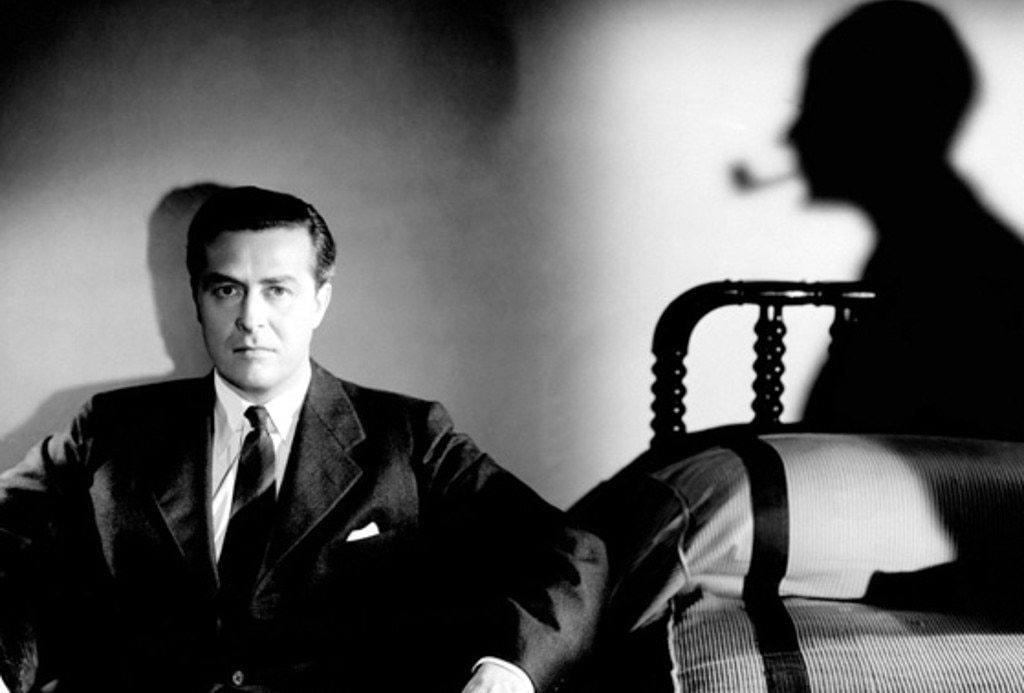
Ray Milland plays Stephen Neale, a man who's just served two years in an
English insane asylum for murdering his wife. Neale was wrongly convicted
of the crime, and he now wants nothing more than to get back to a normal
existence. Unfortunately, he's re-entering society at a time when England
is being bombed every night by the Luftwaffe, and he's about to be drawn
into a bizarre game of intrigue, one that strongly suggests madness also
exists outside the asylum walls.
One day, Neale visits a mysterious fortune teller, then wins a large cake at
a local carnival, which leads to his being mistaken for a Nazi spy. This
has got to be the only movie that begins with intelligence agents trying to
make off with a cake, and it only gets weirder
from there. Eventually, the cake will explode (!), and Neale will attend
another seance...which leads to his being accused of another murder. Then
he'll be forced to clear his name while trying to expose the spy network.
But that's just the bare bones of a wildly Byzantine, Kafka-esque
plot.
Unlike most of his Hollywood contemporaries, director Lang had a real-life
connection to the Nazi party. In fact, many Germans thought he distastefully
utilized the connection to get extra publicity for his war-based films
Hangmen Also Die (1943), Ministry of Fear, Man Hunt (1941), and Cloak and Dagger (1946). As Lang stated in an interview for Hangmen Also Die, Adolf Hitler had personally selected him to make pictures that
glorified the Nationalist Party. Propaganda Minister Josef Goebbels
approached Lang with the news, an intimidating moment that Lang remembered
as sealing his fear of the Nazis. It was also his cue to get out of Germany
as soon as possible.
Opinions differ wildly on Ministry of Fear. It's just that kind of
movie. Some critics hail it as a masterpiece, while others find it too
overtly peculiar for classic status. Lang, rather surprisingly, always felt
the screenplay was beneath him, and he was never happy with the finished
product. In 1967, he told Peter Bogdanovich that he had actually fallen
asleep while trying to watch it on TV.
Lang's view was almost certainly tainted by the fact that screenwriter Seton
I. Miller also produced the picture. Lang always bristled under authority -
Josef Goebbels would have been a bit of a problem - so a writer/producer who
could single-handedly crush his story alterations was the kind of thing that
drove him to distraction. (He disdainfully referred to Miller as "the
supposed producer" during filming.) However, even with Miller watching over
his shoulder, Lang still managed to go $44,000 over the planned $700,000
budget. If he really disliked this fascinating film as much as he said he
did, he could still take solace in that.
Director: Fritz Lang
Producer: Seton I. Miller
Screenplay: Seton I. Miller (based on the novel by Graham Greene)
Editor: Archie Marshek
Music: Miklos Rozsa and Victor Young
Cinematographer: Henry Sharp
Art Direction: Hans Dreier, Hal Pereira
Set Design: Bert Granger
Costumes: Edith Head
Principal Cast: Ray Milland (Stephen Neale), Marjorie Reynolds (Carla
Hilfe), Carl Esmond (Willi Hilfe), Hillary Brooke (Mrs. Bellane), Percy
Waram (Inspector Prentice), Dan Duryea (Cost/Travers), Alan Napier (Dr.
Forrester), Erskine Sanford (Mr. Rennit), Thomas Louden (Mr. Newland)
BW-87m. Closed captioning.
by Paul Tatara
Ministry of Fear
by Paul Tatara | December 22, 2003
SIGN UP FOR OUR NEWSLETTERS

CONNECT WITH TCM