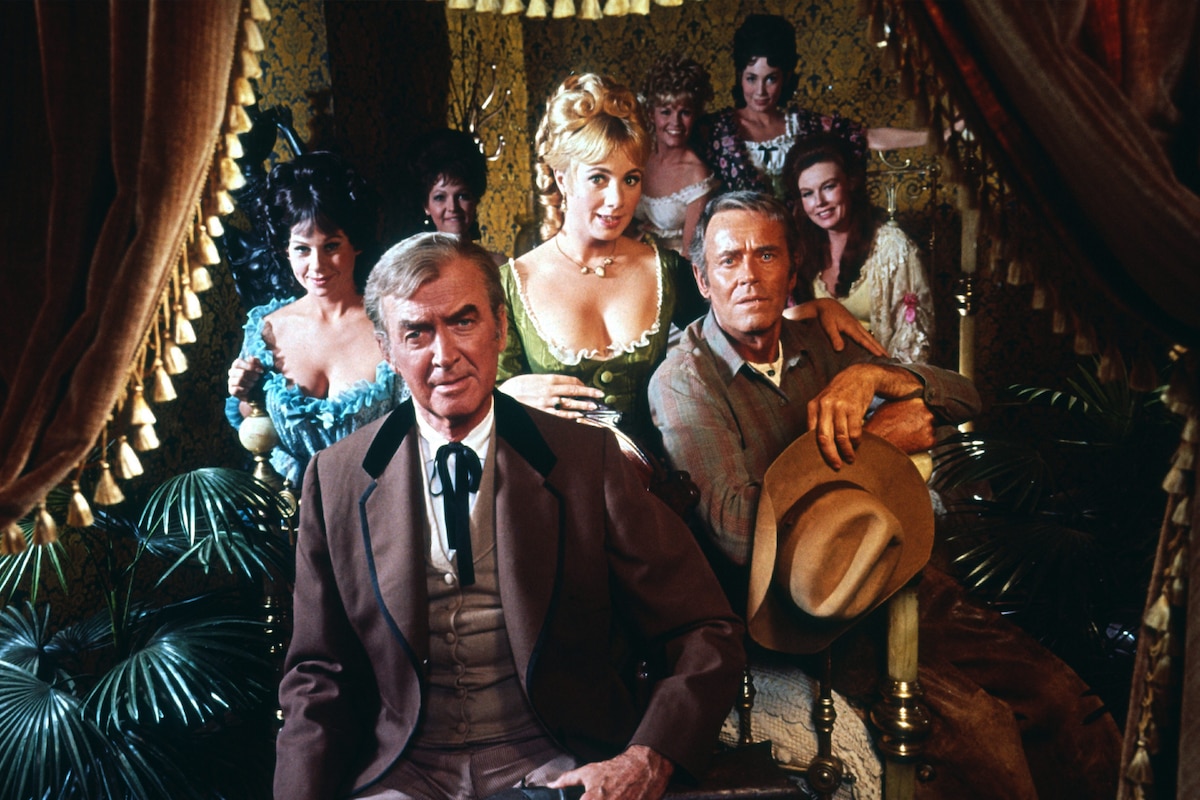
After winning an Oscar® for playing a prostitute in 1960's Elmer Gantry, Shirley Jones returned to the Oldest Profession 10 years later, graduating to the position of Madame in The Cheyenne Social Club (1970). She operates a lively brothel by that name in Cheyenne, Wyoming, in the 1860s, playing a character called Madame Jenny in this Technicolor Western comedy romp. When aging, itinerant Texas cowpoke John O'Hanlan (James Stewart) inherits the property from his brother, "the late D.J.," he invites inseparable sidekick and fellow wanderer Harley O'Sullivan (Henry Fonda) to come along and settle down to run what they think is a legitimate business.
While John is appalled to learn the true nature of his newly acquired enterprise, Harley settles in like a bee in a field of clover. The men in Cheyenne get into a lather when they find John has plans to shut down their "social club" and turn it into a respectable boarding house. All this becomes a moot point when local varmint Corey Bannister (Robert J. Wilke) gets rough with Jenny and John ends up killing him in a gunfight. When the whole Bannister gang comes after them, John and Harley have no choice but to defend themselves along with Jenny and the rest of the bordello workers. In the meantime, the lovely Jenny - who used to be his late brother's "favorite" - has taken quite a shine to John. But the open range is calling, and John and Harley remain true to their profession as "range rats."
Despite the potential for bawdiness and some lightly suggestive dialogue, The Cheyenne Social Club is a fairly genteel affair. The unlikely producer-director is song-and-dance superstar Gene Kelly, handling his only Western. He gives the two lifelong pals Stewart and Fonda plenty of acting room, and they share an easy onscreen chemistry. Jones delivers a fetching performance, but the movie exists mainly as an opportunity for the two male stars to revel in each other's company. Even their personal politics - Stewart conservative, Fonda liberal - are carried over into the characters and their arguments.
Stewart and Fonda had paired two years earlier in another Western, Firecreek (1968), and earlier had been together in the musical comedy On Our Merry Way (1948). Both were in How the West Was Won (1962) but had no scenes together even though their characters were presented as being best friends. In The Cheyenne Social Club, Stewart is the strong, silent type and Fonda is the loquacious one. In an amusing opening sequence, Fonda rattles on as they cross the Western landscapes toward Cheyenne, leading Stewart to complain that "You been talkin' all the way from Texas."
Stewart had agreed to do the film before his buddy signed on and, oddly enough, Fonda was not keen on it, suggesting instead that his role go to Jack Elam. He finally relented after screenwriter James Lee Barrett beefed up the role of Harley, adding among other things the talkathon that John finds so annoying at film's opening. Fonda has amusing scenes pursuing the girls in the bordello, enjoying particularly sprightly byplay with Sue Ane Langdon as Opal Ann.
An autobiography of Jones co-written with Mickey Herskowitz indicates that her impressions of her costars "do not vary in any important way from the accepted ones. Fonda was polite, shy and remote. Stewart was just as you find him on the screen, slow-paced, kind and absentminded." Jones, who earlier had acted with Stewart in the John Ford Western Two Rode Together (1961), chatted easily with him and enjoyed his stories. But this filming, when Stewart was 62, came at a difficult time in his life; his stepson Ronald McLean was killed in Vietnam in 1969, and Stewart himself was having increasing difficulty with his hearing. Stewart had planned on using Pie, the horse he had ridden in so many Westerns, in this film too - but the high altitudes of shooting locations near Santa Fe, New Mexico, proved too much for the aging horse. When filming finished, Fonda (then 65) presented Stewart with a watercolor portrait of Pie; the horse died two days later.
The Cheyenne Social Club made a small profit but not much of a splash in its day, although it has gained popularity over the years through repeated showings on television. Although suggested by a novel by Davis Grubb, Barrett's script earned a 1970 nomination from the Writers Guild of America as "Best Comedy Written Directly for the Screen." It lost to Neil Simon's The Out-of-Towners. Barrett said that, for years afterwards, he kept the sign listing the names of the girls in the brothel hanging in his home.
By Roger Fristoe
The Cheyenne Social Club
by Roger Fristoe | June 06, 2013
SIGN UP FOR OUR NEWSLETTERS

CONNECT WITH TCM