Originally bought by Kirk Douglas as a project for himself and director Martin Ritt, the screenplay The Old Breed -- later re-titled The Good Guys and the Bad Guys -- floated around Hollywood for a few years due to the insistence of its writers, Ronald M. Cohen and Dennis Shryack, to produce the film themselves. No one, it seemed, wanted to take a chance on the first-timers. But they stuck to their guns and finally worked out a deal in 1969 with veteran Robert Goldstein as executive producer, Burt Kennedy as director and Warner Brothers as distributor.
Burt Kennedy was a good choice for a western that mixed comedy and drama; he had much experience in the form. The screenwriting veteran of several brilliant westerns of a decade earlier directed by Budd Boetticher -- Seven Men from Now (1956), The Tall T (1957), Buchanan Rides Alone (1958 -- Kennedy uncredited), Ride Lonesome (1959) and Comanche Station (1960) -- Kennedy had since forged his own directing career with the likes of The Rounders (1965), The War Wagon (1967) and Support Your Local Sheriff! (1969), a huge hit. All these films were filled with varying degrees of humor and comedy that meshed well with the suspense, action and dramatics of traditional westerns.
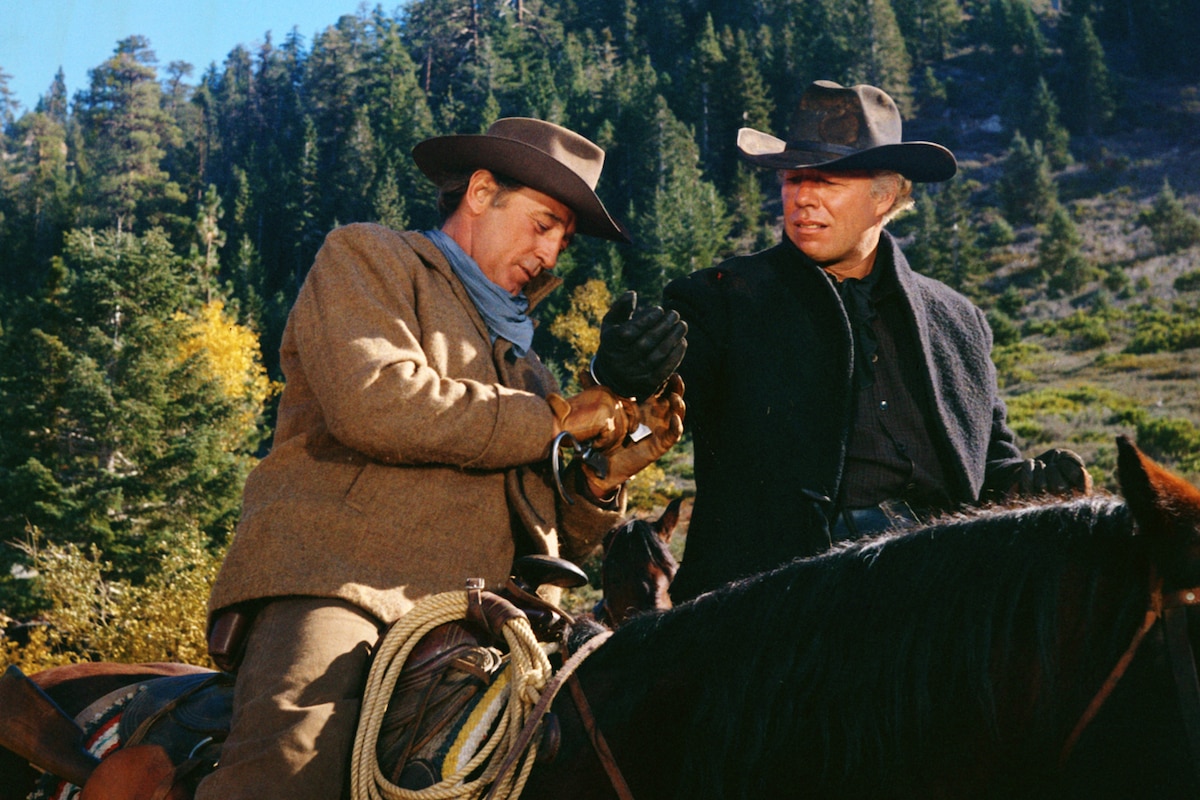
The Good Guys and the Bad Guys is in some ways reminiscent of Sam Peckinpah's Ride the High Country (1962), a film that owed a huge amount to the Boetticher/Kennedy films that preceded it. But now Kennedy was directing his own story of aging western characters, in this case a marshal (Robert Mitchum), retired against his will, teaming up with an aging outlaw and one-time enemy (George Kennedy) to ward off some young guns intent on robbing a shipment of money.
Along the way, the two men engage in outrageous bits of comedy business, as when Kennedy escapes out of a train bathroom window as the train approaches a bridge, and in plenty of comic dialogue, as when Kennedy exclaims, "In the house?!" when informed of the existence of indoor plumbing.
The picture was shot in and around the tiny town of Chama, New Mexico, at elevations reaching 11,000 feet. New Mexico Gov. David Cargo offered tremendous cooperation and was rewarded with a bit role as a reporter who asks the mayor (Martin Balsam) if he intends to run for governor. The film had a healthy budget of $3.8 million. For a train wreck sequence, a miniature was built at a cost of $40,000, even though a real train could have been obtained and wrecked for $8000. The real one, however, would have been too solid to be demolished spectacularly enough.
Critics were quite mixed on the film. The Hollywood Reporter deemed it "surprisingly funny and refreshingly entertaining... backs up its promises and exceeds expectations. Mitchum delivers one of his liveliest and best performances in a long time." Variety said the film couldn't decide if it was comedy or drama, but veered more toward comedy.
The New York Times criticized the "uncertain tone of the picture...which only toward the end asserts itself, clearly and lamely, as a good-natured spoof... Anemic, fumbling and altogether aimless."
This was the second western collaboration in a row for Mitchum and Burt Kennedy, after Young Billy Young (1969). Mitchum biographer Lee Server (Robert Mitchum: Baby, I Don't Care), described Mitchum's performance here as rather lifeless, and reported that Mitchum himself didn't care for the movie. Server quotes Mitchum as wondering, "How in hell did I get into this picture, anyway? I kept reading in the papers that I was going to do it, but when they sent me the script I just tossed it on the heap with the rest of them. But somehow, one Monday morning, here I was. How in hell do these things happen to a man?"
Father and son actors John and David Carradine act together here for the first time in their careers. They'd do so twice again in feature films, in The McMasters (1970) and Boxcar Bertha (1972).
By Jeremy Arnold
The Good Guys and the Bad Guys
by Jeremy Arnold | June 06, 2013
SIGN UP FOR OUR NEWSLETTERS

CONNECT WITH TCM