In 1953, after 10 years and 23 movies at 20th Century Fox, Jeanne Crain began working at other studios including Warner Bros., where she filmed Guns of the Timberland (1960) as the leading lady of Alan Ladd, who made the film through his company, Jaguar Productions. The screenplay by Joseph Petracca and Aaron Spelling was expanded from a 1950 pulp novel by Louis L'Amour, Guns of the Timberlands (plural).
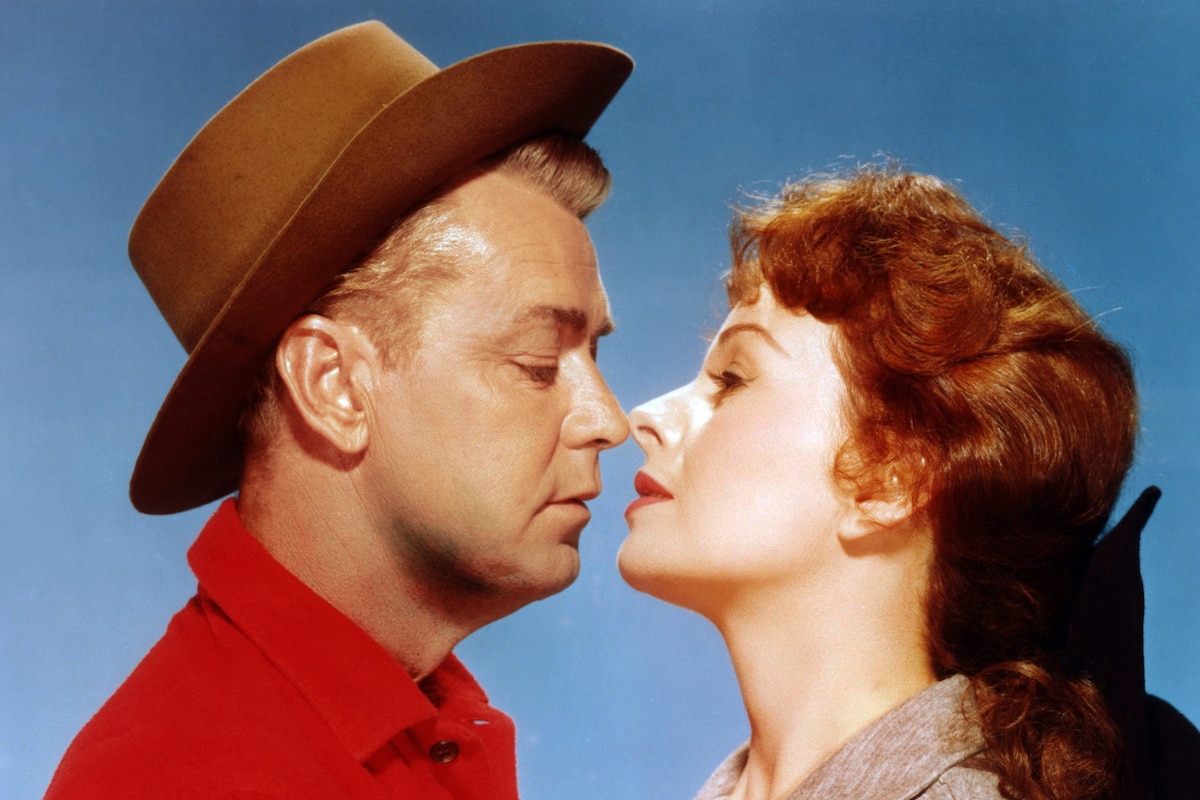
Crain plays Laura Riley, a rancher who is opposed to the actions of logger Jim Hadley (Ladd) and his crew near the Northwest village of Deep Wells, where they have a government contract to fell a prime stand of trees in a dense mountain range. Riley is convinced this will cause devastating ecological damage including mudslides that could destroy local homes and livestock. As her foreman, Clay Bell (Lyle Bettger, playing a good guy for once), puts it, the cattle could soon be eating mud. Despite some literally explosive fighting between the two factions, Hadley and Riley fall in love. Hadley eventually sees the error of his ways, but his partner, Monty Walker (Gilbert Roland) refuses to give up the fight until the bitter end.
Appearing in their movie debuts as a pair of young lovers are Alana Ladd (Alan's daughter) and Frankie Avalon, a then-current teen heartthrob. Avalon sings a couple of ditties by Jerry Livingston and Mack David including one called "Gee Whizz Whilikens Golly Gee." Filling other supporting roles are such reliable character actors as Noah Beery, Jr., Verna Felton and Regis Toomey. Ladd reportedly had originally wanted his costar from Shane (1953), Van Heflin, in Roland's role, and for a time also considered casting Edmond O'Brien and Tony Martin in other parts.
The Technicolor Western was the final credit as cinematographer for the celebrated, Oscar®-nominated John Seitz (1944's Double Indemnity, 1950's Sunset Boulevard). The handsome landscapes were shot in and around Blairsden and Graeagle and other locations in Plumas County, Calif. The scenes involving a steam engine and railroad cars are set on the Western Pacific Railroad right-of-way, while a scene where the steam engine goes over a tall bridge was filmed using the Clio Trestle, located on the Union Pacific's Feather River Route in the Sierra Nevada. Additional filming was done in Williams, Ariz.
Although the action of Guns of the Timberland is set in 1895, there's little in the costuming or atmosphere - and certainly not in Avalon's songs - to indicate that this is anything other than a contemporary Western. This was Ladd's last film under a contract with Warners that had begun with The Iron Mistress in 1952. He had formed Jaguar Productions two years after that; his first movie under the Jaguar banner was Drum Beat (1954). Robert D. Webb, director of Guns of the Timberland, was experienced with Westerns, having such other credits as White Feather (1955) and Love Me Tender (1956), plus TV's Rawhide. Screenwriter Petracca's other credits include another Ladd Western, The Proud Rebel (1958).
L'Amour historian Ed Andreychuk credits Crain with giving the best performance in Guns of the Timberland. In her most effective scene she takes Ladd to a ghost town and explains to him that, with the harvesting of the trees, Deep Wells could come to be the same. Crain, then 35, still looks fresh and beautiful. But Marilyn Henry writes in The Films of Alan Ladd (1981) that "The dissipation in Ladd's appearance by this point in his career made obvious his increasing dependency on alcohol. His puffy, waxen face projects only exhaustion, which is matched by his listless performance."
In his 2004 book, Westerns for a Rainy Saturday, John Howard Reid praises the movie's action sequences including a "rip-roaring forest fire." But he also comments on Ladd's "jaded appearance," adding, "No wonder the distributor didn't dare open the movie in New York, the home of critical antipathy to Mr. Ladd. What a roasting he would have received from The New York Times." Reid surmises that the 5'6" Ladd cast Lyle Bettger "because of his small size," but notes that "with his distinctive voice and forceful manner he's a guy you remember long after Ladd's more routine dramatics have faded from memory." Alana Ladd would appear in another film with her father, 1961's Duel of Champions; ironically, his performances in these two movies are considered by many to be the worst of Alan Ladd's career.
By Roger Fristoe
Guns of the Timberland
by Roger Fristoe | June 06, 2013
SIGN UP FOR OUR NEWSLETTERS

CONNECT WITH TCM