For more than three decades, gruff, tough Wallace Beery (1885-1949) was Hollywood's lovable lug. Well, maybe not during the silent era, where he usually played heavies. But then he had the good luck to be dropped by Paramount at the start of the sound era. MGM's Irving Thalberg scooped him up, cast him in The Big House (1930) as a behind-bars bully and got him an Oscar® nomination. What really put Beery's career in orbit, though, was the warmly sentimental hit, Min and Bill (1930), opposite Marie Dressler. That and the Oscar® that Beery won for The Champ (1931), playing a broken-down alcoholic boxer opposite young Jackie Cooper, made him receptive to tough-on-the-outside-soft-on-the-inside roles, although he had no trouble reverting to crude browbeating in the A-list-loaded MGM extravaganzas Grand Hotel (1932) and Dinner at Eight (1933). Either way, Beery once said, "My ugly mug is my fortune."
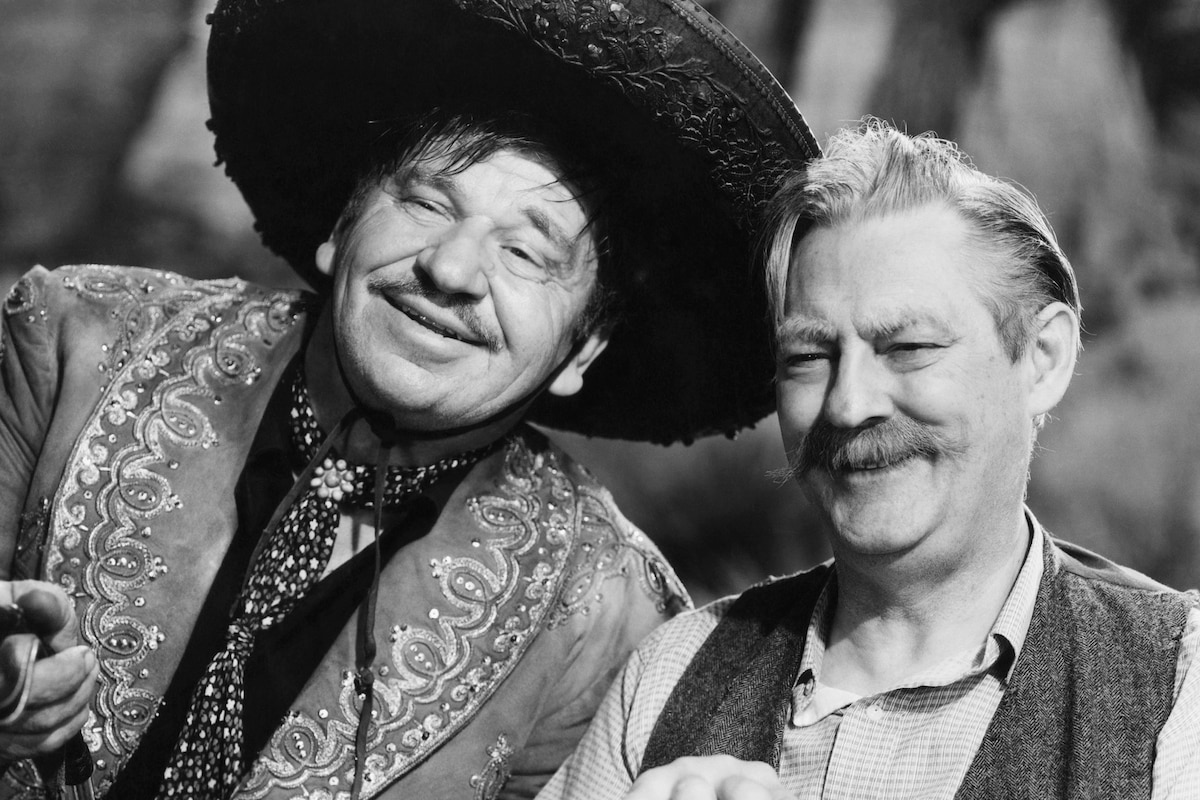
Beery's mug, combined with a raspy growl and slow homespun deliveries (the slow deliveries, not Beery's ability to speak lines, were what worried Paramount), did wonders for Beery's bank balance. Another success came in the title role of Viva Villa! (1934), as the Mexican revolutionary whose conquering armies ride to the tune of La Cucaracha. He was amenable to saddling up again for The Bad Man of Brimstone (1937). With a title like that, you expect a Poverty Row quickie. It's a formula Western, sheer hokum, but MGM being MGM, they loaded the cast with talent and trooped off to the Grand Canyon to film it. Beery plays Trigger Bill, an occasionally deadly but mostly benevolent rapscallion as long as he gets his cut. During filming, Beery killed a five-foot rattlesnake that had wound itself around the leg of a tripod. On the other hand, he also accidentally shot himself in the foot with a blank cartridge and was sidelined for two weeks. So much for trigger fingers!
We meet Trigger Bill as he holds up a stagecoach carrying an Easterner he doesn't realize until later is his son. You'd call Dennis O'Keefe's Jeffrey his long-lost son, except that Trigger Bill ran out on the baby boy and his mother (now deceased) in Brooklyn years ago. So the film rides the old melodramatic device of having Trigger Bill do what he can to help the young man without letting on that they're father and son. Son Jeffrey is a.k.a. The Canarsie Kid, a boxer traveling with his manager, Guy Kibbee's figure of rotund affability. The heavies are three brothers named McCreedy, the middle one played by Cliff Edwards of Ukulele Ike pop music fame. The really bad one, Blackjack, is Bruce Cabot, who only a few years prior snatched Fay Wray from the lovelorn clutches of King Kong (1933). Cabot enjoyed a long career. He lost out to John Wayne in Wayne's breakthrough film, Stagecoach (1939). But he and Wayne became friends and Wayne often got Cabot work in Westerns.
Trigger Bill straddles a sometimes shaky line between good and bad, but winds up on the right side of the law, sort of, when a silver rush transforms Brimstone. Bill talks his son into giving up the law enforcer's job the young man just took, and sends him off to law school with fistfuls of silver. This puts Jeffrey's budding romance with Virginia Bruce on hold. She's the daughter of the local judge (Lewis Stone, the judge and father whose patience was so often tested by son Mickey Rooney in the popular Andy Hardy movies). She projects a soft sweetness as opposed to so much of the aggressive glamour so prevalent in the period. With her pale eyes and blonde hair, she was born to be backlit, and is a lot, with tender, loving care by J. Walter Ruben, who wrote and directed the film, upon the completion of which they married. All that and the veteran Maltese character actor, Joseph Calleia, best remembered as Orson Welles' disillusioned police sidekick in Touch of Evil (1958). Altogether, this supporting cast appeared in hundreds of films.
O'Keefe enjoyed an extensive career too. He had a way of lightening the texture of whatever he appeared in, even crime melodramas. Here, he has a wonderful moment, as he's reluctantly leaving the judge's white picket fenced home. After the requisite bumpy start, things have gone well between him and Bruce in the first scene of their rapprochement. As he leaves, he breaks into a buoyant little dance step as soon as the gate closes behind him. It's just seconds long, but tells us all we need to know better than any script could. In the climactic shootout he has to make a quick choice between the man he doesn't know is his father, and a passel of locals trying to gun him down. Unhesitatingly, he stands alongside his clandestine dad. Among the evil locals (wretched shots, every one of them) is Noah Beery, Wallace's older brother by a few years. The last time they had appeared together was in 1916. They reteamed three more times - in Salute to the Marines (1943), Barbary Coast Gent (1944) and This Man's Navy (1945).
By Jay Carr
The Bad Man of Brimstone
by Jay Carr | June 05, 2013
SIGN UP FOR OUR NEWSLETTERS

CONNECT WITH TCM