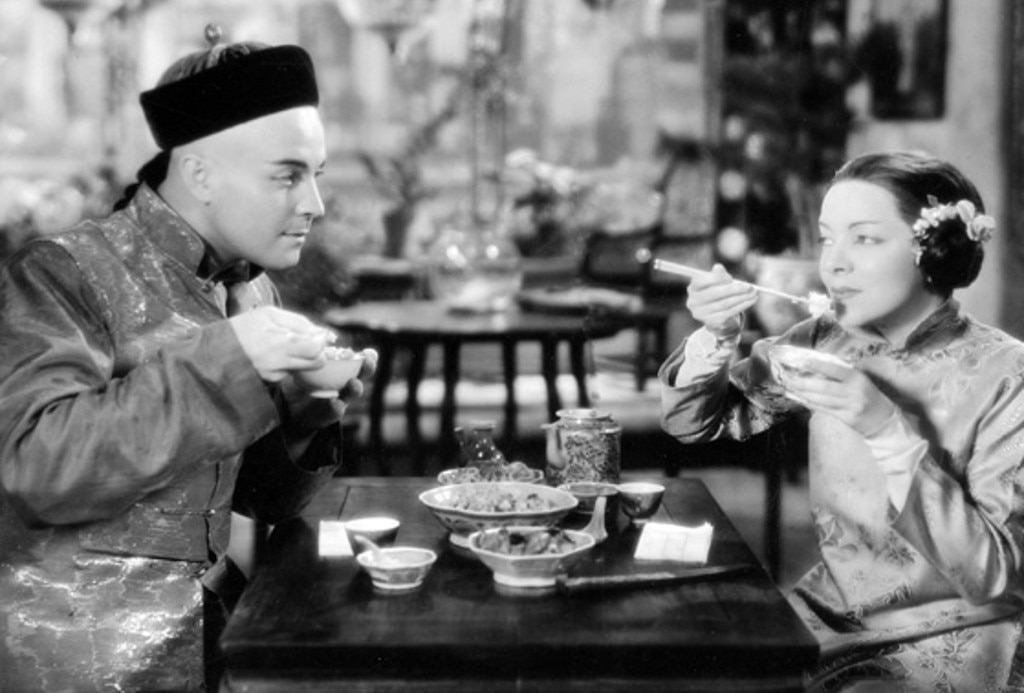
The Son-Daughter (1932), a melodrama about political intrigue separating young lovers in San Francisco's Chinatown, is based on a 1919 play by David Belasco and George M. Scarborough. Although Scarborough is all but forgotten today, Belasco (1853-1931) was a prolific and vastly influential playwright, stage director and producer. One of the leading figures on Broadway, he specialized in melodramas but at the same time pioneered in stage naturalism, combining detailed and realistic sets, elaborate lighting setups and stage machinery, psychologically motivated acting, and a strong ensemble ethos. The composer Giacomo Puccini adapted two of Belasco's productions into operas: Madame Butterfly (1904) and The Girl of the Golden West (1910). Several of Belasco's plays have also been adapted into films multiple times, most notably The Girl of the Golden West, The Heart of Maryland and The Return of Peter Grimm.
From the start of his career Ramon Novarro had played various ethnic roles, including Spaniards, Arabs and an Indian, but The Son-Daughter was his sole attempt at a Chinese role. Despite Novarro's huge success the year prior playing opposite Greta Garbo in Mata Hari (1931), the biographer André Soares argues that his career nonetheless suffered in the Thirties because he was given a number of inappropriate roles, such as a football player in Huddle (1932). This occurred as a result of him not managing his own career effectively, but also because studio heads did not know how to use him. During this time he devoted more energy to his singing career, which would later include a smash concert tour of Europe. In August 1932, MGM requested that Novarro and other top stars accept salary cuts because of the economic downturn. Although Novarro resisted the cuts, he did agree to perform in The Son-Daughter for a lower fee. In a subsequent interview he claimed that he did not enjoy working with Helen Hayes, calling her "the opposite of Garbo," and adding: "She's a very fine technician, but from an artistic point of view..."
For Helen Hayes, the film came at a very active and turbulent period in her career. Although she had married the playwright Charles MacArthur in 1928, in June 1932 MacArthur's ex-wife Carol Frink MacArthur sued Hayes for $100,000, accusing her of being a "homewrecker." In November, while The Son-Daughter was in production, she won an Academy Award for Best Actress for her Hollywood debut, The Sin of Madelon Claudet (1931).
Behind the scenes, the production experienced a great deal of turmoil. The studio originally announced Jacques Feyder as a director, and at various points Robert Young, Robert Montgomery and Richard Cromwell were considered for the lead male role. Anna Mae Wong and Lupe Velez were both considered for the role of Lian Wha before the studio settled on Helen Hayes. In fact, MGM also had Hayes in mind for a leading part as a nun in The White Sister (1933) and nearly took her off The Son-Daughter, but when production of The White Sister was delayed she ended up staying in The Son-Daughter. The film employed hundreds of Chinese extras, and at one point about four hundred of them went on strike in order to get better food. Clarence Brown also fell ill and Robert Z. Leonard took over direction for ten days. George M. Scarborough, one of the co-authors of the original play, reportedly sued MGM over unauthorized changes to the script.
The Son-Daughter faced a divided critical reception when it opened in December 1932, partly because its source material was already considered dated. The reviewer for the New York Times praised the film's production design and noted, "The entire cast is excellent, and there should be a special encomium for Mr. Novarro." The trade paper Hollywood Filmograph called it "another MGM Wow," a "beautiful, sweet and quaint love story," and lauded Clarence Brown's direction for not descending too far into hokum. The article noted that the audience applauded when the villain (as played by Warner Oland) "was given his just deserts." The reviewer for Variety called the 1919 source play "old-time stuff" but praised the "expert" performance of Helen Hayes, writing: "Miss Hayes is more often playing Helen Hayes than Lian Wha, although a neat change of pace in a role that calls for a protean switch from lotus flower to tiger lily." The reviewer also noted a mismatch between Novarro's accent and the script's "stilted and fancy dialogue."
Director: Clarence Brown with Robert Z. Leondard (uncredited)
Screenplay: John Goodrich and Claudine West, based on the play by David Belasco and George M. Scarborough. Additional dialogue by Leon Gordon
Director of Photography: Oliver T. Marsh
Film Editor: Margaret Booth
Musical score: Herbert Stothart
Songs: Anselm Goetzl and Herbert Stothart
Art Direction: Cedric Gibbons
Principal cast: Helen Hayes (Lian Wha); Ramon Novarro (Tom Lee/Prince Chun); Lewis Stone (Dr. Dong Tong); Warner Oland (Fen Sha); Ralph Morgan (Fang Fou Hy); Louise Closser Hale (Toy Yah); H. B. Warner (Sin Kai).
by James Steffen
The Son-Daughter
by James Steffen | June 04, 2013
SIGN UP FOR OUR NEWSLETTERS

CONNECT WITH TCM