The feast of color, melodrama and obsession that is Leave Her to Heaven (1945) was released as a good-looking DVD by Fox in 2004. Now the Twilight Time label has produced a beautiful, high-definition version on Blu-ray, a format that serves this classic melodrama extremely well. Even though the original Technicolor elements of the film no longer exist (as is the case with many Fox titles of the era), Fox technicians have worked from existing Eastmancolor safety prints to produce a still-great-looking color scheme.
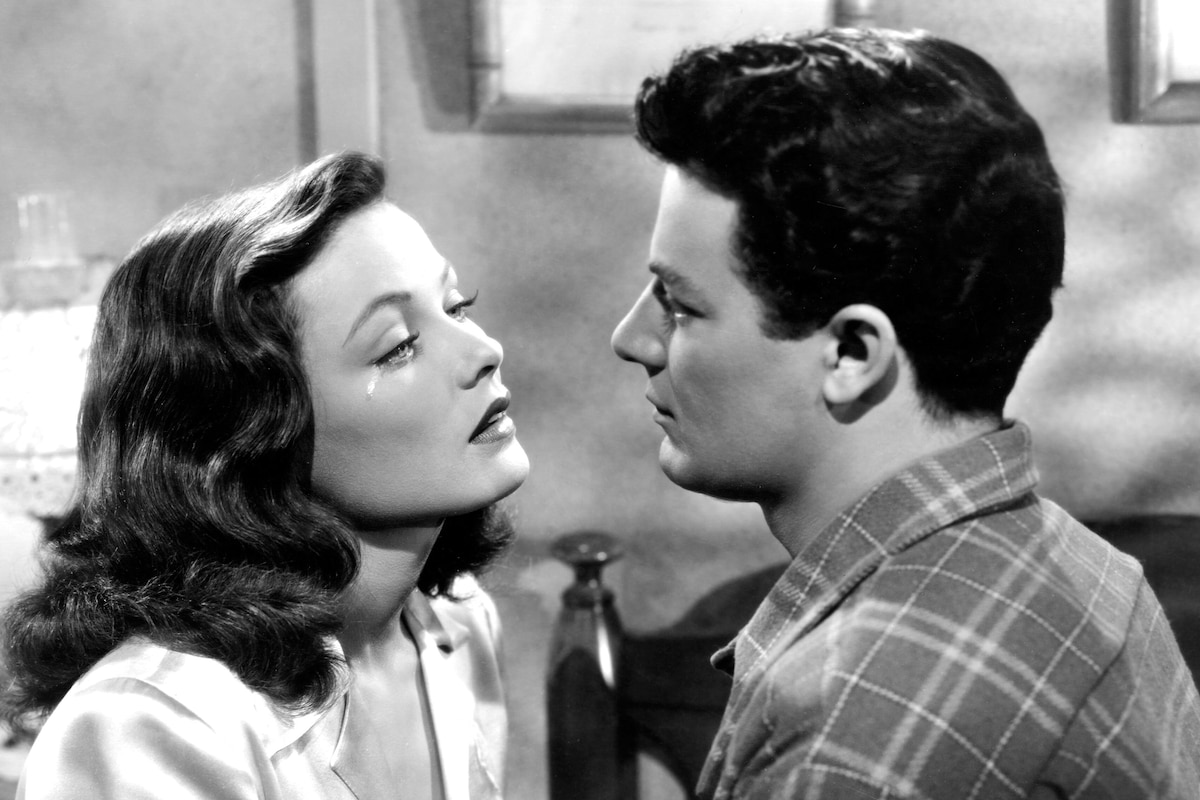
Based on a bestselling novel, Leave Her to Heaven was a huge hit with moviegoers and critics alike, and the character of Ellen became one of Gene Tierney's signature roles. As another character says of her: "There's nothing wrong with Ellen. It's just that she loves too much." It's a kind way of referring to a jealousy so venomous and out of control that Ellen will, quite simply, kill to be alone with the man she loves. The man is Cornel Wilde as Dick Harland, a novelist who meets the breathtaking Ellen on a train to New Mexico. Sparks fly and they are quickly married. Blissful married life, however, is threatened by Ellen's realization that Dick's crippled 13-year-old brother Danny (Darryl Hickman) will be living with them and needing constant attention. Then there's her sister (Jeanne Crain), who seems to be spending way too much time with Dick. And wouldn't having a baby be yet another obstacle to some alone-time? Ellen is consumed by these jealous obsessions and stops at nothing to eliminate them. One scene involving Ellen, Danny, a lake, a rowboat, and a pair of sunglasses is unforgettably chilling -- one of the great moments of its type in all of Hollywood history.
And through it all, Gene Tierney and the film itself look gorgeous. Leon Shamroy's photography includes amazing location work in New Mexico, Wyoming, Arizona and California, but Leave Her to Heaven is not simply pretty. It uses color purposefully and intelligently, as counterpoint to the evil doings of the plot; to have such a psychopathically obsessed character continually bathed in glamorous color (in lighting, costumes and make-up) creates a compelling tension. Rarely has bright color been so ominous, and in fact, Leave Her to Heaven is one of the very few color films from the studio era that could arguably be labeled "film noir."
Leave Her to Heaven was nominated for four Oscars. Shamroy won for Best Color Cinematography, but Tierney lost Best Actress to Joan Crawford for Mildred Pierce (1945). Two other nominations, for Color Art Direction and Sound, were lost to Frenchman's Creek (1945) and The Bells of St. Mary's (1945) respectively. Amazingly, Alfred Newman's superb Bernard Hermann-esque score was not even nominated -- and there were 21 Best Score nominations that year. (Miklos Rozsa won for Spellbound [1945].)
Twilight Time's Blu-ray, which has a limited pressing of 3000 copies, retains the extras that were included on the old standard DVD, including a trailer, vintage Movietone News footage of the premiere and that year's Oscar ceremony (we see Shamroy accepting his award from D.W. Griffith), and a commentary track. But the big addition here is the isolated score track. Newman's score is iconic, and it's a pleasure to be able to listen to it on its own.
The commentary track features critic Richard Schickel and actor Darryl Hickman, who played young Danny in the film. Their comments, not recorded together, flip-flop back and forth through the movie -- a bit frustrating at times, as it would be nice to hear them discuss certain things together. For example, both make interesting points about the mannered acting style of the 1930s and '40s, before the advent of Method acting in the '50s brought a new fire to the screen. Hickman points out examples of the actors "indicating," or registering emotion and thought from the outside in, rather than vice-versa. Schickel offers intelligent, though at times repetitive, points about Stahl's choices and is especially interesting comparing Stahl to Douglas Sirk, another director who made similar kinds of melodramas a decade later.
Hickman also makes some nice observations on Shamroy's work, such as pointing out the shadows of tree branches on Tierney's leg in one scene to create the illusion that she is outside on a balcony, when in fact the scene was shot in a soundstage. He also recalls that Shamroy would insist on waiting 15 minutes for clouds to appear so that a shot would look more interesting. But overall, Hickman considers Leave Her to Heaven "the most difficult experience I ever had as a child actor," mostly due to the fact that director John Stahl and Gene Tierney were unkind to him. "Miss Tierney gave you nothing when you were working with her. And that's not what good acting is about. You either do it together or you don't do it at all." Stahl was mean to him throughout the shoot, he says, until the director received a telegram from Darryl Zanuck congratulating him on the famous lake scene. After that, says Hickman, "he treated me great [but] started to treat Cornel Wilde badly. Apparently he needed a scapegoat to pick on."
By Jeremy Arnold
Leave Her to Heaven on Blu-ray
by Jeremy Arnold | May 23, 2013
SIGN UP FOR OUR NEWSLETTERS

CONNECT WITH TCM