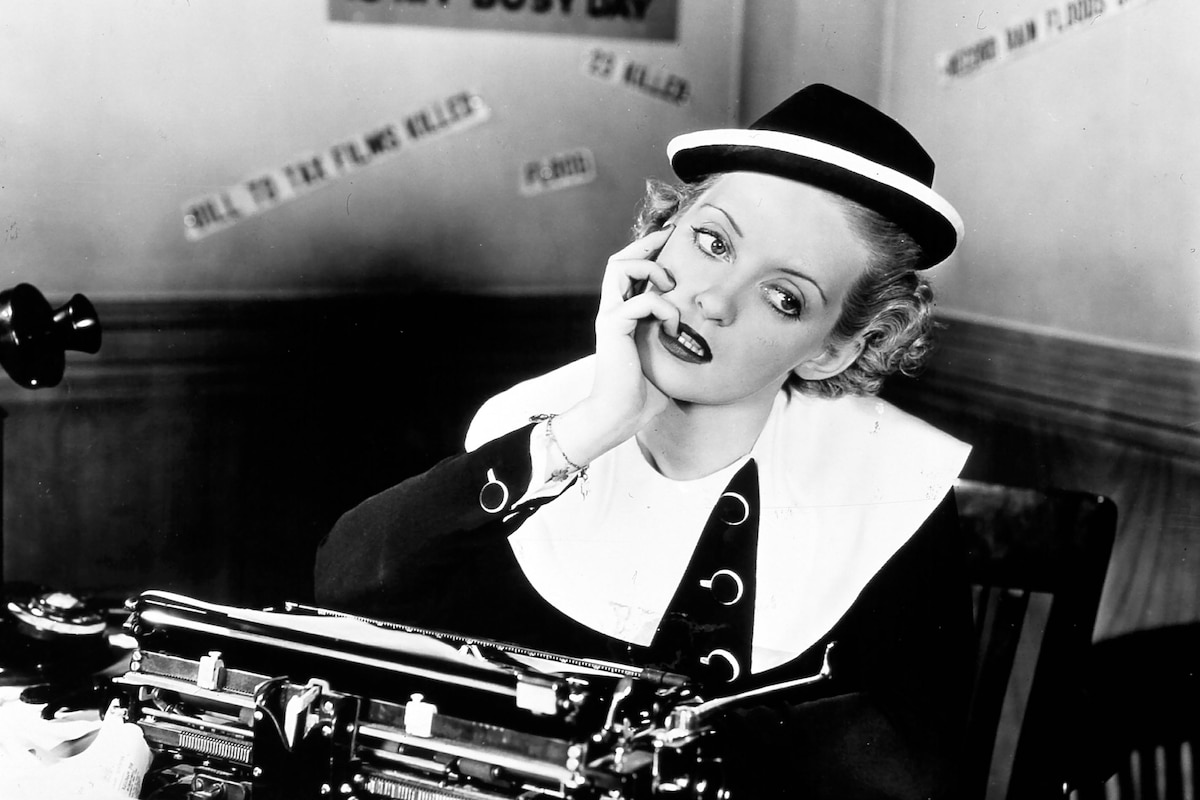
In Michael Curtiz's Front Page Woman (1935), Bette Davis plays a "gal" reporter who strives to prove she's as good as any man. Unfortunately, the chief male she has to impress is her own beau, fellow newsperson George Brent, who strives to undermine her at every turn. Only by proving that she's no good at so-called man's work can he hope to win her hand in marriage. Of course, in the end, she gets the scoop that proves him wrong. But the two still tumble into a happy embrace at the end, despite the fact that Brent's character has done all he can to humiliate her.
Even in the context of films of the mid-1930s, the story is overtly chauvinistic. But Davis is its saving grace: Even though she's trapped in a story that can't quite decide if it wants to defy old-fashioned ideas of feminine inferiority or reinforce them, Davis always makes the picture pleasurable to watch. Her performance is quietly subversive: In an early scene, she's been assigned to cover an execution, her first. Brent warns her how upsetting it's going to be, but she insists she can handle it. Still, you can see a flash of trepidation in her eyes. And sure enough, she faints before she can file her story. (Brent covers for her, though his efforts to help result in disaster.)
Davis brings layers of believability to the scene. This isn't just an instance of a woman being too frail to face ugly things: Davis plays her character's anxiety more as a spark of human decency than as weakness. Even when she faints, there's nothing flirty or manipulative about the way, just as she's begun to dictate her story by phone, she drops to the floor. She simply can't quite process what she's just seen; the guys who prattle on, going about their business as usual, are the ones who seem lacking in character. As Ed Sikov notes in his biography of Davis, "As a hard-headed 1930s newspaperwoman...Davis gets to develop her independent, driven persona: the career woman who doesn't give a damn if she ends up single. And she even manages to wear one of those skinny, weasel-like furs with the head still on it without looking camp."
Warner Bros. made Front Page Woman just a few years after the release of the United Artists feature The Front Page (1931) starring Pat O'Brien and Adolphe Menjou, and the picture is pretty clearly an attempt to duplicate that movie's success. (It also foreshadows, of course, His Girl Friday, 1940.) The picture was also one of three films Davis made with Brent in 1935. (The two would make a dozen or so films together over the years.) Davis liked Brent very much personally, though even she seemed to acknowledge the on-screen limits of this conventionally handsome but not particularly charismatic actor. According to Sikov, she claimed that Brent's "onscreen energy never matched his real-life vigor. After all, this man was a trained pilot and used to buzz the studio for laughs."
Still, the two are reasonably entertaining to watch in Front Page Woman, and the highly unrealistic nature of the plot adds to the fun. At the time of the movie's release, Variety didn't think much of it: "Lacks authenticity and is so far fetched it'll hand newsscribes around the country a constant run of ripples," the paper's critic wrote. But the critic for the New York Times had more fun with the movie, particularly relishing the over-the-top nature of Brent's character: "Ah, there's a reporter! His nose for news is so keen that a sniff of perfume on a dead man's coat collar is all he needs to track down a murderer. And when he walks up to the police lieutenant, hands him two photographs and says, 'Mac, arrest these people for the murder of Marvin Stone'-and the lieutenant does!-then, my friends, you have newspaper work at its best." Front Page Woman needs to be taken with a sense of humor and an appreciation for wholly ridiculous scenarios. But there's no getting around it: Davis, with her soulful, fetching eyes and neat blond bob, certainly does look terrific, even wrapped in those silly dangling fox furs.
SOURCES:
IMDb
Variety, December 31, 1934
The New York Times, July 12, 1935
Ed Sikov, Dark Victory: The Life of Bette Davis, Macmillan, 2008
Producer: Sam Bischoff
Director: Michael Curtiz
Screenplay: Lillie Hayward, Laird Doyle and Roy Chanslor; based on a short story by Richard Macaulay
Cinematography: Tony Gaudio
Music: Leo F. Forbstein
Film Editing: Terrell O. Morse
Cast: Bette Davis (Ellen Garfield), George Brent (Curt Devlin), Roscoe Karns (Toots), June Martel (Olive), Winifred Shaw (Inez Cordoza), Walter Walker (Judge Rickard)
[black and white, 82 minutes]
By Stephanie Zacharek
Front Page Woman (1935)
by Stephanie Zacharek | May 13, 2013
SIGN UP FOR OUR NEWSLETTERS

CONNECT WITH TCM