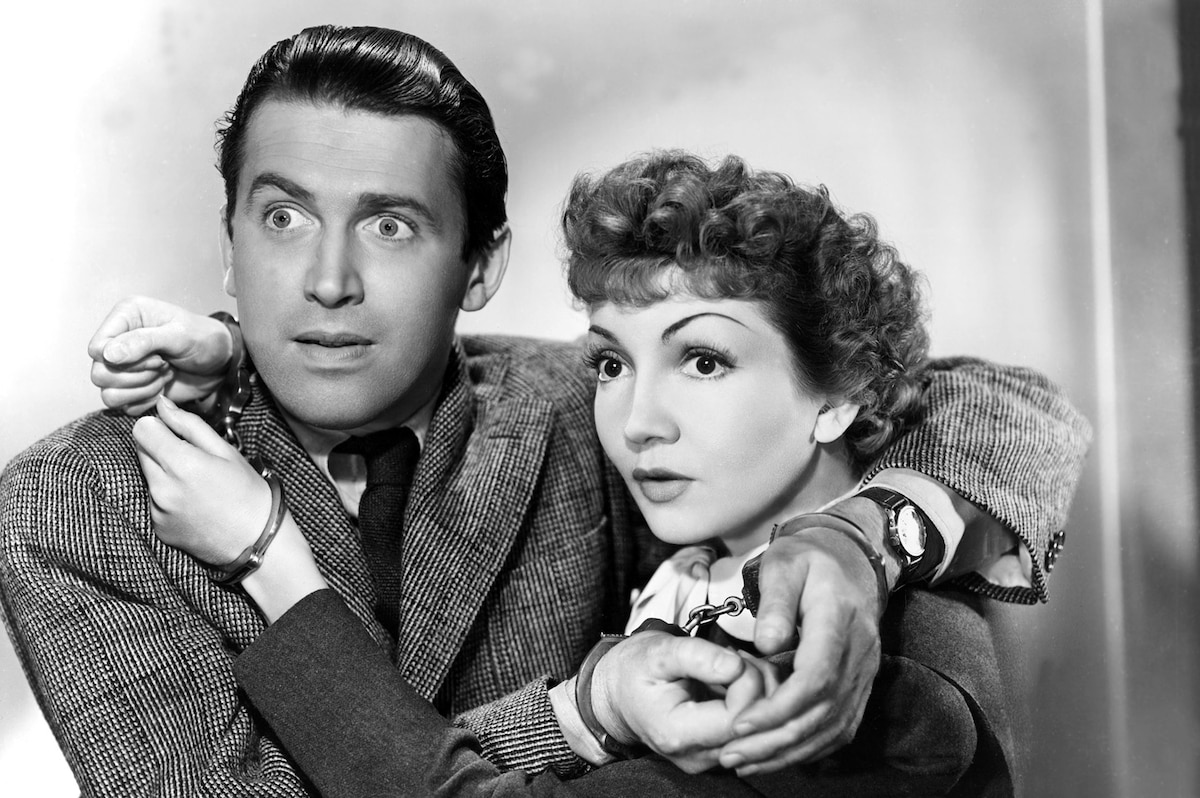
Screwball comedy is not something most directors can pull off easily but when it works, it's sublime, exhilarating and hilarious. During the heyday of this genre, however, there were just as many failures as there were successes but the reaction to It's a Wonderful World (1939) was decidedly mixed.
Though the film benefited from the star luster of
Claudette Colbert and James Stewart and some witty gags from the great Ben
Hecht, most critics at the time found it a strained attempt to revive a
genre they were tired of already. Over time, however, the film has
developed a devoted cult following as much intrigued by the casting as the
screwball antics. And it still draws viewers intrigued by the title's
similarity to one of Stewart's greatest films, It's a Wonderful Life (1946),
and the film's historical position in relation to some of the stars' and
writers' most notable work.
Hecht was one of the most in-demand writers in Hollywood when he sat down
with the equally witty Herman J. Mankiewicz to put together a screwball
farce for MGM. They came up with a story about a private eye on the run
from the law who takes an eccentric lady poet hostage to help him prove his
client innocent of murder. They also came up with a series of clever gags
and disguises -- most notably Stewart's posing as an actor named Ernest
Hemingway and his impersonation of a gangling scout leader in short pants,
scouting shirt and inch-thick glasses. Hecht even threw in some private
jokes, naming one character Willie Heyward in reference to his agent,
Leland Hayward, and another Herman Plotka, a combination of his co-writer's
name and Mildred Plotka, the real name of the actress character in his
classic farce Twentieth Century. With the script finished, Hecht
went on to his next project, an uncredited gig doctoring the script for Gone With the Wind (1939).
It's a Wonderful World was Colbert's first film at MGM, but her
dreams of getting the Metro glamour treatment were dashed when director
W.S. Van Dyke was assigned to the picture. Although he had helped create
the screwball genre as director of The Thin Man in 1934, he was
popular with studio head Louis B. Mayer mainly because he worked quickly,
earning the nickname "One Take Woody." His female star was appalled at how
quickly he threw the film together, being used to the more leisurely pace
at her home studio, Paramount, where great care was always taken to
showcase her beauty. Nor was she very happy when the film's road-trip plot
led to less than favorable comparisons to her earlier hit It Happened
One Night (1934). As consolation, she could revel in the more positive
reviews for the film that had preceded this one, the glittering romantic
comedy Midnight (1939). Her next film was also an improvement as she
teamed with director John Ford and co-star Henry Fonda for Drums Along
the Mohawk (1939).
Leading man Stewart was under contract to MGM at the time, but the studio
never seemed to know how to exploit his talents until other studios led the
way for them. A 1937 loan-out to Columbia for Frank Capra's You Can't
Take It With You had proven his skill at folksy comedy, which explains
his casting in this screwball farce. But his fans at the time were
horrified to see him playing a cynical and chauvinistic private eye who at
one point even slugs his leading lady.
Although It's a Wonderful World got some good reviews, particularly
from Hecht fan Otis Ferguson in The New Republic, it was mostly
dismissed by critics for having too many cheap laughs. Writing for the
New York Times, Frank Nugent complained, "Ben Hecht must have sent
out native beaters with tom-toms and slapsticks to drive stray gags from
miles around into the Metro corral for It's a Wonderful World....The
comedy is almost too strenuous for relaxation." After only three years as
an MGM producer, Frank Davis would return to writing after this picture,
scoring some of his biggest successes with his scripts for A Tree Grows
in Brooklyn (1945) and The Train (1964). Before that, however,
he would issue his own rather prophetic assessment of the production: "The
studio should have known that Jimmy Stewart would never do any of those
unconvincing things. However, I predict that his next film, Mr. Smith
Goes to Washington [1939], will more than make up."
Producer: Frank Davis
Director: W.S. Van Dyke II
Screenplay: Ben Hecht
Based on a story by Hecht and Herman J. Mankiewicz
Cinematography: Oliver T. Marsh
Art Direction: Cedric Gibbons
Music: Edward Ward
Principal Cast: Claudette Colbert (Edwina Corday), James Stewart (Guy
Johnson), Guy Kibbee (Capt. Streeter), Nat Pendleton (Sgt. Kortz), Edgar
Kennedy (Lt. Miller), Ernest Truex (Willie Heyward), Sidney Blackmer (Al
Mallon), Andy Clyde (Gimpy), Cecil Cunningham (Mme. Chambers), Hans Conried
(Stage Manager), Grady Sutton (Lupton Peabody).
BW-87m. Closed captioning.
by Frank Miller
It's a Wonderful World
by Frank Miller | November 24, 2003
SIGN UP FOR OUR NEWSLETTERS

CONNECT WITH TCM