The definitive fever-pitch newspaper comedy, Ben Hecht and Charles
MacArthur's 1928 play The Front Page is a cornerstone of the
screwball genre, serving as the foundation for several big-screen classics.
Beyond the official adaptations, the play's scheming editors, corrupt
politicians and slang-slinging journalists provided the inspiration for
innumerable imitations that followed in its wake, transforming the
fast-talking, conniving reporter into a bona fide cinematic icon.
In 1974, sharp-witted director Billy Wilder (Double Indemnity
(1944) revisited Hecht and MacArthur's Jazz Age saga, injecting it with a
fresh supply of comic give-and-take with the help of legendary screen duo
Jack Lemmon and Walter Matthau (in their third pairing, after The
Fortune Cookie (1966) and The Odd Couple (1968).
Hecht and MacArthur's play was, in the words of a 1931 Motion Picture
Herald article, "noted for its profanity and virility," ingredients
which were downplayed in most film versions, due to the threat of
censorship. Wilder was less concerned with the boundaries of good taste
so, when he and longtime collaborator I.A.L. Diamond (The Apartment
1960) began work on their screenplay, they immediately restored the rough
language and spicy double entendres that had once scandalized Broadway.
For the first time, The Front Page would reach the screen as it had
been originally written.
In Wilder's 1974 version, Lemmon stars as Hildebrand "Hildy" Johnson, a talented reporter who --
after falling in love with a young organist (Susan Sarandon) -- decides to
quit the Chicago Examiner and move to Philadelphia. Meanwhile,
Hildy's ruthless editor, Walter Burns (Matthau), uses every conceivable
ploy to keep the reporter from leaving town. This raucous battle of wills
is suddenly intensified when a meek Communist, Earl Williams (Austin
Pendleton), escapes from death row and practically lands in Hildy's lap.
Thus Hildy embarks on a madcap race against time to protect Williams,
deceive the other reporters, thwart a corrupt mayor (Harold Gould) and
sheriff (Vincent Gardenia), and break the front-page news of Williams's
plight, all before meeting his beloved Peggy at the train station.
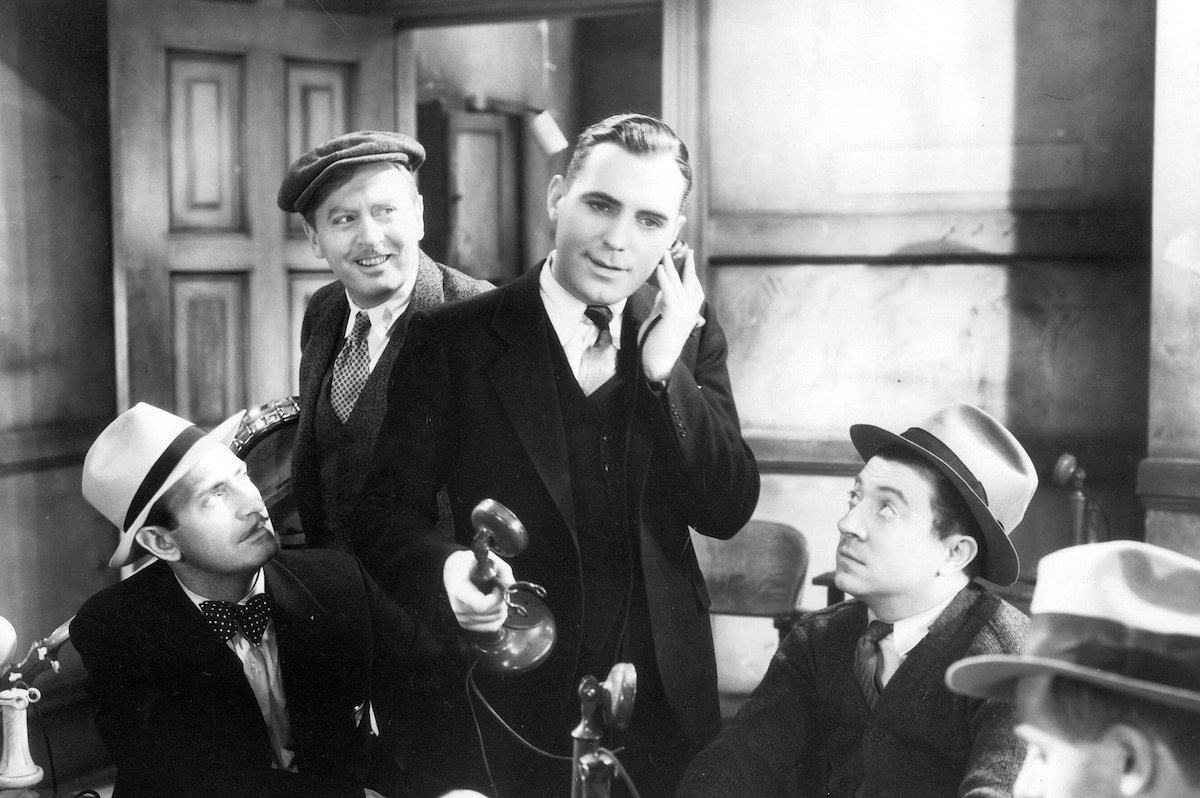
Howard Hughes was the first to bring the play to the screen, independently
producing a film version directed by Lewis Milestone in 1931 (with Pat
O'Brien and Adolphe Menjou in the leading roles). An equally famous
adaptation was released nine years later: Howard Hawks's His Girl
Friday (1940). Hawks changed the sex of the fleeing journalist, so
that crack reporter Hildy Johnson is a woman (Rosalind Russell), trying to
escape the editorial clutches of Cary Grant, investing the film with a
great deal of romantic tension. The same device was used in the 1988 film
Switching Channels, starring Kathleen Turner and Burt Reynolds.
Wilder, however, wanted to retain to the men's-club spirit of the brash and
unrelenting original, and reunited Hildy with his long lost
manhood.
Themselves veteran newspapermen, Hecht and MacArthur worked at rival papers
in 1920s Chicago, but never collaborated until years later, when they met
again in New York. The refined MacArthur had a fondness for the dramatic
stage, while the rough-and-tumble Hecht had a more hard-boiled approach to
storytelling. The blending of these two sensibilities provided the play
with a perfect mixture of theatrical craftsmanship and underworld
atmosphere, a mixture that is a crucial factor in every big-screen
adaptation of the text. Curiously, The Front Page was the
playwrights' second collaboration. Their first effort, The
Moonshooter, was never produced, as the manuscript was accidentally
left on a train while the besotted duo were indulging in a particularly
reckless tour of Prohibition New York.
A foul-mouthed ode to Chicago in the 1920s -- the renaissance of tabloid
journalism and political corruption -- The Front Page pays homage to
several memorable figures of the period. Walter Burns was a thinly-veiled caricature of
Walter Howey, the editor of the Chicago Examiner during
MacArthur's employment there. "He wore a polka-dot bowtie, neat linen and
a pressed suit," Hecht later recalled, "had a soft, benevolent look and air
(but) he could plot like Cesare Borgia and strike like Genghis Khan." The
corrupt Mayor of The Front Page is a winking homage to Big Bill
Thompson, who presided over Chicago during much of the 1910s and '20s,
governing the city according to his own system of campaign contributions
and political favors.
Wilder's effort to be faithful to Hecht and MacArthur's play came from his
deep sentimental attachment to the period of The Front Page. His
classic Some Like It Hot (1959) is also set in gangland Chicago and
is filled with similar characters, events and risque humor. In scripting
The Front Page, Wilder and Diamond expanded the stage-bound story
with scenes that relished the historical setting. In one sequence, Burns
visits the silent-movie theatre where Peggy plays the organ sing-a-long
with a follow-the-bouncing-ball song. Later, in an epic homage to the
slapstick era, the entire police force is launched on a Keystone Kops-style
chase, filling the streets of 1929 Chicago with an army of vintage Model
A's and T's, sirens blaring. Wilder's fondness for the subject and setting
is perhaps most evident in the film's opening title sequence, which depicts
the process by which a newspaper page is created, from the setting of type
by hand to the running of the thunderous high-speed presses.
Wilder was no stranger to the journalism genre. His 1951 drama Ace in
the Hole, follows an opportunistic reporter (Kirk Douglas) who furthers
his career by exploiting the misfortune of a man trapped inside a cavern,
turning it into a media circus. Unlike the carefree romp of The Front
Page, Ace in the Hole is a scorching indictment of irresponsible
journalism. Together, the two films demonstrate the range of Wilder's
cynical wit and gift for social commentary -- two sides of the same coin,
exploring the idea of yellow journalism with two remarkably different
results.
The decision to remake The Front Page in the 1970s may have been
prompted by the success of another male-bonding film: George Roy Hill's
Oscar-winning The Sting (1973), a clever Depression-era tale of the
double-cross and the devious men who perform it. Unfortunately, The Front Page did not ignite the same audience interest as the Paul Newman/Robert Redford film. Screwball comedy with cynical twists did not play well to skeptical, Watergate-era audiences, and
Wilder himself later admitted that The Front Page was perhaps better
suited to a bygone age. "The times were better, or we were a little bit
more naive," said Wilder, "we laughed easier."
Director: Billy Wilder
Producer: Paul Monash
Screenplay: Billy Wilder and I.A.L. Diamond
Based on the play by Ben Hecht and Charles MacArthur
Cinematography: Jordan S. Cronenweth
Production Design: Henry Bumstead
Music: Billy May
Cast: Jack Lemmon (Hildy Johnson), Walter Matthau (Walter Burns), Susan
Sarandon (Peggy Grant), Vincent Gardenia (Sheriff Hartman), David Wayne
(Roy Bensinger), Austin Pendleton (Earl Williams), Allen Garfield (Kruger),
Charles Durning (Murphy), Herb Edelman (Schwartz), Harold Gould (The
Mayor), Cliff Osmond (Officer Jacobi), Carol Burnett (Molly Malloy).
C-105m. Closed captioning.
by Bret Wood
The Front Page (1975)
by Bret Wood | November 24, 2003
SIGN UP FOR OUR NEWSLETTERS

CONNECT WITH TCM