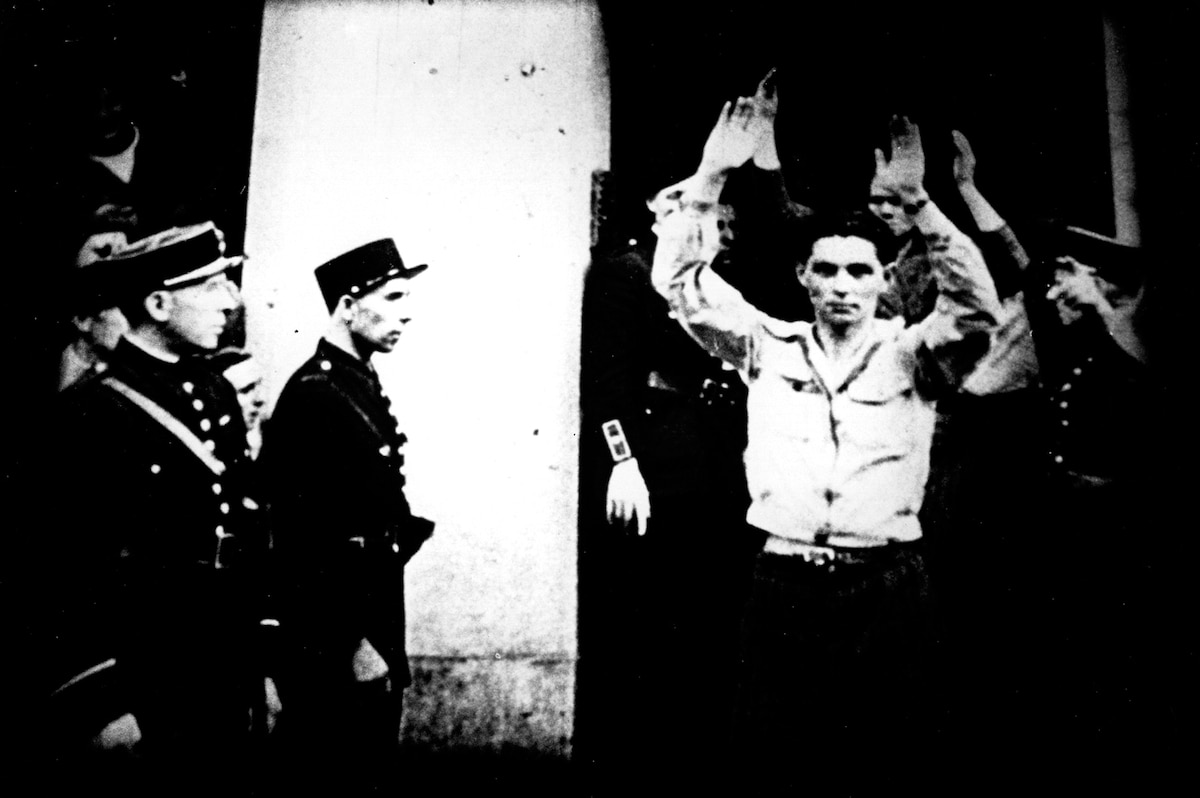
Marcel Ophuls' The Sorrow and the Pity (1971) is an absorbing portrait of the complexities of survival, resistance or capitulation in Nazi-occupied France during the Second World War. This newly restored film features exhaustive interviews with enough intriguing figures to fill a dozen spy novels. Just a few of the ordinary and famous subjects who document their experience of the war for Ophuls are Churchill's Foreign Secretary, Sir Anthony Eden, working-class resistance fighters, a German soldier Helmut Tausend, stationed in France during the war, an aristocratic French Nazi, a British spy in France who worked undercover as a
gay cabaret performer and entertainer Maurice Chevalier, who defends himself against charges of sympathizing with the Germans.
Ophuls' four-hour plus documentary is set in and around the French provincial town of Clemont-Ferrand where the director challenges the notion that all of France resisted the Nazi invasion of their country. Divided into two parts, Ophuls' documentary unfolds slowly, and the pace reveals an intentional strategy of gradually acclimating viewers to how a citizenry could allow their moral values to be compromised for the sake of personal gain or survival. One subtle message of Ophuls' film is how often the bourgeois collaborated with the Germans for wealth or to retain their status, and how it was often the humble peasants and farmers who exhibited the most patriotic and self-sacrificing behavior during the Occupation.
Subjects attest to acts of extreme kindness and bravery shown by humble French farmers who sheltered British spies and of unfathomable barbarity, such as the Gestapo's vicious torture and murder of a Resistance Fighter's wife. But cruelty cuts both ways in France and is not limited to wartime atrocities. Even with liberation, the nation was again divided as suspected Nazi collaborators and even women who dated German soldiers were persecuted as enemies of the state.
The Sorrow and the Pity was originally made for French television, though it was not aired until 1981; some claimed it was because of its troubling indictment of French behavior during the German occupation. The film also offers a glimpse at how perniciously and subtly a nation can be transformed from resistant to compliant through propaganda and intimidation. Ophuls unearthed rare films for The Sorrow and the Pity including German newsreels (originally seen only in enemy territory) and the viciously anti-Semitic Jew Suss (1940) which show the climate of hatred that the Germans stoked. But several of Ophuls' subjects also attest to a closeted anti-Semitism that already existed in France, which the German occupiers merely exploited. In one eerie moment from a newsreel of the anti-Semitic exhibition "The Jew and France," viewers can see the face of esteemed director Ernst Lubitsch used to illustrate how to "spot" a Jew.
Ophuls' voice can be heard throughout the film, questioning his subjects and probing subtly, but effectively, ever deeper to reveal evasions and outright lies in the interviewees' statements. Ophuls saw the film as an examination of history as the "process of recollection, in things like choice, selective memory, rationalization."
The only son of the esteemed German-Jewish director Max Ophuls (La Ronde, 1950) who immigrated to America in the 1940s, Marcel Ophuls returned to France after an education at Hollywood High, Occidental College and the University of California-Berkeley. After several narrative films made at the onset of his career (light comedies like Banana Peel (1963) and Make Your Bets, Ladies (1965), Ophuls did not achieve real fame until he made The Sorrow and the Pity, a three-year project that has come to define his directorial career. Ironically, Ophuls, whose name is forevermore linked to the documentary form, prefers making entertainment films. But after The Sorrow and the Pity, the film he is most remembered for is Hotel Terminus: The Life and Times of Klaus Barbie (1988), yet another epic WWII documentary concerned with a Nazi war criminal. It won an Oscar for best documentary feature.
Director: Marcel Ophuls
Producer: Andre Harris and Alain de Sedouy
Screenplay: Andre Harris and Marcel Ophuls
Cinematography: Andre Gazut and Jurgen Thieme
Music: Maurice Chevalier
Film Editing: Claude Vajda
Appearances by: Georges Bidault, Matheus Bleibinger, Rene Bousquet (Himself (with Laval) archive footage, uncredited), Charles Braun, Maurice Buckmaster.
Part 1, BW-122m. Letterboxed.
Part 2, BW-129m. Letterboxed.
