James Cagney once told a friend that if you could survive seven years at Warner Bros., you could survive anything. During the thirties and forties,
Warner cranked out formula pictures to the literal exhaustion of its talent.
Musicals, adventures, melodramas - once the powers-that-be figured out
what clicked with audiences, they worked their people into the ground. Still, a lot of
artists broke through the assembly-line atmosphere to create memorable
characters in pasted-together pictures. Humphrey Bogart, who had been
trapped in an endless loop of disposable gangster roles, is a prime example.
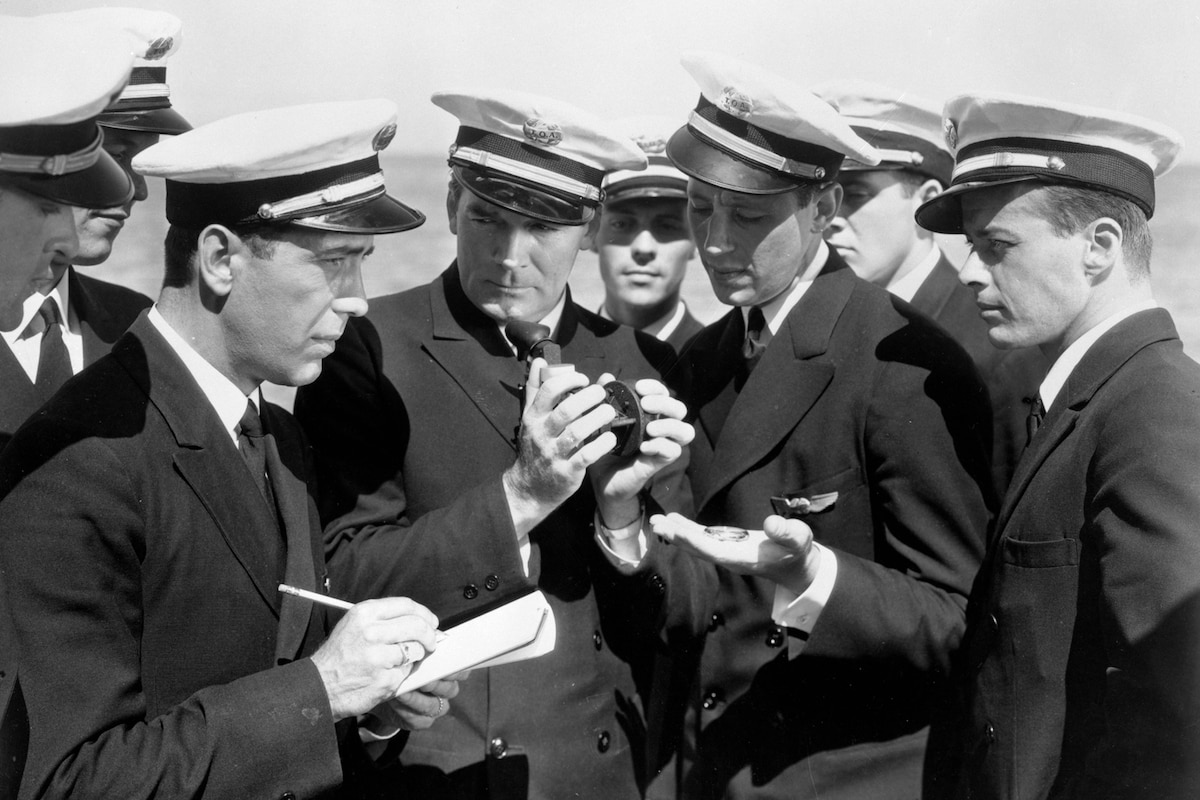
He's a supporting actor again in China Clipper (1936), but he seized the opportunity to play a good-guy and ran with it as far as he could.
Pat O'Brien stars as Dave Logan, a former World War I ace who's inspired to
create a trans-Pacific airline after Charles Lindbergh crosses the Atlantic.
But it takes him a while to do it. First, Dave teams up with his flying
partner (Ross Alexander) and an ambitious airplane designer (Henry B.
Walthall) to establish a Washington-Philadelphia line. Unfortunately, even
with the help of a wealthy backer (Addison Richards), the venture goes
belly-up. Undaunted, Dave recruits fellow flying ace Hap Stuart (Humphrey
Bogart) to join the group in launching a Caribbean airline. When that one
succeeds, he focuses on his trans-Pacific dream, which he hopes to
accomplish after building a plane called The China Clipper.
Obviously, Dave is a busy guy, and it leaves little time for his loyal wife,
Jean (Beverly Roberts.) Will he be able to achieve his dream while holding
together his marriage? Will Jean give up and leave her brave, fly-boy
husband? Frankly, it doesn't make much of a difference. Audiences were far
more interested in the flying footage, which utilizes newsreel shots of real
clippers as Bogart eases the plane over rough terrain and through even
rougher weather. AsMonthly Film Bulletin noted at the time: "Some
drama inherent in the actual achievement is lost in the manufactured drama
of the fictional plot. Nevertheless, vigorous direction with considerable
emphasis on close-up work smoothes over these failings and the flying in
general is quite exciting. Excellent entertainment." That's all Warner
Bros. was shooting for, and it turned out to be enough. One interesting bit of trivia: the screenwriter of China Clipper - Frank 'Spig' Wead - would later be the subject of a film himself, The Wings of Eagles (1957), directed by his pal, John Ford.
Producer: Samuel Bischoff, Louis F. Edelman, Hal B. Wallis, Jack L. Warner
Director: Ray Enright
Screenplay: Norman Reilly Raine, Frank Wead
Cinematography: Arthur Edeson
Film Editing: Owen Marks
Art Direction: Max Parker
Music: W. Franke Harling, Bernhard Kaun
Cast: Pat O'Brien (Dave Logan), Beverly Roberts (Jean 'Skippy' Logan), Ross Alexander (Tom Collins), Humphrey Bogart (Hap Stuart), Marie Wilson (Sunny Avery), Joseph Crehan (Jim Horn).
BW-89m.
by Paul Tatara
China Clipper
by Paul Tatara | November 24, 2003
SIGN UP FOR OUR NEWSLETTERS

CONNECT WITH TCM