There was a lot of pressure to get the movie into theaters by summer 1975, so the prep time was incredibly short for such a complex production. Principal photography was scheduled for May 1974, which Spielberg said was far too early, especially for special effects expert Robert Mattey to have the shark finished. Richard Dreyfuss said the picture was begun "without a script, without a cast, and without a shark."
One of the first scenes shot was the opening, in which the young woman swimming at night is eaten by the shark. Because of the method used for making it look like the swimmer is being thrashed about by the shark, Spielberg knew he needed a stuntwoman for the role and cast Susan Backlinie, a stunt performer who specialized in swimming scenes. She was fitted with a harness connected to a 300-pound weight that had ropes coming out of each side. Crew members on either rope ran first one way, then the other, to create the illusion of the swimmer being dragged back and forth in the water.
Three mechanical sharks were created for the shoot, collectively referred to as "Bruce." One was open on one side for left-to-right movement, another open on the other side for right-to-left shots, and the third fully covered for frontal shots.
According to production designer Joe Alves, the platform that operated the shark needed a minimal change in tidal depth, about 25 feet, and the downwind side of an island for protection. Locations were first scouted at Montauk and Sag Harbor, Long Island. Martha's Vineyard, an island south of Cape Cod, Massachusetts, proved to have all the right elements.
The first two months of the production were one disaster after another. Hoses burst, mechanisms malfunctioned, one of the three mechanical sharks ran aground. Zanuck and Brown witnessed the accidental sinking of the platform, rig, and shark. One of the biggest problems for realism and continuity was getting the shark's tail to move back and forth because the force of the water against the device was too strong. Everything really fell apart when they realized the shark had been designed for use in fresh water, not salt water. The number of technical problems forced the company to shoot everything they could without a shark until the kinks could be worked out.
The shark problems had an upside, too. Scheider said it gave all the actors a chance to know each other better and evolve as a team. "It made for a small repertory company over a period of five or six months." Spielberg agreed, noting that the cast was the best behaved he's ever had "because we were soldiers against an unseen enemy."
Spielberg said that the mechanical difficulties forced him to rethink how much of the shark would be seen throughout the movie, shifting it from "a Japanese Saturday-matinee horror flick to more of a Hitchcock, the-less-you-see-the-more-you-get thriller." In his original storyboards, the shark appeared three times more than in the finished film.
The script was reworked practically every night in improvisatory sessions involving Spielberg, writer Carl Gottlieb, the three male principal actors, and editor Verna Fields, who would walk them all through the consequences every change would bring about.
Despite the overwhelming difficulties, the company enjoyed the time on Martha's Vineyard, especially the actors, except Dreyfuss who was an up-and-coming young actor ready to get on with more projects. Spielberg said Dreyfuss used to half joke: "What am I doing here? I should be walking into Sardi's to applause and acclaim."
Apparently one of the elements responsible for keeping people more accommodating during the very long shoot was alcohol. Shaw was a heavy drinker, and he and Zanuck would get into fiercely competitive ping-pong games that even held up viewing the dailies from time to time. Zanuck said Shaw once proposed a wager on a game-his $200,000 salary against Zanuck's five percent of the profits. They played well into the night, quite drunk, long after everyone else went home. The bet was never settled. Sometimes the matches between these two hot-tempered men almost led to fistfights.
Dreyfuss said the only truly bad thing that happened to him on Martha's Vineyard was the cruel treatment he received from Robert Shaw. Although Shaw could be very nice to him in private, such as the time he read Dreyfuss his entire play, The Man in the Glass Booth, while the two were sitting in the hold of the Orca (the name for Quint's boat), publicly he was brutal to him, telling him things like he thought Dreyfuss would only have a career "if there's room for another Jewish character man like Paul Muni." In turn, Dreyfuss would antagonize him by throwing Shaw's liquor into the water. At one point, Shaw, remarking loudly on what he said was Dreyfuss' cowardice, dared him to climb to the top of the Orca's mast (about 75 feet) and jump off into the ocean, for which he would pay him upwards of $1,000 (the price rising with each taunt). Spielberg finally intervened by telling Dreyfuss, "I don't care how much money he offers you, you're not jumping off the mast, not in my movie."
The night before shooting the Indianapolis speech, Shaw called Spielberg and asked if he could have one drink before filming and do at least one take with no cuts "because this [speech] is the reason I made the movie." Shaw showed up on set the next day with substantially more than one drink in his system and had to be helped into the boat. He started it brilliantly but after a minute he stumbled on his lines and began rambling about his own personal life until the film ran out. Spielberg sent him home and shot inserts the rest of the day. The following day Shaw came in and did the whole monologue brilliantly.
The Orca was a 29-foot trawler that had to carry the weight of more than 20 cast and crew members at any given time. For several shots, the boat had to rock as if being struck by a huge shark from below. To accomplish this, there was a speedboat with a rope attached to it that ran under the Orca's hull and hooked to the other side. It would be gunned at full speed, causing the Orca to rock violently and everyone on board to fall, which is what they wanted. After doing that three or four times, a hole broke open in the Orca's hull. With safety boats rushing in and people yelling "Get the actors off the boat," the vessel sunk in about three and a half minutes.
Although he displayed enormous self-confidence on location, Spielberg began to have doubts about his ability to finish the picture. On top of that, Universal was starting to come down hard on him, badgering editor Verna Fields about the lack of action sequences, threatening to pull the plug on the Martha's Vineyard shoot and move the whole production to the calmer waters of the Bahamas. When the picture was already two months behind schedule, Universal boss Sid Sheinberg flew to the location to try to resolve the difficulties and was horrified to see that script work was being done every night. At some point, there was talk of re-shooting in a studio tank, which Spielberg was very much against. To his credit, Sheinberg stood by the young director, and the studio pressure and threats abated, even though it took another 40 days to complete shooting.
Most of the third act of the film, with the three men out on the sea to kill the shark, was handheld, occasioning Spielberg's comment that Jaws was the most expensive hand-held movie ever made.
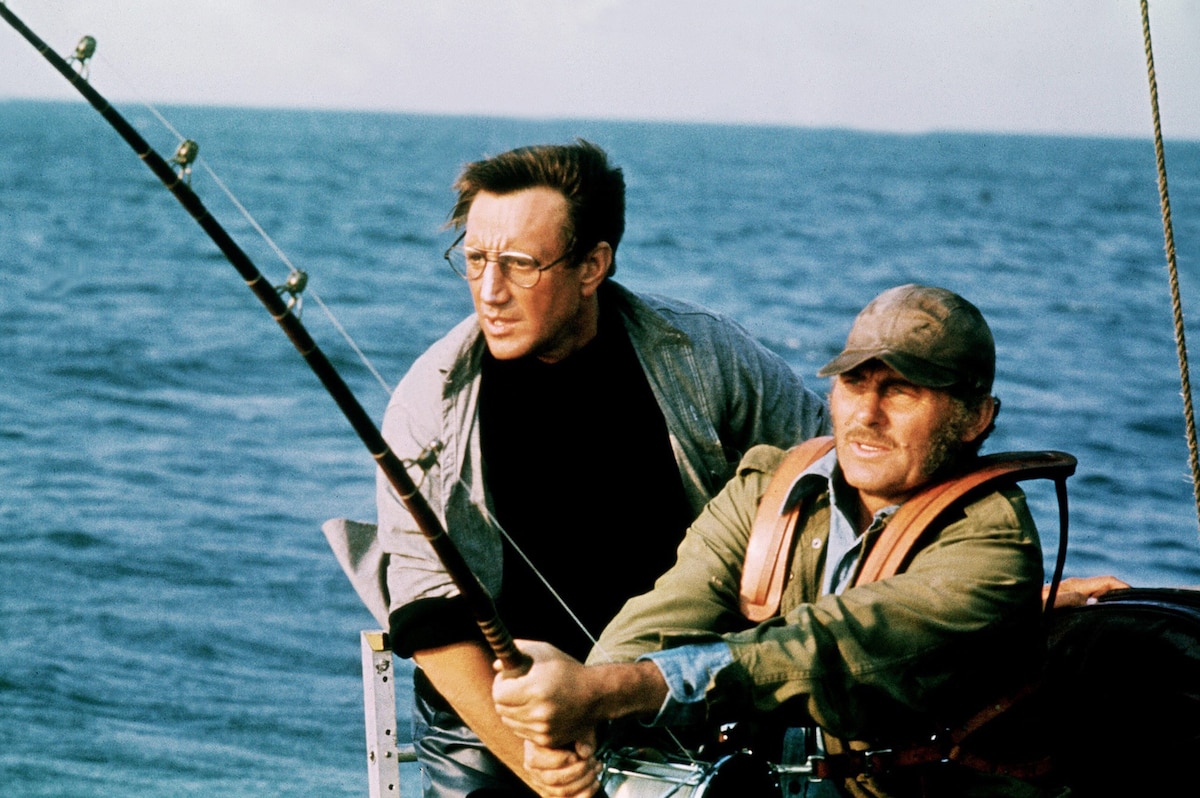
In the final scene (after Quint has been eaten by the shark and Hooper has escaped the damaged shark cage and hidden at the bottom of the ocean), Brody is left alone on the Orca, where he uses a rifle to shoot the scuba tank lodged in the shark's mouth and blows the animal up. The first shot called for the shark to leap out of the water and land on the transom. It took a half day just to prepare the shot. One camera was placed on the back deck, one inside the cabin to get Brody's point of view, and one on top of the cabin. The mechanical shark cooperated beautifully and Spielberg yelled "Cut." But the boat (not the main Orca but a lighter "prop" one designed to be destroyed and sunk) was so damaged it began to sink. The two lower cameras went into the water and Scheider dove over the side. Operator Michael Chapman dove over and caught a camera that was about to fall 20 feet into the ocean, saving the magazine from sinking. Butler acted quickly to save the waterlogged footage by placing it in a bucket of fresh water to keep it wet but without the damaging salt. A crew member had to fly to New York with the bucket and have the film developed immediately.
A scene of Brody's son's life being saved from a shark attack by a man, who then dies a gruesome death in the shark's jaws, was filmed but not included in the final film. Spielberg thought it was far too gruesome.
Underwater shots of a real shark were provided by Australians Ron and Valerie Taylor, well known for their underwater and shark photography.
By September, the people of Martha's Vineyard, at first curious and welcoming, were fed up with having the production on their island.
The blowing up of the shark was scheduled for the last day of the shoot. Four cameras were trained on it. Spielberg, however, was not there. He decided that before the crew did any kind of wild prank on him to mark the end of principal photography, he would just leave quietly. He and Dreyfuss were on a plane to Boston when the actor turned to him and asked how the final shot went. When Spielberg answered, smiling, "They're shooting it now," Dreyfuss began laughing hysterically.
When composer John Williams played the low, minimal notes of the shark theme for him, Spielberg thought he was joking. But after hearing it a few more times, the director began to like it, eventually saying the theme became the soul of the movie and gave the shark "an identity, a personality, a soul."
Spielberg has also given much credit to editor Verna Fields, one of the greats of her business, earning her the nickname Mother Cutter. Fields worked diligently to match the shots as closely as possible, despite weather conditions changing from shot to shot with the sea calm for one take and swelling for the next.
After the Dallas preview audience screamed only once in the picture (near the end when the shark first surfaces near the Orca), Spielberg decided to re-shoot the scene in which Hooper/Dreyfuss goes under water to dig a shark tooth out of a boat that has been attacked. As originally shot, he shines his light into the hole in the boat's hull and sees a dead face inside, but the preview audience didn't react very strongly to that. Spielberg asked Verna Fields if he could borrow her pool in Los Angeles. He put milk into the water to make it cloudy, ground up aluminum foil to simulate floating silt, and shoved the dead man's head out through the hole very suddenly into Dreyfuss' face.
Most reports say the production was budgeted at $4 million, which doubled by the time the picture was completed. Producer Richard Zanuck explained the rather more complicated process of budgeting Hollywood movies like this: "Our final budget was only $10 million. We started off with a very unrealistic $3.5 million, and it came up to around $8.5 million, and then they added some overhead and it was about 10."
by Rob Nixon
Behind the Camera - Jaws
by Rob Nixon | April 24, 2013
SIGN UP FOR OUR NEWSLETTERS

CONNECT WITH TCM