Alfred Hitchcock insisted on shooting the film in sequence, which meant most of the actors had to be paid for the entire shoot. When studio head Darryl F. Zanuck objected, the director insisted this was necessary to shape the unconventional narrative.
William Bendix joined the cast a few days into shooting when the original actor cast as Gus, Murray Alper, fell sick. Two weeks into shooting, cinematographer Arthur C. Miller also grew too ill to continue. He was replaced by Glen MacWilliams.
Zanuck's major concern about the film was length. Before production began and during its earliest days, he badgered Hitchcock to cut the film, insisting that he had had the script timed and felt that without cuts it would come in at almost three hours. Hitchcock insisted that whoever was timing the script was wrong and possibly sabotaging the production. He claimed the film would come it at about 90 minutes (it actually ran 97). Since Hitchcock was shooting in sequence, it was fairly easy to cut the film as they went along. As soon as Zanuck saw the first complete reel, he was satisfied and trusted Hitchcock.
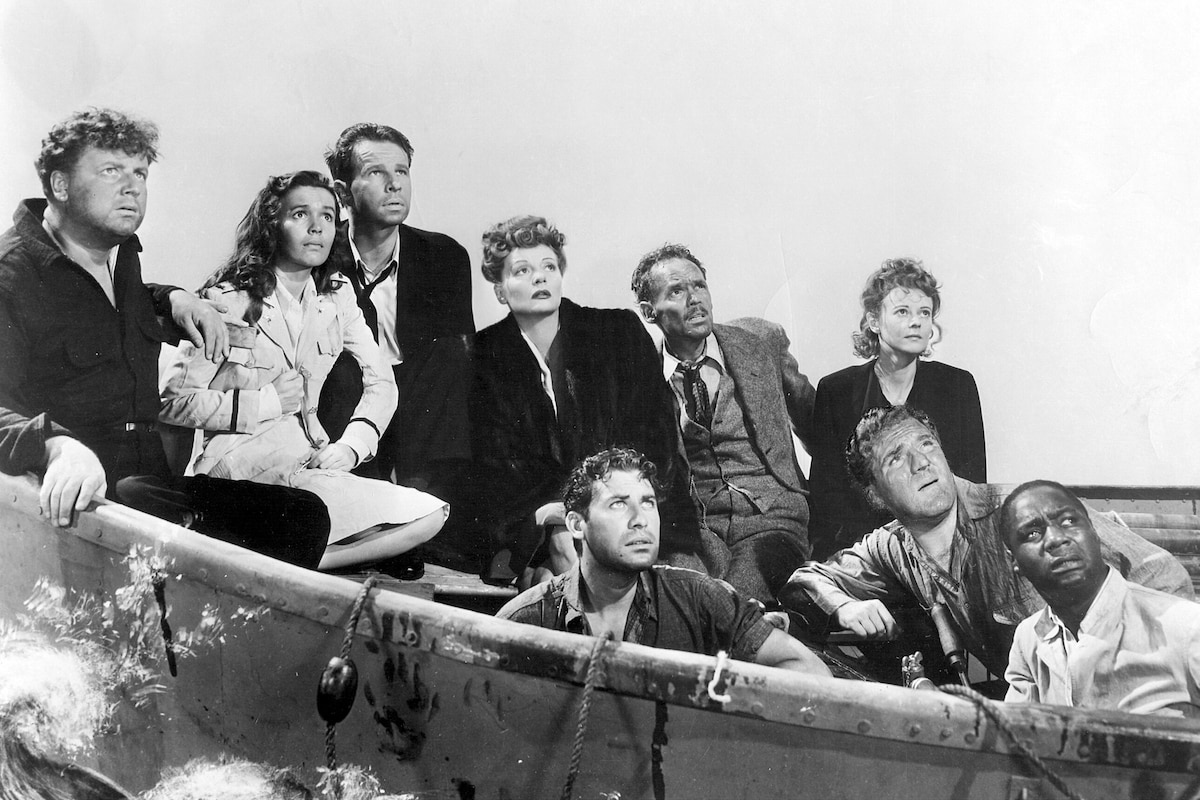
To get all the camera angles he needed, Hitchcock actually used four boats for the film. Two were the complete lifeboat. The other two were cut in half, one lengthwise fore to aft and the other from port to starboard.
The film was shot entirely at the studio, with lifeboats set up in two places. One was the studio tank, in which the boat was held in place by a system of underwater wires. There were water chutes on all four sides of the tank, each fed by a tank containing 4,000 gallons of water. For some scenes, however, there was a lifeboat suspended above rollers that duplicated the boat's movements on the waves.
Leading lady Tallulah Bankhead created a stir in Hollywood by refusing to wear underwear, a fact that was readily apparent whenever she hiked her skirts to climb into the lifeboat set. When a female journalist visiting the set complained, Zanuck sent orders that somebody tell her to dress properly. The problem was, nobody wanted to tell the temperamental star to do so. When the unit manager asked Hitchcock for advice, he responded dryly, "I've always tried to be very careful of getting involved in departmental disputes. And in a case like this it's hard to decide where the responsibility lies. You might consider this a matter for the wardrobe department, or perhaps for the makeup people -- or perhaps it's even for hairdressing!" (Hitchcock, quoted in Hume Cronyn, A Terrible Liar: A Memoir) In the end, Zanuck simply ordered the set closed.
To allow for quick changes in composition that would keep the picture visually exciting, Hitchcock kept a clipboard with a legal pad hanging from the camera dolly. Whenever he felt the need for a new composition, he would grab the clipboard, sketch out the image in a square approximating the film frame and hand it to the cameraman.
With so much of the film shot in the studio tank, Hitchcock had a lifeguard stationed out of camera range in case of emergencies. He came in handy when Hume Cronyn fell off the boat and got caught underneath one of the water agitators. The lifeguard saved him from drowning.
That wasn't the only mishap for Cronyn. During the storm at sea, he was supposed to be washed overboard by one wave and washed back on by another. They attempted to use a stunt double, but that wouldn't give Hitchcock the shot he needed. After the crew rehearsed the stunt with the double, Cronyn was wired into a harness that would allow them to pull him off the boat and back on. But since the stunt had been set up for a heavier man, it didn't work quite right. Cronyn was pulled back into the boat so violently he broke two ribs and had to get through the rest of the shoot with them taped up.
The rigors of production took their toll on the entire cast. They were regularly doused with water, shivering in wet costumes and then sweltering under the hot stage lights. By November, Tallulah Bankhead had contracted pneumonia, which shut down production. After three days off, she returned to the set, only to suffer a relapse. With only one shot remaining in the film, she convinced her doctor to send her back to the set immediately.
Bankhead was noted for her fierce political positions, including a vehement hatred of the Axis powers during World War II. Although co-star Walter Slezak was an outspoken critic of the German government, his Austrian background and the Nazi character he played in the film put him firmly in Bankhead's sites, and she insulted him constantly. When Italy surrendered during filming and Slezak expressed the hope that this would bring the war to an early end, Bankhead spat out "I hope they spill every drop of German blood there is. I hate them all! And I HATE YOU!" All he could say was "I'm sorry about that, Tallulah." (Bankhead and Slezak, quoted in Cronyn)
Production finished on November 17, 1943. The final budget was a little over $1.5 million. Hitchcock had spent so much time in story development and production that he never made the second film for which Zanuck had contracted him. Some biographers have suggested he deliberately dragged his feet working on Lifeboat since he made the same weekly salary whether he directed one film for them or two.
When Lifeboat premiered it triggered a major controversy over the depiction of Slezak's German submarine captain as more capable than any of the American characters in the lifeboat. Newspaper columnist Dorothy Thompson famously gave the film "ten days to get out of town" (Dorothy Thompson, quoted in Donald Spoto, The Dark Side of Genius: The Life of Alfred Hitchcock), while New York Times critic Bosley Crowther said that with very little cutting the film could be turned into a piece of Nazi propaganda. The Writers War Board called it "a credo of German super-intelligence and of the degeneracy of the democratic peoples." (Writers War Board, quoted in Joel Loebenthal, Tallulah!: The Life and Times of a Leading Lady) When he read the comments, John Steinbeck was so upset he wired Zanuck demanding his name be removed from the credits.
Although the film did good business in New York and other big cities, it failed to attract audiences in smaller theatres and rural areas. As a result, it was a rare Hitchcock film that actually lost money at the box office.
The film placed tenth on the National Board of Review's annual ten-best list.
Tallulah Bankhead was named Best Actress by the New York Film Critics.
Lifeboat was nominated for three Academy Awards: Best Director, Best Original Story and Best Cinematography.
Behind the Camera - Lifeboat
April 24, 2013
SIGN UP FOR OUR NEWSLETTERS

CONNECT WITH TCM