The Critics' Corner: DINER
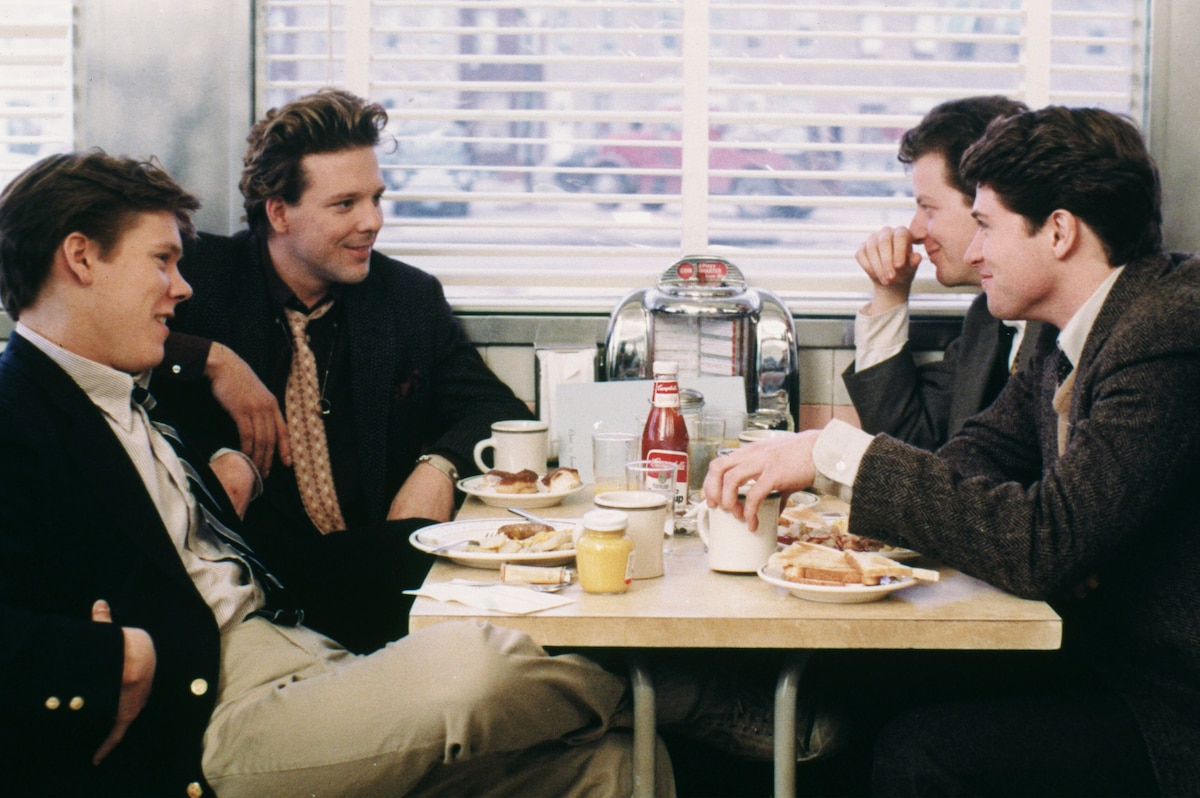
"You have a lot to learn about filmmaking," an MGM executive told Levinson after seeing the picture's rough cut. The executive complained that Levinson let the roast beef sandwich scene go on too long instead of getting on with the story. Levinson explained to him that the conversation was the story, that what they were really talking about was their relationship, their friendship.
The studio decided to test market the film first in Phoenix, which Levinson said was like "testing Fiddler on the Roof in Cairo," and St. Louis. The response was awful. Then, MGM-UA tried to fashion the movie's marketing to appeal to the audience for teen gross-out comedies like Porky's (1982) and Animal House (1978). When that failed, the studio was ready to shelve it until one of their publicists insisted on screening it for New York critics. David Denby called it "a small American classic" and Pauline Kael hailed it as "a great period piece." When Kael said she would publish her review even if the studio pulled the picture from distribution, executives were embarrassed into releasing it, now using an ad campaign that stressed the very favorable notices.
The film was opened in one theater in New York, the Festival, where it broke the house record on a weekday and during a blizzard. But the studio was still hesitant about opening it wide and sent it to a cinema in Boston next where it had a very good first week and broke that house record the second. The same thing happened in Toronto, then San Francisco. Nevertheless, the studio never did let the film play wide in the U.S., having only 200 prints of it circulating because, as Levinson said, "they were so adamant it was not going to succeed, and nothing was going to change their minds." The movie eventually earned about $25 million.
Diner received an Academy Award nomination for Best Screenplay Written Directly for the Screen.
The Boston Society of Film Critics awarded its Best Screenplay honor to Barry Levinson and Best Supporting Actor to Mickey Rourke.
The picture received a Golden Globe nomination for Best Picture - Comedy/Musical.
The National Society of Film Critics named Mickey Rourke Best Supporting Actor.
Levinson's screenplay was nominated by the Writers Guild of America.
Years later, cast member Kevin Bacon said he was very disappointed when he first saw the movie. He thought it was too quiet, that the whole cast was mumbling, that audiences wouldn't be able to tell the characters apart, and that it was too dark. "All those things that I had a problem with are all the things that people love about it," he said.
"It's easy to tell that MGM-UA's Diner was chiefly conceived and executed by a writer. In his directorial debut, Barry Levinson takes great pains to establish characters so real and universal that it's doubtful anyone will escape without seeing someone they once knew. But for all his painstaking accuracy, Levinson has also concocted a dark and depressing period story devoid of a single person without a major problem or character flaw. That makes for an interesting picture difficult for most audiences to watch. And for MGM-UA, difficult to sell." - Variety, December 31, 1981
"A wonderful movie...like a comic version of [Fellini's] I Vitelloni (1953). ... Diner is a great period piece-a look at middle-class relations between the sexes before the sexual revolution. ... Levinson doesn't violate his characters by summing them up-he understands that we never fully understand anybody. ... Levinson likes actors, the way Mazursky does. ... Levinson has a great feel for promise. At the diner, the boys are all storytellers, and they take off from each other, their conversations are almost all overlapping jokes that are funny without punchlines...and the actors all get a chance to be comedians." - Pauline Kael, The New Yorker, April 5, 1982
"Diner is often a very funny movie, although I laughed most freely not at the sexual pranks but at the movie's accurate ear, as it reproduced dialogue with great comic accuracy. If the movie has a weakness, however, it's that it limits itself to the faithful reproduction of the speech, clothing, cars, and mores of the late 1950s, and never quite stretches to include the humanity of the characters. For all that I recognized and sympathized with these young men and their martyred wives, girlfriends, and sex symbols, I never quite believed that they were three-dimensional. It is, of course, a disturbing possibility that, to the degree these young men denied full personhood to women, they didn't have three-dimensional personalities." - Roger Ebert, Chicago Sun-Times, 1982
"Diner isn't lavish or long, but it's the sort of small, honest, entertaining movie that should never go out of style, even in an age of sequels and extravaganzas. " - Janet Maslin, New York Times, 1982
"The film is wonderfully cast and played, right down to the bit player (Ralph Tabakin) who shops suspiciously for a TV set." ¬- Richard Corliss, Time, 1982
"An extremely clever, slick male fantasy that takes some time to work out its mood and tone but ultimately blossoms into a moving film." - Boston Globe, April 16, 1982
"Not a lot to it, but the sense of period is acute, the script witty without falling into the crude pitfalls that beset other adolescent comedies, and the performances are spot-on." - Geoff Andrew, Time Out January 2006
"[Diner] influenced a whole generation of writers, revolutionizing the way characters talk and how realistic we were going to be. And it was particularly influential with actors-this notion that you could play someone who was extremely real and at the same time be humorous and emotional. It had a complexity that not a lot of movies at the time had-they tended to be tremendously dramatic or broadly comic-and this was landing in a territory between, where somebody could be entertaining and humorous and also make you cry." - John Wells, executive producer of the TV series ER, quoted by S.L. Price in Vanity Fair, March 2012
by Rob Nixon
Critics' Corner - Diner
by Rob Nixon | April 24, 2013
SIGN UP FOR OUR NEWSLETTERS

CONNECT WITH TCM