Levinson auditioned about 600 actors for the five lead roles. The actors he chose were not widely known but were also not complete newcomers. The best known of the group at the time was probably Daniel Stern, who made his debut in the Oscar®-nominated Best Picture and Best Screenplay winner Breaking Away (1979), about another group of young men coming to terms with approaching adulthood. Mickey Rourke had done only a few small roles before he was cast here, although the picture did get some boost by his powerfully understated supporting performance in Body Heat (1981), a film he did after he was cast in Diner but which was released before. Steve Guttenberg had a handful of small feature roles and a short-lived TV series under his belt, as well as a leading role in the box office bomb Can't Stop the Music (1980), a disco musical featuring the Village People. Kevin Bacon had been in Animal House (1978) and Friday the 13th (1980) and did a stint as a troubled youth on the soap opera Guiding Light. Even Tim Daly, making his feature film debut, had some stage and television experience and came from an acting family that included father James Daly and sister Tyne Daly.
Ellen Barkin was, as Levinson recalls, the only woman he saw for the key role of Beth, Shrevie's wife. He realized immediately that she was perfect for it, although producer Jerry Weintraub balked, claiming she wasn't conventionally pretty enough. She and Levinson got along very well during the shoot. "I had an instant rapport with Barry," she later said. "Maybe it was two urban Jews together."
Guttenberg said he brought a lot of himself to the role, both his outward macho swagger and his inner conflict and insecurity. Levinson thought he was perfect as the guy who gives his fiancée a football test before their wedding. "He could be thickheaded, stubborn, appealing and likable, like Eddie."
Bacon had just decided not to renew his soap opera contract, and the audition for Diner was all he had on the horizon. But on the day he was scheduled for a screen test, he was very ill with the flu and a fever of 104. It was his intention to read for the part of either Boogie or Billy, but the illness gave him just the right "spaced out, not-all-there aspects of the character," as he later put it, to get him the role of Fenwick.
Bacon has said he was never very good at improvising like several of the other actors, so he would just sit and listen and grin, which turned out to be right for his character, who he considered "a reactive sort of character, someone who's kind of on the outskirts."
Levinson got all his cast down to Baltimore a week or so before shooting but didn't really rehearse them more than an hour or so a day. The idea was for them to just start hanging out together and getting to know each other. Levinson also said that for him rehearsal takes the edge off things. "I prefer to let the actors be almost struggling with their lines and worrying about how they are going to cope with certain things," he said in Levinson on Levinson (Faber & Faber, 1993). "If, as in the case of Diner, you are selecting certain actors who are not so far removed from their characters, then they are in the ball park already. So you want them to sneak up on that behavior without feeling they have to do lots of acting."
Kevin Bacon said first-time director Levinson hadn't yet learned to hone his skills in talking to actors. According to various cast members, he was so green-and perhaps so caught up in the process-that on the first day he forgot to say either "action" or "cut."
Despite his inexperience, Levinson was described later by Daniel Stern as "the most confident director you could imagine, especially considering none of us had any idea what we were doing."
Levinson later characterized his directing style and skills as trying to find "the idea of controlled freedom. It seems very loose and open, but I know where I want to go," adding that he likes to give as little apparent direction as possible.
Levinson learned a lot on this picture, not least to trust his own instincts when it came to choosing locations. He realized that no matter how good a location looked, unless he had an immediate sense of where the camera would go and how the actors would move around in the space, the location wasn't right.
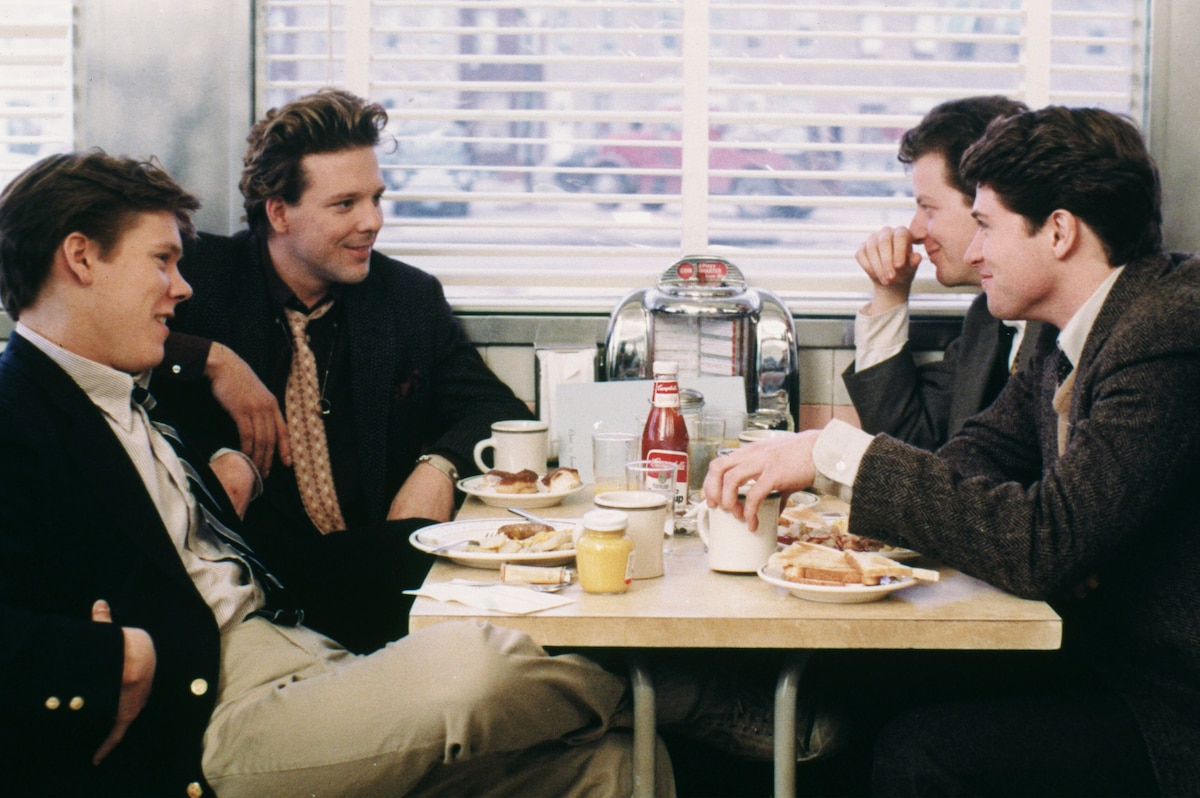
The camaraderie between the actors was crucial to conveying the sense that the characters had known each other a long time. An almost frat party sense of fun grew among them, or as Tim Daley put it: "A bunch of guys on a holiday in Baltimore, we were all pretty much in a sexual frenzy." They often went out cruising for women together (except for Stern who, like his character in the film, was the only one married at the time) and to strip clubs and bars. Sometimes they made up stories about who they were. Sometimes they claimed to be racecar drivers. One time, Daly came up with the idea of telling girls they were a group of engineers brought in to solve the problem of twisted plumbing in a revolving restaurant. Whenever Levinson perceived the bond between them was flagging and tension was growing, he would confine them to what became known as the "camaraderie camper," a small trailer on set they were crammed into five and six at a time to just hang out, talk, argue, whatever, "like a frat house, and it worked," Daly said.
In an interview with TCM years later, Bacon said Guttenberg used to eat "incredible amounts of food" and drink milk all the time, and that he looked up to Mickey Rourke as a kind of mentor or teacher. Bacon felt Rourke was very intense and skilled at being "very, very small" in terms of his subtlety, doing work "that you almost are unable to see being shot at the time, and then it gets on camera and it just, you know, explodes into something great."
Levinson shot all the diner scenes at the end of production when the bond between the actors was at its maximum.
Although not part of the "boys' club," Ellen Barkin got along well with the male actors. Guttenberg later noted how she was "really cool to talk to" and would set him straight about his own problems with women.
Michael Tucker, who played the small role of Bagel, had the greatest local advantage of the cast, being a Baltimore native who knew the accent exactly.
The greatest source of competition among the actors came about when they were called on to improvise, a skill in which they each had different abilities. Bacon, by his own admission, was the least adept at it. Tim Daly said it was hardest to top Paul Reiser's improv dexterity because "he's the sharpest, fastest guy alive."
The production had a diner location picked out but it was on a highway, necessitating shutting down traffic, and the owner wanted to charge them an exorbitant amount. Levinson and producer Mark Johnson found a diner "graveyard" in New Jersey where they could buy one and have it moved to Baltimore. The city gave them a plot of land to use on the waterfront. Levinson said the production designer originally planned to face the diner on the water because the view of the city out of the windows would be very picturesque, but the director insisted that diners need to face the road to attract customers driving by. The more experienced crew members kept arguing to face the diner onto the water, and Levinson wavered slightly, because he had never made a movie before. Finally, however, he put his foot down. "At some point you have to step up, otherwise you're lost, you might not make the movie you see," he said, citing this incident as another valuable lesson he took through his career. "I had to go on my intuitive feeling that this is what is right. In a sense, it's the only thing that I've used as a guideline. In every thing I've done, I can only go with what makes sense to me."
Levinson delivered the movie on time and about $500,000 under its initial budget of $5.5 million.
by Rob Nixon
Much of the material for this section came from the documentary by Bruce Stuart Greenberg, Diner: On the Flip Side (2000).
Behind the Camera - Diner
by Rob Nixon | April 24, 2013
SIGN UP FOR OUR NEWSLETTERS

CONNECT WITH TCM