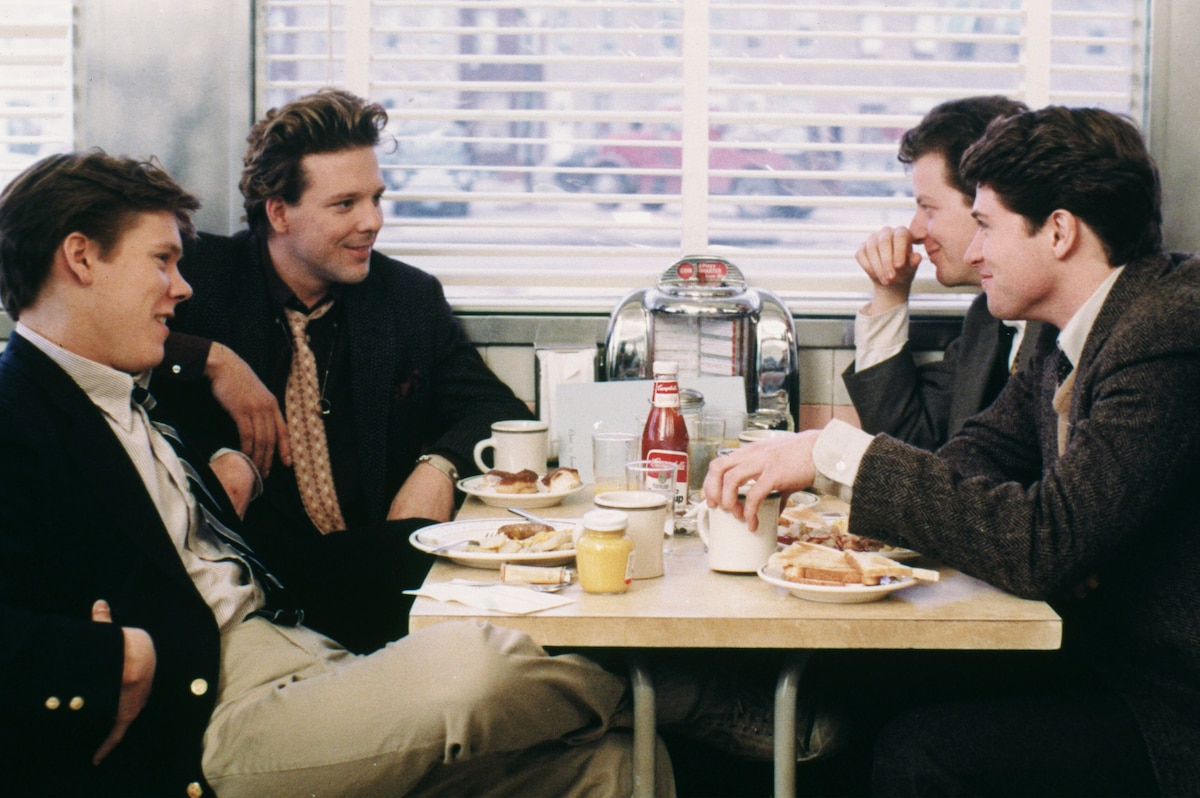
Barry Levinson was born and raised in Baltimore and, although he would have been slightly younger than his characters in this movie, he knew well the milieu, particularly the nights young men used to spend at the local diners. When he was in high school, he and his friends used to gather at the Hilltop Diner, "the place to go after you took your date home. ... That's when the night really started. You'd get there at two in the morning, and you stayed until daybreak."
While working as a writer on Silent Movie (1976) and High Anxiety (1977), Levinson would tell director Mel Brooks about his experiences at the Hilltop Diner. Brooks said they reminded him of Fellini's I Vitelloni (1953) and encouraged him to build a screenplay around them.
At first the idea of putting together a story based on his memories of the guys he knew in Baltimore wasn't appealing to Levinson until he realized that all of the stories were really about women. "When I figured that out, I realized why we guys behaved the way we did; that the whole idea of hanging out at the diner together created this amazing naiveté in terms of women, and then I could begin to try and deal with it."
While his wife and writing partner Valerie Curtin was away on an acting gig, Levinson sat down and wrote the script for Diner on a legal pad in three weeks. He never went back and rewrote it, although the finished film would incorporate a great deal of improvisation.
Levinson's creativity in writing the script was fueled by not only his general theme-the difficulty young men have with women-but by the challenge of making his movie as close as possible to true life. "I want to make the movie seem as if it's happening in front of you," he is quoted in Jesse Kornbluth's introduction to Three Screenplays by Barry Levinson (Atlantic Monthly Press, 1990), explaining that he often doesn't believe the dialogue of movies he sees. "In life, conversations aren't very accurate or focused. We are fairly inarticulate. We get screwed up, we go sideways. ... There's overlap. ... In a mystery film, the script and language must be specific. The closer you get to life, the more you find digressions."
Levinson took his screenplay to Mark Johnson, then head of production for producer Jerry Weintraub. Johnson appreciated what Levinson was doing in the script and brought it to his boss. Neither Weintraub nor executives at MGM understood what they were really getting, but they were impressed with Levinson's screenwriting track record (including the two Brooks movies and another two he had co-written with Curtin, the Al Pacino vehicle ...And Justice for All,1979, and the critical indie hit Inside Moves, 1980) and with the fact that Fox had given him the go-ahead to direct his and Curtin's script for Toys (eventually made in 1992 after a change of hands at the studio derailed the original offer). Assuming they had an inexpensive teen comedy or another nostalgia piece like American Graffiti (1973) on their hands, they gave him a budget of $5.5 million and sent him off to Baltimore to begin production.
by Rob Nixon
The Big Idea - Diner
by Rob Nixon | April 24, 2013
SIGN UP FOR OUR NEWSLETTERS

CONNECT WITH TCM