SYNOPSIS
Baltimore 1959. A group of guys in their early 20s are alternately struggling to find their way into adulthood and avoiding it at the same time, making stabs at responsible lives but capping their days with carefree guy time at their local diner hangout. One of the group, Billy, returns home from college to serve as the best man at the wedding of Eddie, who refuses to go through with the marriage unless his future wife can pass a football trivia quiz. Among the other young men are Boogie, a womanizing hairdresser with a gambling problem; Shrevie, the one married man, having difficulty sharing his life with wife Beth; and Fenwick, a troubled, hard-drinking trust fund kid. Above all, what they are most preoccupied with are women, who are an unending source of mystery, desire, fear, and anxiety to them.
Director: Barry Levinson
Producers: Mark Johnson, Jerry Weintraub
Screenplay: Barry Levinson
Cinematography: Peter Sova
Editing: Stu Linder
Art Direction: Leon Harris
Original Music: Bruce Brody, Ivan Kral
Cast: Steve Guttenberg (Eddie), Daniel Stern (Shrevie), Mickey Rourke (Boogie), Kevin Bacon (Fenwick), Tim Daly (Billy), Ellen Barkin (Beth), Paul Reiser (Modell)
Why It's Essential
It's always heartening to see an enduring classic grow from a little movie that practically no one in Hollywood believed in-certainly not its studio, MGM/United Artists. Even more inspiring is the story of the film's near oblivion at the hands of executives disappointed not to get another teen gross-out comedy like Porky's (1982), only to have it resurrected by a critics' campaign that embarrassed the studio into releasing it. And all of this was done without compromise by the film's first-time director, Barry Levinson, working off an episodic, character-driven script taken from his own experiences as a young man in Baltimore in the late 1950s.
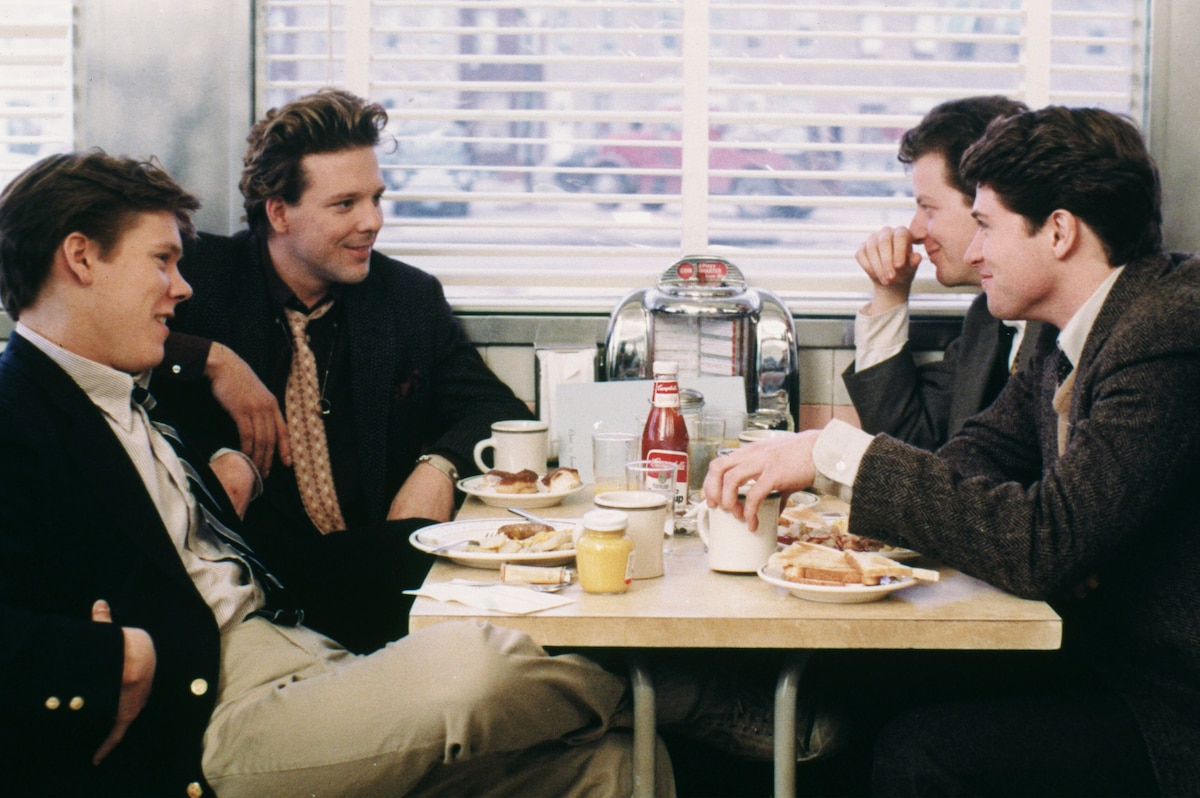
So just what was the studio's problem with the picture? More of that is detailed in the pages to follow, but in a nutshell, take the scene in the diner when Modell (a brilliantly improvisatory Paul Reiser) and Eddie (Steve Guttenberg) argue over a roast beef sandwich. Executives asked Levinson why that scene had to go on so long, why Eddie couldn't just give the food to Modell and get on with the story. Levinson replied that the roast beef sandwich, or at least the dialogue about it, was the story. Not the kind of thing a Hollywood bigwig wanted to hear in a year that included big-budget, high-concept sci-fi blockbusters like E.T. and Star Trek II; prestigious historical dramas like Gandhi; and, of course, Porky's. Diner wasn't something that fit neatly into any specific genre or niche. Was it a comedy? A drama? (Today, when many more films and TV shows emulate its style, we'd call it a "dramedy.") An exercise in fashionable nostalgia? A male buddy flick? Well, perhaps all that, but what the critical champions saw was a film about the way young men stumble into adulthood trying unsuccessfully to cope with their fearful, conflicted feelings about women, adolescents past their time whose only real solace is each other's company, like a bunch of little boys in a "girls forbidden" tree house (i.e., the diner).
Partly because it resonated so strongly with the men who had passed through that phase of life and the women who recognized their men in it, the film was rescued from obscurity and got out in front of audiences, not large ones at first, but better than initially expected, and growing over the years. Still, it might have been forgotten soon after by all but its most loyal fans if it hadn't also practically invented a style that was more widely appreciated about a decade later and remains key in popular culture through today.
To sum up that impact in a single word: Nothing. What the studio executives saw (and feared) were conversations about nothing, at least as far as advancing plot was concerned, dialogue Levinson assured them was entirely the point. In the 1990s, that invention became the hallmark of the sitcom Seinfeld (which proudly declared itself to be about nothing) and movies like Pulp Fiction (1994), one of the most influential films of its time, both of them prominently featuring guys sitting around diners and coffee shops throwing out pop culture references and speaking of little that could be mistaken for conventional plot. As an article by S.L. Price in Vanity Fair put it in March 2012, on the 30th anniversary of Diner's release: "Levinson took the stuff that usually fills time between the car chase, the fiery kiss, the dramatic reveal-the seemingly meaningless banter ('Who do you make out to, Sinatra or Mathis?') tossed about by men over drinks, behind the wheel, in front of a cooling plate of French fries-and made it central."
Delivering this strange new style was a cast of young actors whose careers were given a boost by this film. Ellen Barkin, Daniel Stern, Steve Guttenberg, Kevin Bacon, Mickey Rourke, Tim Daly, and Paul Reiser would all go on to have long and varied careers. The men in particular rose to the task of investing enough vulnerability and recognizable confusion into characters whose behavior wasn't always very likeable. Thanks to the ability to handle Levinson's digressive dialogue so naturally and winningly convey the sense of people entering adulthood with all their adolescent fears and flaws intact, the entire cast, down to the smallest supporting roles, helped make his offbeat, talky script into something people still quote from and remember with great fondness today.
by Rob Nixon
The Essentials - Diner
by Rob Nixon | April 24, 2013
SIGN UP FOR OUR NEWSLETTERS

CONNECT WITH TCM