There has been confusion over the correct name of the author of the original Frankenstein novel. Mary Shelley was born Mary Wollstonecraft Godwin, daughter of noted intellectuals William Godwin and Mary Wollstonecraft. Sometimes the author is credited as Mary Godwin Shelley but most often as Mary Wollstonecraft Shelley.
There's also some confusion about the picture's title. Although print ads and posters often read "The Bride of Frankenstein," the picture's title on screen does not include the initial article.
There has been some discussion over the years among those who study and analyze Bride of Frankenstein about what exactly is the time period of this movie. Judging from the Frankenstein castle, the village and its citizens, it appears to be set well into the past, certainly no later than Mary Shelley's own era (1797-1851), yet from certain clothing and hairstyles, particularly Elizabeth's, it looks contemporary to the 1930s. Adding to this impression are such details as the telephonic device Elizabeth uses to communicate with Henry from captivity. It was Whale's intention to create something of an alternate but somewhat up-to-date world, as he stated in an interview around the time of the film's release: "The whole of the theater, both stage and screen, is unreal, and if for an hour and a half the audience can be transported into a strange atmosphere in which unnatural things happen but appear to happen naturally and believably, the object of the film producer is accomplished." Universal's press book accompanying the film's distribution also identified the time as the present. Yet the story is being told by Mary Shelley back in the early 1800s. That would have been explained by dialogue cut from the prologue in which she says she's taken the story far into the future, making use of developments that will eventually become commonplace to science.
The title character's name in Mary Shelley's book was Victor Frankenstein. For some reason, it was changed to Henry for the 1931 version, a name logically retained for the sequel.
The film opens with footage of a graveyard scene from the 1931 original. For many years, the scene has been cut from some prints, particularly those aired on television.
Much has been made of the film's Christian imagery, such as the crucifix prominent in the hermit's hut, the sacramental "last supper" of bread and wine shared by the Monster and the hermit, and the shots of the Monster bound by his captors in a crucifixion pose. Film historian Scott McQueen, in his commentary on the DVD of the film, dismisses any notion that the Monster is meant to be identified with Jesus, claiming instead the imagery is a "mockery of the divine." McQueen says the Monster, created by man and not God, inverts the Christian belief of death by crucifixion followed by resurrection because he is risen from the dead first, then crucified.
One of the most distinctive, talented, and successful filmmakers of the 1930s, British-born James Whale began his show business career in the oddest way, putting on plays in a World War I prisoner of war camp. His London stage career as an actor, set designer, and director led to his early association with playwright R.C. Sherriff and actor Colin Clive, who played Henry Frankenstein. Following the success of his film adaptation of Sherriff's Journey's End (1930), he was offered a contract at Universal, where he made Waterloo Bridge (1931). His real fame came with the two Frankenstein movies, as well as The Old Dark House and The Invisible Man. Although he expanded his range with the musical Show Boat (1936) and the romantic comedy The Great Garrick (1937), he was typed as a horror director and soon grew tired of working in Hollywood. He retired from feature directing in 1941 and made only two more shorts in that decade (plus an unreleased full-length film in 1949), preferring to spend his life painting. In the 1950s, he suffered a series of strokes and committed suicide by drowning in his pool in 1957 at the age of 67.
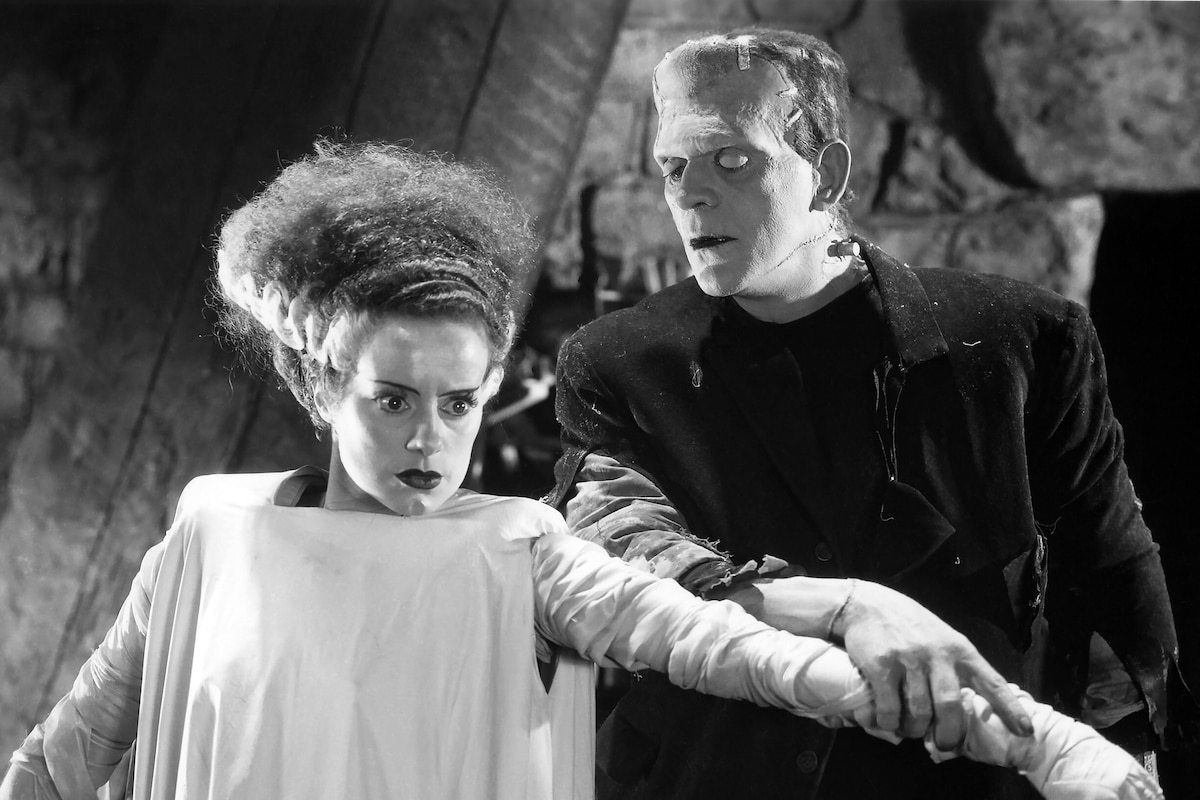
Boris Karloff is one of the great icons of horror films. Born William Henry Pratt in London in 1887, he began his film career relatively late, in 1919, but it wasn't until his turn as Frankenstein's Monster at the age of 44 that he achieved immortality. He worked steadily until his death in 1969. Karloff was by all accounts a gentle, refined man, quite the contrary of the frightening image he built up over the course of more than 150 films.
Elsa Lanchester (1902-1986) was born in London and started her career in British silents. She first came to the attention of American audiences as Anne of Cleves, the monarch's fourth wife in The Private Life of Henry VIII (1933), opposite Charles Laughton, to whom she was married from 1929 until his death in 1962. Other notable screen appearances include The Spiral Staircase (1945), Bell, Book, and Candle (1958), and Murder by Death (1976), as a spoof of Agatha Christie's Miss Marple character. She frequently played small parts in movies starring her husband.
Irish-born Una O'Connor (1880-1959) appears in the prologue as Lord Byron's servant and then in the story as the servant to Henry Frankenstein and his bride Elizabeth, both foreshadowing Elsa Lanchester's reappearance as the Bride after her role as Mary Shelley in the prologue and reinforcing the notion that the monster's story is all from Mary Shelley's imagination. She had a long career as a character actress providing comic relief in dramas, action-adventure pictures, and mystery-horror movies, often as a servant: The Invisible Man, The Barretts of Wimpole Street (1934), The Adventures of Robin Hood (1938), The Bells of St. Mary's (1945). Her final role was as a servant who provides damning testimony in Witness for the Prosecution (1957), which also featured Elsa Lanchester.
The roles played by E.E. Clive (Burgomaster) and Una O'Connor (Minnie, the servant) are very close to the ones they played in Whale's earlier film The Invisible Man. Their parts in Bride of Frankenstein were written specifically with them in mind.
James Whale's life partner, David Lewis, said he detested Ernest Thesiger, who was very nasty and "treated me like some kind of servant in my own home. He was a terrible snob, but he was related to aristocracy and that's what Jimmy [Whale] liked about him."
David Niven tested for the part of Percy Shelley.
The tiny mermaid in Dr. Pretorius' collection is played by Josephine McKim, a swimmer in the Olympics in 1928 and in 1932, where she was part of the gold-medal freestyle relay team. McKim appeared in a small handful of movies in the first half of the 1930s, including a turn as another mermaid in The King Steps Out (1936) and as Maureen O'Sullivan's nude body double in the underwater swimming scene from Tarzan and His Mate (1934).
The baby in Dr. Pretorius' collection is played by 11-year-old Billy Barty (1924-2000), who had one of the longest and most prolific careers of any Hollywood character actor despite, or because of, his diminutive size (3' 9" at his most developed). Barty appeared in such major productions as Gold Diggers of 1933 (1933), A Midsummer Night's Dream (1935), and Nothing Sacred (1937). He worked steadily for the rest of his life and was an important advocate for raising awareness about people of short stature, including founding Little People of America, a non-profit that provides support and information for those with one of the more than 200 medical conditions known as dwarfism.
Hollywood's supreme character actor, Walter Brennan, appears very briefly as an angry villager. Brennan had been in movies several years at this point, playing small uncredited roles like this. The following year, he would get a more substantial part and win a Best Supporting Actor Academy Award for Come and Get It (1936), his first of three.
by Rob Nixon
Trivia - Bride of Frankenstein - Trivia & Fun Facts About BRIDE OF FRANKENSTEIN
by Rob Nixon | April 22, 2013
SIGN UP FOR OUR NEWSLETTERS

CONNECT WITH TCM