The film was remade, after a fashion, as The Bride (1985), although it veered wildly from the original, having the Bride (here called Eva) and the Monster (given the name Viktor) running off to Venice together at the end. There is reportedly a new version in development, scheduled for a 2015 release.
In Kenneth Branagh's take on the story, Mary Shelley's Frankenstein (1994), the Monster kills Dr. Frankenstein's bride, Elizabeth, and removes her still-beating heart. The doctor puts her back together and restores her to life, only to have the Monster try to steal her. Realizing what Frankenstein has done, she immolates herself.
Arguably the most famous reappearance of the Bride character was in Mel Brooks' spoof Young Frankenstein (1974), in which Madeline Kahn played Dr. Frankenstein's intended, Elizabeth, transformed into the Bride not by reanimation from the dead but from having sex with the Monster, whom she eventually marries. The comedy also satirizes the famous blind hermit scene from this movie, with Gene Hackman as the kindly soul. Reportedly, Brooks found the original props and set pieces from Frankenstein's lab in storage and used them in his movie.
Universal's Frankenstein series continued with six more movies after this, although Boris Karloff only played him once more, in Son of Frankenstein (1939), which featured Bela Lugosi as Ygor. The Monster role was then taken by Lon Chaney, Jr. (The Ghost of Frankenstein, 1942, again featuring Lugosi as Ygor), and Lugosi (Frankenstein Meets the Wolf Man, 1943, with Chaney Jr. as the Wolf Man). Glenn Strange stepped into the costume in House of Frankenstein (1944), with Karloff as Dr. Niemann, Chaney again as the Wolf Man, and John Carradine (the hunter in this movie) as Dracula; House of Dracula (1945), featuring Carradine again as Dracula and Chaney as the Wolf Man; and in the final, comic installment Bud Abbott Lou Costello Meet Frankenstein (1948), which also had Chaney as the Wolf Man and the return of the original screen Dracula, Lugosi. House of Dracula also contained archive footage of Karloff as the monster in a dream sequence.
Footage of Colin Clive from this movie also turned up in The Ghost of Frankenstein, in the TV movie Silent Night, Deadly Night (1969), and in Cry Uncle! (1971).
Universal reused pieces of Franz Waxman's score for this movie in Flash Gordon and Buck Rogers serials and several B pictures.
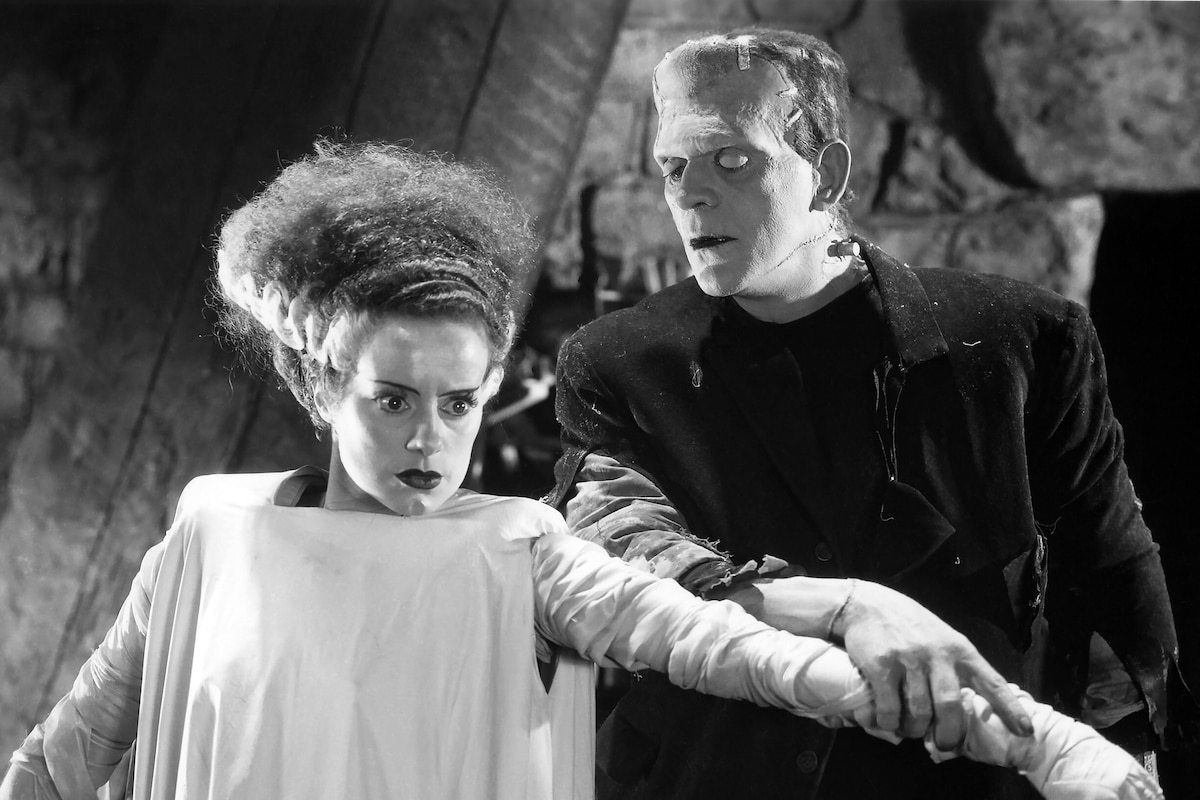
The look of the Monster (and variations thereof), as created by Karloff and Universal's make-up and costume departments, has been the standard image of the character in cartoons, Halloween costumes, and products (e.g., Frankenberry cereal). Interestingly, many cartoons and some costumes depict the Monster with a green face. Karloff did, in fact, wear green-tinted make-up but only to enhance the effect of deadness. It was never intended that the character actually be green.
The Bride's characteristic look-gowned, bandaged, and electro-shocked hair with lightning-bolt streaks of white at the sides-is also the standard for costumes and other likenesses. The white streaks may have also inspired the looks of other actors playing roles in horror films, including Rafaela Ottiano in The Devil-Doll (1936), Boris Karloff in The Walking Dead (1936), Humphrey Bogart in The Return of Doctor X (1939), and Ramsay Ames in The Mummy's Ghost (1944). Towards the end of The Rocky Horror Picture Show (1975), Magenta has hair like the Bride's.
Mary Shelley's story has been adapted several times with varying degrees of faithfulness to the novel, notably an acclaimed television production written by Christopher Isherwood and Don Bachardy, Frankenstein: The True Story (1973), with Leonard Whiting as Victor Frankenstein and Michael Sarrazin as his creation. That version also featured such acting heavyweights as James Mason, Ralph Richardson, John Gielgud, Michael Wilding, and Agnes Moorehead. Most significantly for Bride of Frankenstein, the TV movie depicted the creation of a female, called Prima, a beautiful but cold-hearted creature played by Jane Seymour.
A sinister character named Dr. Pretorius appears in the movie From Beyond (1986). The character name comes from the story by H.P. Lovecraft, not Mary Shelley's book, in which he did not appear.
It was noted years later that the first three notes of the Bride theme composed by Franz Waxman are the same as the opening notes of the song "Bali Hai" from the musical play and subsequent film and television adaptations of South Pacific. By the 1990s, the similarity had grown into an urban legend claiming Waxman had once sued Oscar Hammerstein for stealing the theme, a ridiculous twisting of facts since Hammerstein wrote the lyrics for South Pacific not the music. If any suit had happened-and it didn't-it would have been against composer Richard Rodgers.
Some modern film scholars have attempted a gay reading of the film, inspired in part by the knowledge that director James Whale was openly gay. Ernest Thesiger was also known for his campy impersonations, and his performance here was noted by gay film historian Vito Russo as "sissified." A 1936 novelization of the story in Great Britain emphasizes Pretorius' homosexuality, giving him the following line to explain his tiny creations: "'Be fruitful and multiply.' Let us obey the Biblical injunction: you of course, have the choice of natural means; but as for me, I am afraid that there is no course open to me but the scientific way." Both horror movie director Curtis Harrington, a friend of Whale, and producer David Lewis, Whale's life partner from 1930 to 1952, completely dismissed the notion that Whale created the film with any gay angle or hidden meanings.
Gods and Monsters (1998), a film based on the last years of James Whale (played by Sir Ian McKellen) takes its title from Dr. Pretorius' line "To a new world of gods and monsters!" At the end of the movie, Clayton Boone, a fictitious character played by Brendan Fraser, proves to his son that Whale had been a friend of his by showing him a sketch the director had given him of the Frankenstein monster with the words "To Clayton, Friend? Friend?" scribbled on it, an echo of the Monster's query to the newly created Bride. Lanchester, Karloff, Clive, Thesiger, and Jack Pierce appear briefly as characters in the story.
The crypt set in Bride of Frankenstein was the same one used in Dracula and later in Mystery of Edwin Drood (1935).
by Rob Nixon
Pop Culture 101 - Bride of Frankenstein
by Rob Nixon | April 22, 2013
SIGN UP FOR OUR NEWSLETTERS

CONNECT WITH TCM