The film opened in San Francisco on April 19, 1935, Good Friday, ironic (perhaps not so coincidental?) considering the Christian and crucifixion imagery that remained in the film. It was quickly a commercial and critical success, although some reviewers qualified their praise with a somewhat dismissive attitude about its being in the horror genre. According to a 1943 box office report, the film had by that point made about $2 million, returning a substantial profit.
Bride of Frankenstein was publicized in the British film trade as "for adults only and quite unsuitable for children or for nervous people of any age." British censors also objected to a shot of the Monster gazing longingly at the not-yet reanimated Bride, saying it smacked of necrophilia.
Sound director Gilbert Kurland received the film's only Academy Award nomination, for Best Sound Recording.
Director James Whale arranged a preview screening at Universal for Elsa Lanchester and her husband Charles Laughton, whose only comment after the screening was, "Doesn't Elsa have the most beautiful shell-like ears?"
In 1998, Bride of Frankenstein was added to the U.S. National Film Registry, having been deemed "culturally, historically or aesthetically significant."
Time magazine named the movie to its list of All-Time 100 Movies released between March 3, 1923 (when the magazine's first issue was published) and early 2005 (when the list was compiled).
"Karloff is so moving, like one of the great clowns who make you cry." - co-star Valerie Hobson (Elizabeth)
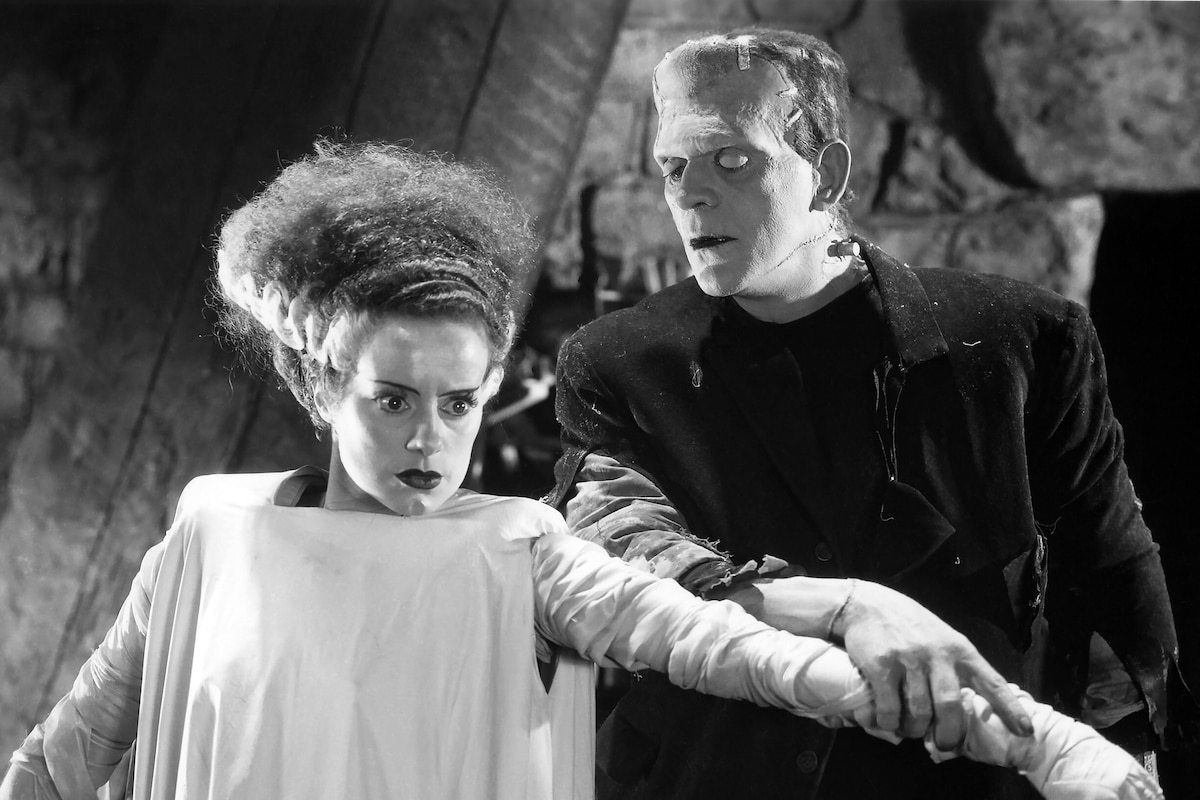
"One of those rare instances where none can review it, or talk about it, without mentioning the cameraman, art director, and score composer in the same breath as the actors and director. ... Karloff manages to invest the character with some subtleties of emotion that are surprisingly real and touching. ... Thesiger as Dr Pretorius [is] a diabolic characterization if ever there was one. ... Lanchester handles two assignments, being first in a preamble as author Mary Shelley and then the created woman. In latter assignment she impresses quite highly." - Variety, 1935
"The 'big moment' when the synthetic woman begins to breathe is duly spellbinding. ... Miss Lanchester, though her part is small, manages to make the Mate worthy of Karloff's gruesome Monster, and she is indeed a strange-looking 'new woman' with hair that stands out a foot from her head and movements as staccato as modern music." - New York Herald Tribune, 1935
"[The film has] a vitality that makes their efforts fully the equal of the original picture. ... Screenwriters Hurlbut & Balderston and Director James Whale have given it the macabre intensity proper to all good horror pieces, but have substituted a queer kind of mechanistic pathos for the sheer evil that was Frankenstein." - Time, April 29, 1935
"A fantasy produced on a rather magnificent scale, with excellent stagecraft and fine photographic effects." - Wood Soanes, Oakland Tribune, May 25, 1935
"Mr. Karloff is so splendid in the role that all one can say is 'he is the Monster.' Mr. Clive, Valerie Hobson, Elsa Lanchester, O. P. Heggie, Ernest Thesiger, E. E. Clive, and Una O'Connor fit snugly into the human background before which Karloff moves." - Frank S. Nugent, New York Times, May 11, 1935
"James Whale's The Bride of Frankenstein has an in-your-face audacity that hasn't dimmed all that much after 63 years. ... Bride is often cited as Whale's masterpiece, and one of the reasons surely is his intentional lacing of humor throughout that never completely undercuts the horror or pathos. ... Lanchester's twitchy Bride is one of the unforgettable screen presences, with her big birdlike movements and squawks and hisses, and perhaps the biggest joke of all comes when she lays eyes on her intended monster of a mate." - Bob Graham, San Francisco Chronicle, October 9, 1998
"The best of the Frankenstein movies-a sly, subversive work that smuggled shocking material past the censors by disguising it in the trappings of horror. Some movies age; others ripen. Seen today, Whale's masterpiece is more surprising than when it was made because today's audiences are more alert to its buried hints of homosexuality, necrophilia and sacrilege. But you don't have to deconstruct it to enjoy it; it's satirical, exciting, funny, and an influential masterpiece of art direction." - Roger Ebert, Chicago Sun-Times, January 3, 1999
"What distinguishes the film is less its horror content, which is admittedly low, than the macabre humour and sense of parody. Strong on atmosphere, Gothic sets and expressionist camerawork, it is, along with The Old Dark House [1935], Whale's most perfectly realised movie, a delight from start to finish." - Geoff Andrew, Time Out Film Guide, 2000
by Rob Nixon
Critics' Corner - Bride of Frankenstein
by Rob Nixon | April 22, 2013
SIGN UP FOR OUR NEWSLETTERS

CONNECT WITH TCM