The picture was budgeted quite lavishly for its genre at $300,000.
The film was shot entirely in the studio. Principal photography began in early January 1935.
Many sources say Whale had a few women in mind to play the Bride, probably led to this conclusion by Universal publicity claiming there had been a big talent search. Among the names bandied about: Brigitte Helm, the robot woman of Fritz Lang's Metropolis (1927), whose creation inspired the scene of the birth of the Bride in the lab; Louise Brooks, the American star who made a splash in Europe with Pandora's Box (1929); and Arletta Duncan, who played Elizabeth's bridesmaid in Frankenstein (1931). On the contrary, script drafts indicate Elsa Lanchester had long been considered for the role. Her name with a question mark appears on John Balderston's June 1934 draft, and six weeks later, she's indicated to appear as both the Bride and Mary Shelley.
Ill health prevented Mae Clarke from returning as Dr. Frankenstein's intended, Elizabeth. Whale cast 17-year-old British actress Valerie Hobson.
Various stories have Claude Rains as the first choice for the role of Pretorius, saying he was unable to do it because of other commitments or illness. Despite having directed Rains in The Invisible Man, Whale apparently always favored Ernest Thesiger for the part.
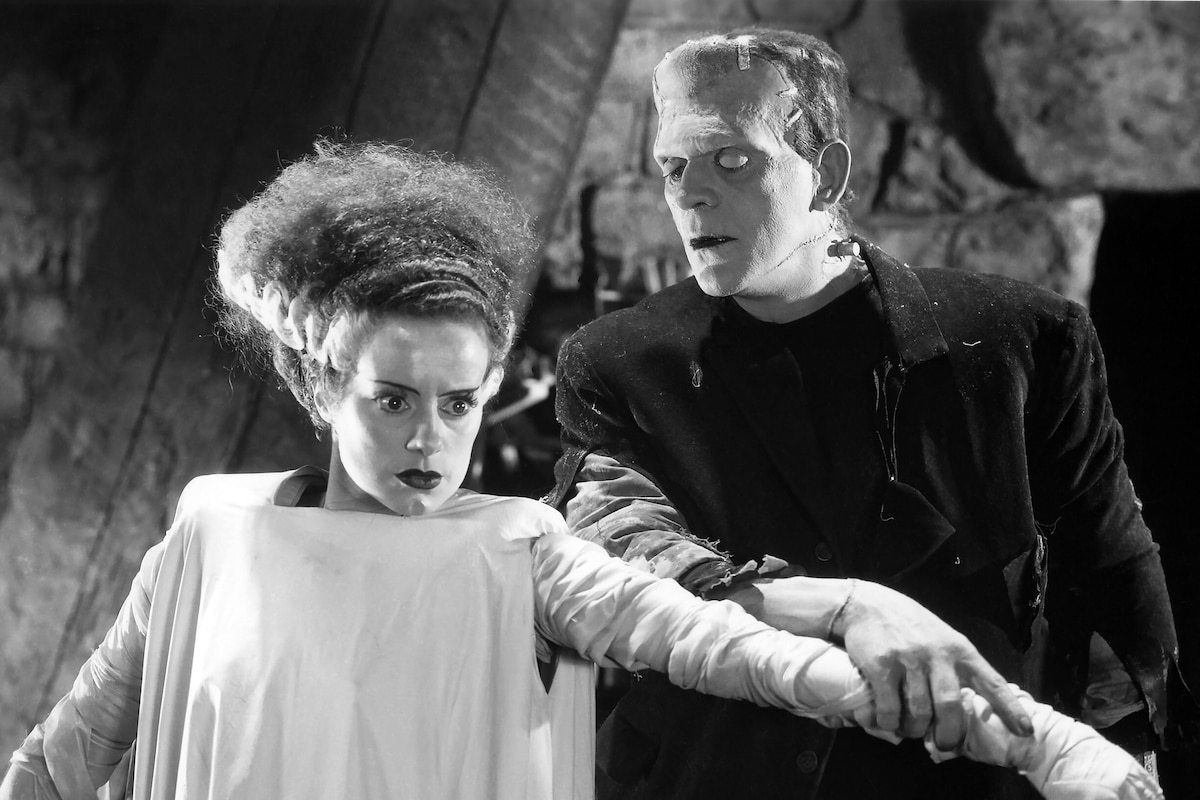
Karloff was against having the monster speak in this film, later saying he knew it would eventually destroy the character. The Monster's cheeks appear less hollow here because, in order to speak more clearly, the actor kept in the dental plate he removed in the first film.
Karloff was paid $2,500 per week, for a total of $12,500, a large sum in the mid-30s but perhaps not enough to compensate the 48-year-old for playing the role in the elaborate make-up and heavy costume, exacerbating his already severe arthritis. He lost 20 pounds during filming and had to lie down and rest between takes. While filming his first appearance on screen, in the flooded cellar, the rubber suit he wore under his costume to protect him from the damp and cold inflated, causing him to lose his footing and dislocate his hip. He had to undergo special infrared treatments throughout the remainder of the shoot.
Elsa Lanchester had to spend days trussed up tightly in bandages. She needed to be fed by her dresser since even her fingers were wrapped. According to one story, one of her stand-ins had a screaming attack of claustrophobia.
Jack Pierce re-imagined the Monster's make-up to reflect certain other aspects of the sequel as well. Because the Monster had been burned in the original, Pierce gave him a higher hair line (as though it had been seared away) revealing more of his scars, stitches, and clamps.
As in the first film, Karloff's make-up had a blue-green tint and the light projected on him came through blue filters to give the effect of deadness in black and white. When other characters appeared in scenes with him, their make-up was pink or reddish in tone with lights of a corresponding shade trained on them, while the Monster's blue lights were shielded from spilling onto them.
Lanchester said her Bride make-up took three hours for her face alone, and Karloff's took five.
According to editor Ted Kent, the Bride's look was Whale's conception, but Elsa Lanchester said Pierce behaved as though he really had created these characters, like a god who made human beings. She said whenever she went in to be made up, he would meet her in full doctor's lab coat and with a cold, superior attitude.
Kent said the back pages of Whale's script were filled with sketches of ideas for the art director or costumer. "In this area, I would say, at least in the pictures I worked on, he had complete control from beginning to end," Kent said. "I don't believe he could have worked any other way."
Lanchester said she thoroughly enjoyed working with James Whale and "admired both his method of directing and the pleasant atmosphere he created around him."
Special effects experts John Fulton and David S. Horsley spent two days shooting Dr. Pretorius' miniature beings. The actors were placed in full-sized bell jars set against black velvet. These shots were meticulously lined up to match them with shots of Ernest Thesiger, Colin Clive and the interior set.
James Whale was so set on having Australian-born actor O.P. Heggie play the blind hermit that he shut down production from February 19 to March 2, 1935 while waiting for Heggie to finish a production at RKO.
Elsa Lanchester said she got the Bride's famous hiss from observing the swans in London's Regent Park.
Just prior to production, Joseph Breen, lead enforcer of the Motion Picture Production Code, had balked at the number of killings in the shooting script, but Whale decided to leave most in and have Breen "sort it out" after the first cut, which ended up with 21 deaths either committed on screen or alluded to. Before release, the number dropped to ten.
Several scenes were cut after censor's objections. References to the scandalous sexual arrangements of Mary, Shelley, and Byron were eliminated, particularly the line of dialogue: "We are all three infidels, scoffers at all marriage ties, believing only in living freely and fully." Breen's office also objected to shots they considered too revealing of Elsa Lanchester's cleavage in the prologue. Also dropped were a scene in which the Monster pulls the Burgomaster through a window and thrashes him about and the sequence of Dwight Frye's character killing his uncle for money and blaming it on the Monster. To bridge the gap left by those cuts in the village scenes, the gypsy camp sequence was added in re-shoots.
Despite his brilliant camerawork, cinematographer John Mescall presented a problem with his drinking, so serious the studio had to provide a car to get him safely to and from the set. Nevertheless, he was very good at his job, even when drunk, and Whale liked that he worked fast and rarely wasted time fussing with incidental camera and lighting hardware.
Whale was delighted to have the services of Franz Waxman, whom he considered a wonderful composer after hearing his score for the Fritz Lang-directed Liliom (1934).
Principal photography took 46 days to complete. The picture eventually ran $100,000 over budget, coming in at $400,000.
The film was previewed on April 6 and reviewed by the Hollywood Reporter. At the last minute, Whale relented on his decision to have Henry and Elizabeth killed in the final destruction of the lab and shot a new ending in time for the opening. In at least one long shot, Henry can be seen still in the lab as it collapses on the Monster, Bride, and Pretorius.
by Rob Nixon
Behind the Camera - Bride of Frankenstein
by Rob Nixon | April 22, 2013
SIGN UP FOR OUR NEWSLETTERS

CONNECT WITH TCM