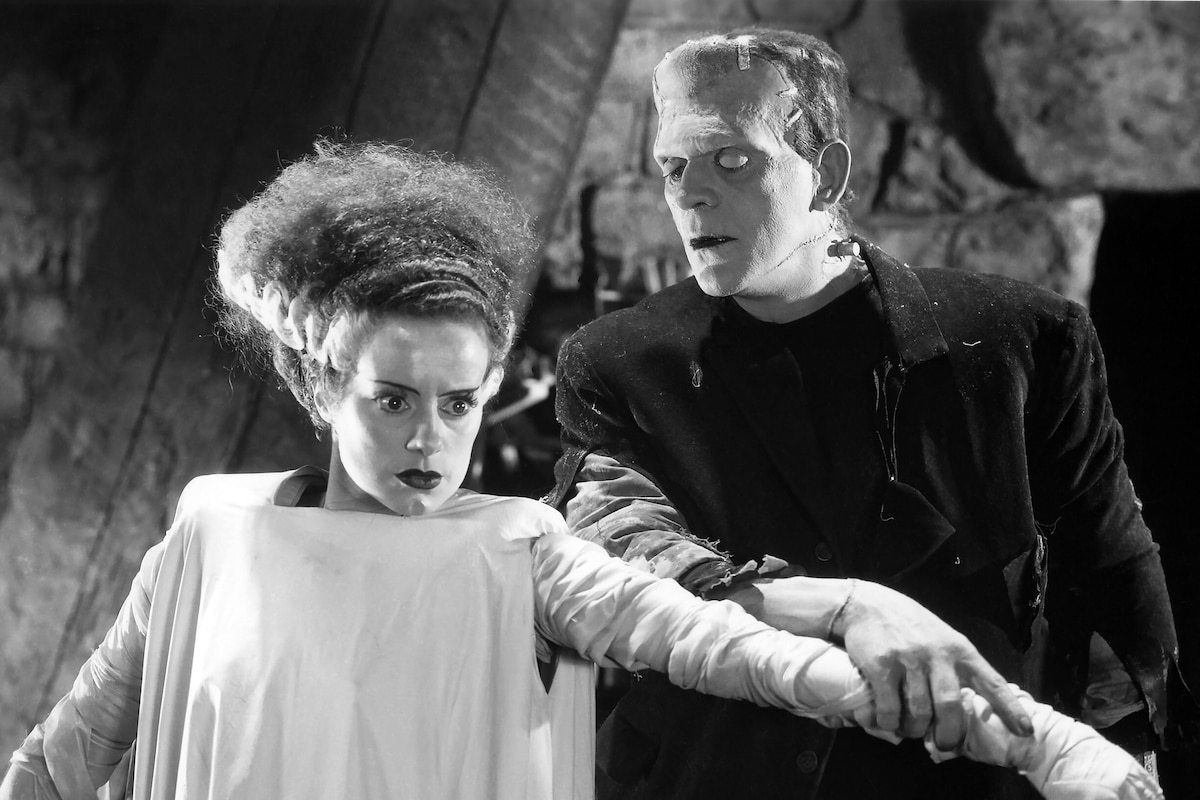
Universal released two horror movies in 1931, Dracula and Frankenstein, both big successes, and the studio was eager to capitalize on their popularity. A sequel to Frankenstein was in the works as early as 1933, but the film's director, James Whale wasn't interested. In the face of his continued refusal to work on the project, the studio put director Kurt Neumann in charge.
The sequel was further delayed when Boris Karloff was loaned to Twentieth Century for The House of Rothschild (1934). At the time, anyone but Karloff as the creature was unthinkable.
Many different writers worked on the script, under the title "The Return of Frankenstein." Mystery writer Lawrence Blochman's December 1933 treatment seemed to be inspired by Tod Browning's Freaks (1932), with Henry and Elizabeth Frankenstein running off and joining a carnival incognito as puppeteers. The Monster catches up with them demanding a mate, and dies in the jaws of a lion. Another writer, Philip MacDonald (Rebecca, 1940), had Henry develop a death ray to sell to the League of Nations as war clouds gather over Europe. A demonstration of the machine inadvertently revives the monster, giving him superhuman strength. Playing with the device, the Monster wipes out whole cities, the mass destruction ending only when Henry uses his invention to vaporize himself and the creature. Whale's reaction to the initial script work? "They have a script prepared, and it stinks to heaven."
The excellent box office for Whale's screen version of H.G. Wells' The Invisible Man made him the obvious choice to direct the new picture. He was hoping instead to develop a story about a voyage to Mars, which was eventually abandoned. He finally relented, with the stipulation that he would have total creative freedom and that he could first make One More River (1934), based on the John Galsworthy novel and featuring his original Dr. Frankenstein, Colin Clive. The studio didn't care as long as he gave them a Karloff Frankenstein picture they could sell as well as or better than the first one.
Whale conceived the idea of the prologue featuring Mary Shelley, her husband, and Lord Byron. He felt this prologue was key to making more than a rehash of the first picture. By starting with Mary Shelley relating further details of her story to her two gentlemen companions, he knew he could take it into the realm of fantasy brewing in the author's mind.
Whale asked his recent collaborator, R.C. Sherriff, to write the script. The British playwright had contributed to three Whale films-The Old Dark House, The Invisible Man, One More River-but he refused this assignment, saying he didn't want to spend his summer writing "pulp."
Whale brought in John L. Balderston, co-author of a never-produced Frankenstein stage piece as well as the Dracula stage play on which that movie was based. Balderston supplied a script that was a good blueprint for the finished product, but Whale felt it lacked magic.
In November 1934, playwright William Hurlbut was brought in. He and Whale worked together to refashion the story with a more fanciful, witty approach, adding Dr. Pretorius, his miniature humans, and the comic characters of Minnie the servant and the Burgomaster. Pretorius was originally conceived as Henry's teacher and his inspiration for creating the monster in the first movie.
In addition to the given of Karloff and Clive in the cast, Whale had specific actors in mind, and created roles based on their particular skills and demeanor, including Ernest Thesiger as Dr. Pretorius and Una O'Connor as Minnie.
Some sources say Hurlbut wrote the earlier draft and that it was reworked by Whale and Balderston.
Some accounts of the picture's development claim Elizabeth's character was to have been killed and her heart harvested for the Bride, which would have motivated the Bride's instant attraction to Henry. Historian Scott McQueen, in the commentary on the DVD release, said that option was never on the table.
Joseph Breen, lead enforcer of the Motion Picture Production Code, reviewed the shooting script and balked at the number of killings: ten separate scenes of people being strangled or trampled by the Monster in addition to several murders carried out by secondary characters. Whale's response was, "Kill them all; let Breen sort it out." For the final outcome, see the Behind the Camera section for this film.
by Rob Nixon
The Big Idea - Bride of Frankenstein
by Rob Nixon | April 22, 2013
SIGN UP FOR OUR NEWSLETTERS

CONNECT WITH TCM