By the 1980s, Stephen King was one of the most popular and successful American writers, a perennial best seller in the genres of horror, fantasy, thriller, and science fiction. In addition to many hit novels, several of which had been turned into major motion pictures, he also wrote dozens of short stories and novellas. One of these, "The Body," originally published in his 1982 collection Different Seasons, became the basis for this movie.
Despite his reputation for horror and thriller stories, King had wanted for a long time to write about childhood, the good and bad, funny and sad aspects of being a kid that he had experienced himself. He wasn't getting anywhere with the story until he hit upon the idea of having a group of boys, based on himself and his early adolescent friends, setting off to look for the body of another boy who had died. Although that plot point would seem to be another King horror device, the dead boy became only the impetus for what they experience on the trip they take into the woods to find him. "I think that most good stories about boys are stories about journeys," King said.
Rob Reiner was the Hollywood-raised son of comic actor-producer-writer Carl Reiner and an actor himself since 1959. His family connections and, more important, his popular success as the character Michael "Meathead" Stivic on the long-running TV sitcom All in the Family (1971-78), gave him the clout to move into directing, scoring big with his first feature, the fake rock documentary This Is Spinal Tap (1984) and the teen romance The Sure Thing (1985). For his next project, Reiner was attracted to King's story "The Body" because it was such a character piece and so personal to the writer. Reiner himself related to the story, having been a boy of roughly the age of the ones in King's tale in the late 1950s setting. King has also opined that he believed the story also appealed to Reiner's sense of humor.
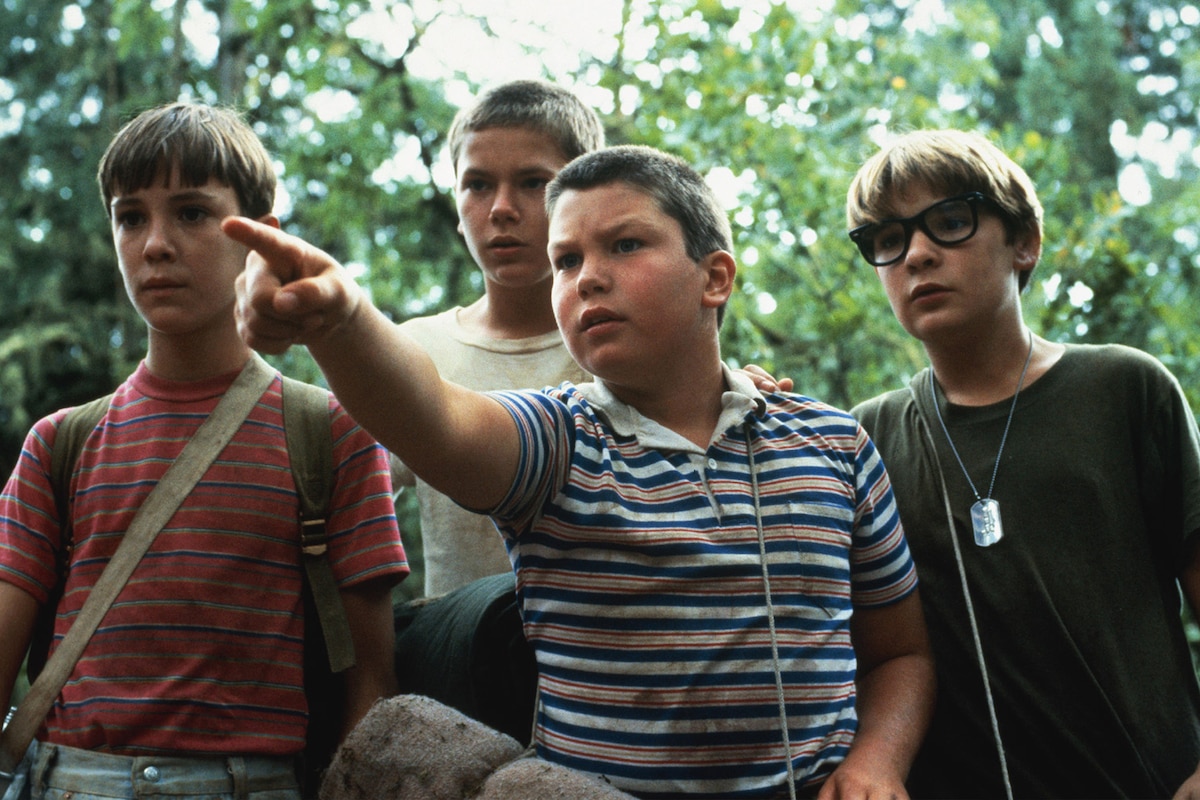
The main focus of King's story was the tragic figure of Chris Chambers, the kid from the wrong side of the tracks who is murdered later in life. The character of Gordie Lachance served mostly as the narrator, the writer looking back on Chris' story. Reiner decided the film would be more about Gordie, about a kid who doesn't feel good about himself and looks to his friends for the approval he can't get at home or from the adult world. "Once I hit upon that, I knew I could tell the story, because those were feelings I had growing up." A major change from story to screen was having Gordie pick up the gun at the end instead of Chris because Reiner wanted the climax to be about the moment of change in Gordie, his awakening and the beginning of the respect and accomplishment he would feel as an adult. King had no problem with the shift in focus Reiner wanted to make.
Reiner added the particular kid touches that were right for the period-the behind-the-back butt kicks, the pinky swear, the two-for-flinching game-as well as sayings like "So funny I forgot to laugh" and "Did your mother have any children that lived?"
The story by King was set in his native Maine, which was changed to Oregon for the film.
In March 1986, when Columbia Pictures had signed on to distribute, the film was renamed. Executives felt that "The Body" was a misleading title and might give the impression that this was a horror film since it was from a story by Stephen King. According to screenwriter Raynold Gideon, "Rob came up with Stand by Me and it ended up being the least unpopular opinion."
by Rob Nixon
The Big Idea - Stand by Me
by Rob Nixon | April 22, 2013
SIGN UP FOR OUR NEWSLETTERS

CONNECT WITH TCM